Congrats to CWW Poetry Faculty Rita Banerjee, shortlisted for the 2016 Willow Books Literature Award

willow-lit-awards-2016On February 5, 2016, Willow Books announced their shortlist for the Aquarius Press/ Willow Books 2016 Literature Awards.  Rita Banerjee’s poetry manuscript, “Echo in Four Beats,” was shortlisted for the award.  The contest is currently being judged by poet Tyehimba Jess, and information about Willow Books and their shortlist can be found here.

Rita Banerjee is the Executive Creative Director of the Cambridge Writers’ Workshop, and her writing has been featured in Electric Literature, VIDA: Women in Literary Arts, Queen Mob’s Tea House, and Riot Grrrl Magazine, and on KBOO Radio’s APA Compass.  She is author of the poetry collection, Cracklers at Night,and her novella, A Night with Kali, is forthcoming from Spider Road Press in 2016.  She is teaching at the Cambridge Writers’ Workshop Summer in Barcelona and South of France (July 18-26, 2016) and Summer in Granada (July 28 – August 5, 2016) Writing Retreats.

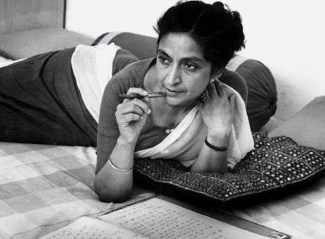
CWW Poetry Faculty Rita Banerjee discusses Amrita Pritam, Publishing, and Sexual Politics for VIDA: Women in Literary Arts Exclusive

AP2Rita Banerjee’s article, “Amrita Pritam: Sexual Politics and Publishing in mid-20th Century India” is now live as a VIDA Exclusive on VIDA: Women in Literary Arts.  In the article, Banerjee translates Pritam’s poem, “Night” from Hindi into English, and writes:

Writing from a minority perspective as an American, it’s often hard to find creative and intellectual predecessors who are writing from your culture of origin but who aren’t necessarily writing in English or just trying to be celebrities in the global Anglophone literary marketplace.  For South Asian writers, for women in the literary arts, and for writers who are looking to challenge the patriarchal hegemony of Anglo-American literature, Amrita Pritam is a must-know writer.  In the 1940s, she came to prominence as a political and feminist writer in India, first in Punjabi literature, then in Hindi and Urdu translation, and finally internationally.  By the 1950s, like Simone de Beauvoir and Bretty Friedan in the West, Pritam was challenging patriarchal values at home, redefining gender roles and narratives assigned to women, and openly challenging heteronormative sexual politics.  In doing so, she ushered in a new wave of feminist literature in mid-20th century India even as she faced criticism for her work from her male counterparts and from within the Punjabi, Hindi, Urdu, and South Asian publishing industries at large.

That was our tryst, yours and mine.
We slept on a bed of stones,
and our eyes, lips and finger tips,
became the words of your body and mine,
they then a made translation of this first book.

The Rig Veda was compiled much later.

– Amrita Pritam, “First Book”

In Pritam’s poetry, one is not born, but rather becomes a woman.  Her unflinching gaze at sex, her exploration of emotional and psychological nakedness, and a sense of self-irony and self-knowledge underwrite several of her poems.  In her poem, “First Book,” quoted above, Pritam explores how the very act of physical, sexual love, unbound by the mores of society, collapses the distances between the sacred and the profane.  And in her poem, “Amrita Pritam,” the poet takes a hard look at the mythos of her own public identity and the narratives of victimization ascribed to it.  She writes: “Pain: / I inhaled it, / quietly like a cigarette. // Song: / I flicked off / like ash / from the cigarette.” (Singh 29).

Read the full article on VIDA: Women in Literary Arts.

Cambridge Writers’ Workshop #Live Tweeting from Sanders Rally in Manchester, NH!

Update:

The Cambridge Writers’ Workshop was definitely #FeelingtheBern during a Bernie Sanders Rally in Manchester, New Hampshire this week. The rally took place at the historic Palace Theater, which was filled to capacity with supporters for Senator Sanders and press from around the country. Songs like “Revolution” by The Beatles and “The Times They Are a-Changin'” by Bob Dylan blasted through the theater until Sanders finally stepped onto the stage to thunderous applause.

Sanders explained that his campaign does not represent Wall Street or corporate America and argued that the middle class shouldn’t be subsidizing the top 1 percent of earners.

“Democracy is not about billionaires buying elections,” Sanders said.

The Vermont senator also outlined his policies on education: he emphasized funding for education instead of jail for youth, and that earning a degree shouldn’t be punished with crippling debt. His reputation of authenticity was cemented when he asked questions directly to the crowd about student debt and health care – instead of taking questions formally, he simply had a conversation with individuals in the audience.

Although Sanders talked for over an hour, the crowd was begging for more and chanting “Bernie!” as he waved goodbye and left the stage. Voters were clearly fueled by Sanders’ revolutionary-style rhetoric, since he later won the New Hampshire primary by a huge margin.


The Cambridge Writers’ Workshop is currently live tweeting the Bernie Sanders Rally from Manchester, New Hampshire.  Follow us on twitter at @CamWritersWkshp for live tweets & updates!  And stay tuned to this website for full coverage from the rally from our talented managing intern, Emily Smith!

Robin Lindley interviews David Shields on the New York Times Glamorization of War

WarisBeautiful

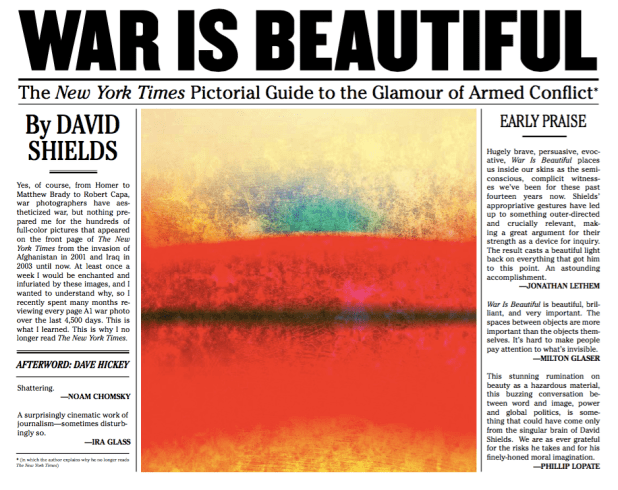
Bestselling author and our featured nonfiction faculty David Shields argues in his new book, War is Beautiful: The New York Times Pictorial Guide to the Glamour of Armed Conflict (Power House Books), that The New York Times glamorized acts of war by using images that softened the terror of battle. The book grew out of Shields’ concern with the paper’s compelling front-page war photos. To better understand how the Times portrayed war, he analyzed thousands of front-page photographs, and particularly full-color photos since 2001 of the wars in Afghanistan and Iraq. David Shields discusses this process and topic in the following excerpt of his interview with History News Network Features Editor Robin Lindley. 

David Shields will teach during our Summer in Barcelona & South of France Writing Retreat (July 18 – 26, 2016) and during our Summer in Granada Writing Retreat (July 28 – August 5, 2016). To apply, visit cww.submittable.com by March 15, 2016.

Robin Lindley: You make a case that The New York Times is complicit with power, particularly with the wars in the Middle East. You compare some of the photos you feature to recruiting posters. How is the Times’ relationship with power revealed in its history?

David Shields: That’s a complicated argument, but I ask what is the Times doing here, and what is the context of that? A good book about the history of the Times is called The Trust, and I quote the coauthors throughout the book.

The Times was founded in 1851 by a German-Jewish family. Anti-Semitism in the U.S., which was much more virulent than it is now, was visited against The New York Times, and it was accused of being “too Jewish” a newspaper.

There’s a strong argument to be made that the Times during the Holocaust, under this German-Jewish family, deliberately underreported the full extent of the atrocities. Afterward, the Times was properly criticized for underreporting those crimes against humanity.

My argument is that the Times has wildly overcorrected. The Times always wants to be at the dead center of American culture—to be complicit with American power and American government and to be always at the center of the conversation. That’s the Times’ brand.

With only a very few exceptions, the Times has rather aggressively supported every American military misadventure since World War II, to the point of having their editorial columnists like James Reston advising John F. Kennedy and at the same time editorializing in favor of the man who he was advising. This continued with Thomas Friedman who still advises Obama. And there was William Safire who advised Bush and editorialized in favor of Bush and Reagan.

So the point is that the Times underreported the Holocaust and was widely criticized for hugely failing in that coverage. Over the last 70 years, the Times has taken a rather bellicose, American masculine, militaristic posture toward war. It supported the Korean War, to a large extent the Vietnam War, and the Afghanistan and Iraq wars. LBJ said, “I can’t win this war without the support of The New York Times.” Only very late in the Vietnam War did the Times join people like Walter Cronkite and express some skepticism.

That provides a socio-historical contextfor why the Times, founded by German Jews and being the victim of a lot of anti-Semitism from say 1850 to 1950, then overcorrected after World War II, and ever since has made sure it does not stray from a complicit bargain with the powers that be. For example,they’ll bury an article on page 27 that may have a slightly negative information about the war, but that front page, A1 photo, has huge power and sets the entire argument that the war is a sacrifice worth making, that the war is noble and dignified, and in a way a beautiful cultural enterprise.

I don’t know how conscious all of this is, but it seems almost a willful visual gesture that sends an unmistakable message to the powers that be and the culture as a whole that the war is a worthy sacrifice.

Robin Lindley: Stephen Colbert called the press, like Times’ reporter Judith Miller, “stenographers” for Bush and Cheney at a White House gala.

David Shields: That’s a point I try to make in the book. The reporting of [Times’ reporter] John F. Burns was disastrously credulous on the Iraq invasion, and with Judith Miller, he carried water for Bush-Cheney. These pictures are the visual equivalent.

My beef is less with the photographers and far more with the photo editors and page A1 editor. Photographers have told me off-the-record that they’re sending hundreds if not thousands of photos every week to the Times and every other institution. These pictures are criticized often for being “too violent,” of all things. Most people know that war is violent. Or pictures may be seen as “in bad taste.” But, as Picasso said, “the enemy of great art is good taste.” What I try to point out is how ludicrously tasteful these pictures are. It’s as if they’re covering war through a thick film of Vaseline—there’s very little war here.

I think some of the photographers are struck by how predictable it is that their less revelatory pictures and their more blandly compositionally beautiful pictures are the photos that get chosen, rather than the photos that more faithfully document the actual horror of war. It seems the Times is looking for pictures that aestheticize war rather that those that show what war is like.

Robin Lindley: I’ve interviewed some combat photojournalists, such as Michael Kamber, who edited an anthology of Iraq War photos called Photojournalists on War, and Peter van Agtmael on Disco Night 9/11, his book of photos on the Middle East wars abroad and at home. They both noted that photographers were frustrated by censorship at both ends—by the military abroad and by editors at home who seem to want to shield readers from the human reality of modern war.

David Shields: Exactly. I’ve been doing readings of the book around the country, and quite a few veterans and photographers come up to me and express gratitude for the book, and say the idea that these pictures say anything about war is so ludicrous, and it’s important to point out what an absolute horror storm war is. Some of them show me photos on their phones or physical photographs.

General Sherman said, “War is Hell,” and it would be good if these pictures pointed that out. The underlying message of the photos that the Times ran is that war is a very pretty and very distant event. There’s no hell here; just a mild heck. That seems to me worth pointing out because who knows when the next run up to the next war is, and who knows what country the U.S. will invade.

It would be good if we knew by what process we get sold the next war. One of the many ways war gets sold is in prominent magazines and newspapers. The New York Times disseminates a certain image and it really matters—unlike USA Today, the Wall Street Journal, or Fox News—because the Times is understood as being in the center or center-left, and the Times carries important cultural symbolism so it seems an important task to pull out these images from the so-called “Paper of Record” that is sending out unmistakably flag-waving, cheer-leading, pro-war messages through these pictures.

You mentioned censorship. A crucial part of the censorship and self-censorship is the military’s brilliant, Machiavellian move to embed and keep journalists and photojournalists from direct battle and to get the agreement of the media to, for example, not show pictures of caskets coming back from war.

These [policies] have created censorship as well as self-censorship for journalists and photojournalists sending material back home. They don’t have access to stories or situations that are terribly revelatory.

Robin Lindley: The Times seemed particularly reluctant to show images of wounded or dead American troops, whereas such images of Iraqis or Afghanis have been run. That reluctance may be an issue in every war. In World War II, Life magazine didn’t show images of dead Americans until 1943, with a photo of dead soldiers on a beach in New Guinea. And more recently, a Seattle photographer was officially reprimanded for photographing flag-draped coffins of American dead from Iraq.

David Shields: It’s a military policy I guess not to allow the media to show caskets coming back from war. And you have the embedding of journalists and photojournalists, and then you get the censorship. And then the Times is working overtime to access the highest levels of government and to deepen its brand as a quasi-Paper of Record.

Adding up all of these things, there’s almost nothing left. There’s no war there. There’s no attempt to document reality. It’s basically the war as screen saver, as wallpaper—a very distant aesthetic experience. Certainly, part of that is not to show the American dead except in a posture of composed relief. It seems the grief is kept out of frame in any true sense of agony or viscera or blood.

Some people criticize media outlets for showing gruesome images, and then there’s the Times at the other end in which there is a highly aestheticized and “dignified” war that is fought. It’s not that I have it all figured out or have found a newspaper or magazine that has embodied a perfect duration of these photographs. Certainly, after the Paris attacks, the BBC website and the Daily Telegraph of the U.K. showed more direct images. A Danish blogger also showed strikingly more revealing images than the Times with its self-periodically and comically glamorizing photos of Paris post-bombing.

In the book, the last few images are of a dead Iraqi soldiers left behind.

I think what’s so insidious is that it’s not as if the Times is overtly disseminating the most obvious propaganda by only showing dead soldiers of the enemy. The Times is much more subtle, and that bears mentioning. These pictures are not overt propaganda, as you might have seen in World War II, but I argue they are a not too oblique propaganda with the beautifying, sanctifying photographs.

Robin Lindley: Do you believe your book may prompt a change in how the Times and other publications decide on the images of war to carry—photos that capture the human consequences of war?

David Shields: That would be interesting. I saw the book as a long letter to the editor. I don’t read the Times anymore. I had read it for more than 40 years.

I ask that the Times think about the kind of power it has. It’s not what it had 30 or 40 years ago, or even ten years ago, but it has a certain power. So on some level this is an attempt to urge the Times to rethink its role, and to urge other similar newspapers and magazines to rethink their roles. I urge them also to depend less on complicit institutional journalism and more on independent thinkers and journalists and authors who are not beholden to institutional powers.

Read the full interview on History News Network here.

Robin Lindley is a Seattle-based writer and attorney, and the features editor of the History News Network (hnn.us). His articles have appeared in HNN, Crosscut, Salon, Real Change, Documentary, Writer’s Chronicle, and others. He has a special interest in the history of conflict and human rights. His email: robinlindley@gmail.com.

David Shields is the internationally bestselling author of twenty books, including Reality Hunger (named one of the best books of 2010 by more than thirty publications), The Thing About Life Is That One Day You’ll Be Dead (New York Times bestseller), and Black Planet (finalist for the National Book Critics Circle Award). Forthcoming from Knopf in February 2017 is Other People: Takes & Mistakes. The recipient of Guggenheim and NEA fellowships, Shields has published essays and stories in the New York Times Magazine, Harper’s, Esquire, Yale Review, Village Voice, Salon, Slate, McSweeney’s, and Believer. His work has been translated into twenty languages.  He is teaching at the Cambridge Writers’ Workshop Summer in Barcelona and South of France (July 18-26, 2016) and Summer in Granada (July 28 – August 5, 2016) Writing Retreats.

Congrats to CWW Director Rita Banerjee, named finalist for Red Hen Press Benjamin Saltman Poetry Prize

RedHenLogoOn January 21, 2016, Red Hen Press announced the winner and finalists for its 2015 Benjamin Saltman Poetry Award.  Rita Banerjee’s poetry manuscript, “Echo in Four Beats,” was listed as a finalist for the 2015 Saltman Award.  Rita Banerjee is the Executive Creative Director of the Cambridge Writers’ Workshop, and her writing has been featured in Electric Literature, VIDA: Women in Literary Arts, Queen Mob’s Tea House, and Riot Grrrl Magazine.  She is author of the poetry collection, Cracklers at Night, and her novella, A Night with Kali, is forthcoming in 2016.  The contest was judged by Carl Phillips, and information about Red Hen Press and the 2015 winners and finalists can be found here.

“All Roads Lead to Rome” feat. Erica Buettner

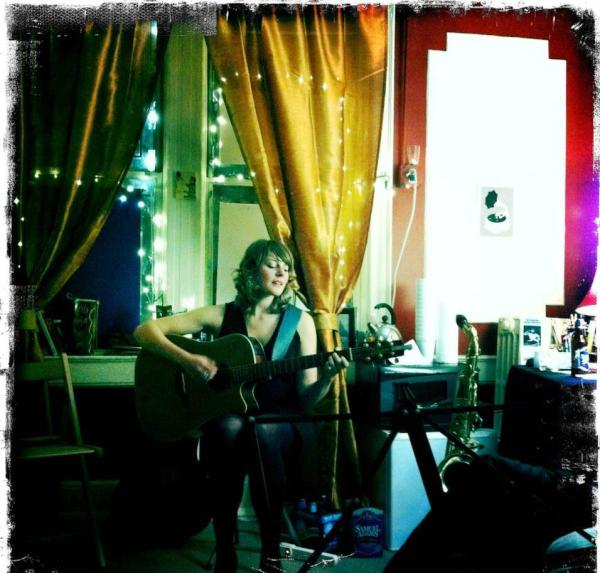
EricaBuettner-CWWBack in February 2012 when the Cambridge Writers’ Workshop opened our office in Brooklyn, New York, singer-songwriter Erica Buettner came to help us inaugurate our workshop and move to Brooklyn.  Erica also joined the Cambridge Writers’ Workshop on August 3, 2015, when many of members of our writing faculty and participants of our Summer in Paris Writing Retreat read at SpokenWord Paris.  This past August, Erica performed her new song, “Rome,” which celebrates the victories and challenges of being a wandering bard.

In honor of our upcoming Summer Writing Retreat in Barcelona & Narbonne, France (July 18-26, 2016) and Summer Writing Retreat in Granada, Spain (July 28 – August 5, 2016), we’d like to feature the debut of Erica’s new song, “Rome.”  Come join us in Europe this summer on all our roads to “Rome.”  Our summer writing retreats in France and Spain offer opportunities for writers of all genres and levels to work alongside award-winning authors & editors.  Past faculty include Kathleen Spivack, David Shields, Peter Orner, Diana Norma Szokolyai, Stephen Aubrey, Rita Banerjee, Jessica Reidy, and Elissa LewisStay tuned for information on our retreats and registration deadlines!

Der Spiegel features Rita Banerjee’s “War is Beautiful: An Interview w. David Shields”

DerSpiegelOver the holidays, Germany’s Der Spiegel and Perlentaucher: Das Kulturmagazin featured Rita Banerjee’s piece from Electric Literature: “War is Beautiful: An Interview with David Shields.”  On Shields’s new book and Banerjee’s interview, Der Spiegel wrote:

“Etwas skeptisch liest Tim Parks im Blog der NYRB den neuen Essay von David Shields “War Is Beautiful”, der die New York Times anklagt, mit ihren Kriegsfotos den Krieg zu ästhetisieren. Ganz von der Hand weisen kann Parks das nicht: “Es ist beim Durchblättern dieser Fotos kaum zu leugnen, dass sie ihre Gegenstände mit voller Absicht ästhetisieren – und auf den Betrachter somit anästhesierend wirken. Das sind Glamour-Bilder, gemacht, bewundert zu werden und keine Dokumentarbilder, die der Gewalt und dem Horror Unmittelbarkeit geben… Kurz: Wir sind weit entfernt von den nüchternen Schwarzweißbildern, die den Vietnamkrieg in der selben Zeitung illustrierten.” Parks Gegeneinwand liegt in einer Frage: “Ist es uns überhaupt möglich, dieser Verwandlung der Bestie in eine Schönheit zu entkommen?” Rita Banerjee hat schon im November bei electricliterature ein Interview mit Shields zu dem Buch geführt.”

The text can be translated as:

“In the NYRB Blog, Tim Parks somewhat skeptically reads the new essay by David Shields, War is Beautiful in which [Shields] accuses the New York Times of aestheticizing war with their war-photos.  Parks cannot totally dismiss [Shields’s claim]: “When leafing through these photos, one can scarcely deny that they [NYT] with full intention aestheticize their materials and in doing so, anesthetize the viewer.  These are Glamour-photos, made to be admired and are not Documentary-photos that give immediacy to horror and violence… In short, we are far from the sobering black and white photos of the Vietnam War, which were depicted in the same newspaper.”  Parks’s counter-argument lies in the question: “In this transformation of the beast into beauty, is it possible for us to escape at all?”  Rita Banerjee already conducted an interview with Shields about [his] book via Electric Literature in November.”

Read more about Der Spiegel‘s culture and media reviews here.

“War is Beautiful: An Interview with David Shields” – Rita Banerjee, Electric Literature

WarisBeautifulEarlier this month, I sat down with David Shields to interview him about his new book, War Is Beautiful: The New York Times Pictorial Guide to the Glamour of Armed Conflict (powerHouse Books 2015). During our conversation, Shields spoke about the New York Times’s use of sanitized, sensually inviting front-page photography to glamorize the wars in Afghanistan and Iraq; these photos—in Shields’s view—desensitize readers to the cruelty and violence of these wars.

David Shields is the author of international bestsellers and critically acclaimed books, including The Thing About Life Is That One Day You’ll Be Dead (Knopf 2008), Black Planet (Three Rivers Press 2009), and Reality Hunger: A Manifesto (Knopf 2010), which argued for the obliteration of the distinction between fiction and nonfiction, the overturning of laws regarding appropriation, and the creation of new forms for a new century. Over the past several years, Shields’s work has become increasingly political.

Rita Banerjee:  The images of war in the book are very provocative. For example, in the Nature section, in the photo where you’re looking at a beautiful field of flowers and then you see the helmet of a soldier, it’s shocking. It grabs you. And even in the “Paintings” section, many of the images are so aesthetically inviting.

David Shields:  They look like Abstract Expressionist paintings. They might as well have been painted by Rothko or Pollock.

RB:  Reading War is Beautiful, you realize how cleaned up American media is. It’s weirdly Puritan, weirdly sanitized.

DS:  It’s quite striking how this process happened over the last couple of decades. First of all, the rise of digital culture so that a picture could be sent instantaneously from the battlefield to the Times. Second of all, the advent of color photography on page A1 (starting in October 1997).

In the book’s afterword, Dave Hickey points out how serious and great war photography was from Mathew Brady in the Civil War all the way through Robert Capa during World War II and, say, Tim Page in Vietnam. And basically what happened during World War II was the rise of something he calls the “swipe photograph”—the quick photograph that conveys a quick, blurry image; for example, Capa, with his famous picture of a fallen Spanish soldier during the Spanish Civil War. And then what Hickey argues is that with the rise of Abstract Expressionism, people like Diebenkorn, Rothko, Pollock, Gerhard Richter, the swipe image became a huge part of Abstract Expressionism. And now war photographs are not based on what the war photographer is actually seeing in war. Rather, he or she is trying to reproduce Abstract Expressionist tropes—swipe-image gorgeousness.

All of these pictures from the New York Times are remarkably hollow and bloodless, composed, and abstract. All of these photographs have come, to a staggering degree, from art history.  These pictures are beautiful but dead.

RB:  I was really struck by your commentary in the beginning of War Is Beautiful. You raise the point, Is the Times complicit in selling a certain kind of narrative to the United States? That is, the Times promotes its institutional power as a protector or curator of a death-dealing democracy. Who is responsible for it? We all are. We are all inscribed in that death-dealing democracy.

Maybe that’s why we’re so accepting of capitalism as well. We don’t see the devastation. If people are dying of chemical poisoning in an Apple factory in China, how much do we care? The same with Iraq or Afghanistan. As Americans, we’re so used to the idea of distance. When the political world is distant from us, not only are we desensitized and numb to it but it’s almost as if we’re watching cinema or playing in a video game; there’s even a certain aspect of pleasure in a weird way. We have power and yet we’re at such a great distance from what’s going on and what’s going down.

DS:  I try to make this emphatically clear via the book’s opening epigraph from Edmund Burke: “When danger or pain press too nearly, they are incapable of giving any delight, and are simply terrible; but at certain distances and with certain modifications, they may be, and they are delightful, as we every day experience. The cause of this I shall endeavour to investigate further.” Capitalism, distance, aesthetic pleasure, drone voyeurism are all part of one complicated cocktail. You’ve summarized it very well; it’s clearly capital that’s driving all this. We take pleasure in the privileged distance that capitalism buys.

Read the rest of the interview on Electric Literature.

Happy Halloween, Writers!

MonsterMash2

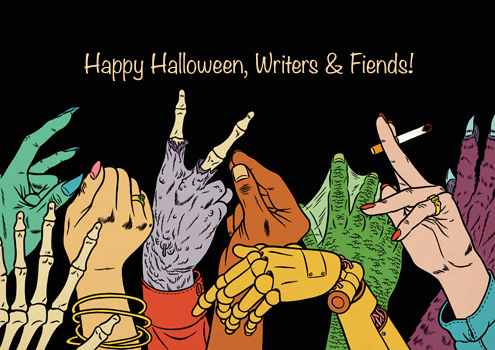
Happy Halloween, Writers & Fiends!  To kick off the the Day of the Dead, we here at the Cambridge Writers’ Workshop are getting our quills ready for NaNoWriMo 2015!  November is National Novel Writing Month (NaNoWriMo), and our CWW staff is up for an exciting writing challenge! We have the entire month of November to write draft, sketch, and complete the first versions of our novels.  The goal is to get to over 50,000 words by November 30.  We at the Cambridge Writers’ Workshop are working on our novel projects a little bit everday.  For food for thought and writing inspiration, we’re turning into @NaNoWriMo, @NaNoWordSprints, and all the amazing writers participating in #NaNoWriMo on Twitter!  During the month of November 2015, we’re going to be working on book-length manuscripts.  Writers are invited to work on novels, short story collections, nonfiction and poetry manuscripts, essays, and plays during the month of November!

If you’d like to join us for NaNoWriMo, please sign up on the NaNoWriMo website and join us on the Cambridge Writers’ Workshop NING Membership Network!  You can post a short summary of your book project on our CWW Membership site, check out our weekly prompts, and cheer each other on as we write our book-length manuscripts during the month of November!

xo, The Cambridge Writers’ Workshop

BitchBoys

The Monarch Review features Rita Banerjee’s poems “Please Listen and Do Not Return” and “Storyteller”

MonarchReviewThe current issue of The Monarch Review, Seattle’s literary and arts magazine, features two new poems by Rita Banerjee, “Please Listen and Do Not Return” and “Storyteller.”  The poems are inspired by Nick Carraway, Tom Joad, and Gloria Rich, respectively.

RBRita Banerjee is a writer, and received her PhD in Comparative Literature from Harvard University.  She holds an MFA in Creative Writing and her work has been featured in VIDA: Women in Literary Arts, Riot Grrrl Magazine, Poets for Living Waters, The Fiction Project, Jaggery, The Crab Creek Review, The Dudley Review, Objet d’Art, Vox Populi, Dr. Hurley’s Snake-Oil Cure, Chrysanthemum, and on KBOO Radio’s APA Compass in Portland, Oregon. Her first collection of poems, Cracklers at Night, received First Honorable Mention for Best Poetry Book at the 2011-2012 Los Angeles Book Festival. She is Executive Creative Director of the Cambridge Writers’ Workshop.