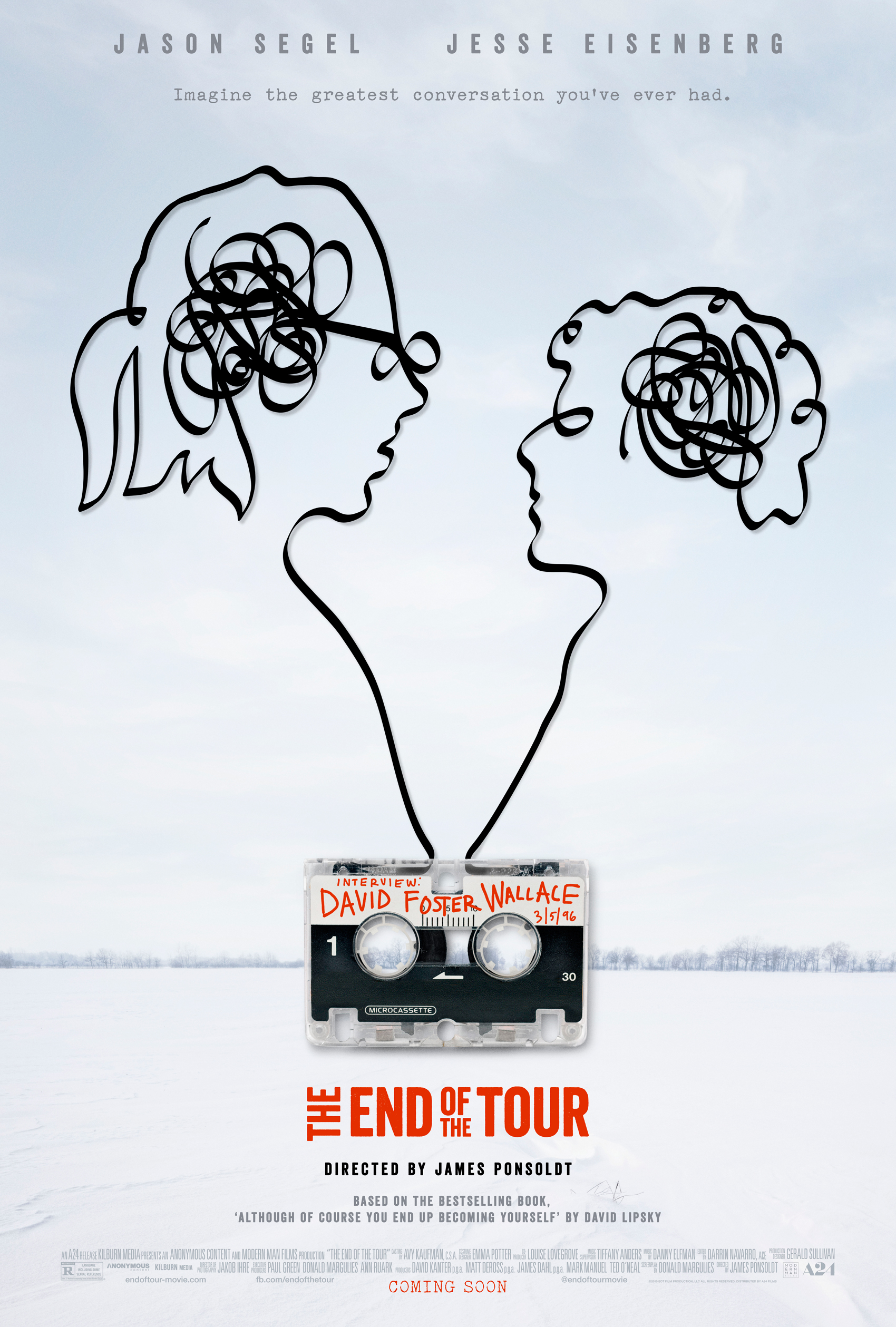
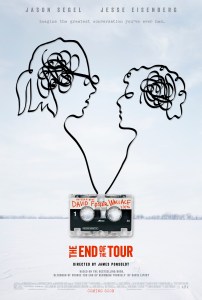
 The End of the Tour (dir. James Ponsoldt, 2015) tells the story of writer David Lipsky’s unpublished Rolling Stone interview with David Foster Wallace, in which Lipsky (Jesse Eisenberg), an emerging writer of some acclaim, follows Wallace (Jason Segal) on a five-day book tour, pitching questions the whole way along the road of junk food, hotels, and indie bookshops packed with fans. The screenplay, by Pulitzer Prize winning playwright Donald Margulies, is based on Lipsky’s memoir Although Of Course You End Up Becoming Yourself: A Road Trip With David Foster Wallace. When first meeting Wallace in The End of the Tour, he is strikingly wry, reclusive, and aloof, which could be mistaken for the personality of a writer too full of his own genius to be close to the world. But soon Lipsky and the audience see that Wallace’s distance is the product of anxiety, his cutting quips are deflection, and that his evasive or non-existent answers stem from his fear of what people might believe about him if he presents himself wrong. Wallace lets Lipsky see this vulnerability early-on, unable or unwilling to keep up the pretense. Even when Wallace’s over-eager desire to behave well ultimately folds on itself, it’s in a charming, nervous, very forgivable way. Lipsky, who shares Wallace’s vulnerability, goes from holding his breath to sighing in relief many times over throughout the course of interviewing Wallace, yet these fluctuations still give way to a kind of constructed intimacy between the interviewer and his subject. What makes The End of the Tour enthralling is Lipsky’s almost-loving attention to Wallace’s authenticity, and the question of whether or not authenticity is even possible. Here is a writer celebrated as a genius for his momentous tome, Infinite Jest, trying to put everyone at ease—the reader, the aspiring and emerging writer, the writers on the scene with less fame and critical appeal—by assuring us all that he is not as smart as we are, that he needs pen and paper, a library, and so much time to sound clever, that in any moment of this off-the-cuff, on-the-record interview, he will seriously fuck this whole thing up. Lipsky calls him out on these in-authentic reveals repeatedly, pointing out those few moments when Wallace is comfortable in the assumption that he is the smartest person in the room, moments, which of course, tread on Lipsky’s own ego and jealousy. Lipsky’s journalistic (and rather personal) finger-pointing comes out particularly when the course of their intellectual, maybe unrequited, bromance is made rocky by many social slips, mostly rooted in their own fears of baring the self, but also, predictably, the presence of a desirable and amiable lady, Betsy (Mickey Sumner).
Perhaps because the relationship between Lipsky and Wallace is built on pretense, they are deeply dimensional characters on screen—their intimacy, while it has moments that feel, and maybe are, genuine for both of them, is ultimately faux and thus reveals so much more complexity. They remember, from time to time, that this friendship is an interview, and both of them have a game. “This is nice,” Wallace tells Lipsky, “but it isn’t real.” And yet, it does feel real, and the viewer is left to wonder if so much of his despair comes from the short-sightedness of waving off the constructed interactions we all share, day in, day out, as necessarily meaningless. Throughout the film, Wallace despairs perhaps the most because of this inability to accept and trust the truthfulness of relationships. The people who are kind and close to him – editors, colleagues, publicists, agents – are nice but not real to him. The film reveals that there is real intimacy even in pretense, and as Wallace’s character shows, there is authenticity even in inauthentic behaviors, although he can’t see it himself.

The film itself is, for the most part, made with the same nail-biting self-awareness. Says director James Ponsoldt: “Biopics have a tendency to flatten out and reduce the complexity of a life. I usually have a fierce aversion to them. The End of the Tour is more like a snapshot of two lives taken over just a handful of days.” There is one aspect of the film that lacks the character-vibrancy of these biopic snapshots—the female characters and the role of women. Wallace and Lipsky talk at length about women, just as they talk about art and the cosmic palpitations we all feel. Wallace wants women and a partner to have children with, but he frets that getting close to any woman who might admire him, as people often admire their partners, may make him look like he’s using his book to get his “dick sucked,” a reduction which is both attractive and vile to him. In Wallace’s eyes, and perhaps Lipsky’s too, women are reduced to a one-dimensional femme fatale (or her opposite), even though the film shows, through one line of dialogue, that Wallace clearly respects women writers. The film, however, does not make the same artful reveal about the three-dimensionality of the women around them that it does for the realness of Wallace and Lipsky’s own structured intimacy. If this riveting film with brilliant performances by Eisenberg and Segal has a downfall, it’s that in all of its heart-breaking reveals to the audience of what the two characters are missing, it failed to be self-aware of the trope of the one-dimensional woman. Lipsky and Wallace speak of the women in the film, likely out of normalized fear rather than malicious intent, as objects that fulfill or fail to incite sexual desire and emotion from them. This is unchallenged by the film—the female characters have no moments of revelation, do not show us their power, their realness, or in short, what the main characters are missing. Considering that Wallace’s failure to bring himself past the façade of human existence and connection is both the crux of the film and the subject of discussion between himself and Lipsky, both in terms of his life and Infinite Jest, it seems all the more important to give the women in the film three-dimensional characters that, at the very least, pass the Bechdel test, and ideally show-up the myopic tics that Wallace and Lipsky share. When so much of the beauty and poignancy of this film deals with revealing the ever-shifting fullness and authenticity of the characters in it, even the authentically inauthentic qualities of people, the woman who incited so much angst (Betsy) was at most an avatar of Lipsky’s and Wallace’s imagination.

And while the film has very limited diversity, it lifts the skin to reveal the anatomy of Wallace’s melancholy and unflinchingly reveals the structure of his privilege. We have all heard privileged, white male writers emerging and struggling to carve out a place in their MFA programs or writing communities, complaining that because they were neither poor nor abused, neither a minority voice nor traumatized, no one cared about their stories of middle-class, white guy directionless angst. I have two reactions when I hear this: one primarily of rage and jealousy, the second of rage and confusion.
1. It must be nice. If you had any idea what you’re wishing for, sweet baby
2. The nameless angst of privileged white men is the majority of whom and what gets published. Check the numbers—VIDA has them.
These kinds of men with these kinds of complaints rarely make anything of value because they are not thinking in interesting directions. Their self-absorption is an un-ending loop. Their inability to look outside themselves, to explore that feeling of lack rather than childishly resenting the often debilitating horrors or centuries of oppression that they believe make someone “interesting,” is what castrates any virility their work might have. I also wonder how many writers of color and women writers they read, but that’s another issue altogether. The End of the Tour shows a man who is all too aware of his position and still aches, and aches from awareness, and aches from guilt, and aches from the inability to foster the intimacy he needs, but he recognizes all of this and makes something great of it. The film, through device and the clever awareness of device, reveals a writer who has “exhausted” too many ways of living, and ultimately closes the miles between himself and sleep, but with both eyes wide open.
– Jessica Reidy

 The current issue of The Monarch Review, Seattle’s literary and arts magazine, features two new poems by Rita Banerjee, “Please Listen and Do Not Return” and “Storyteller.” The poems are inspired by Nick Carraway, Tom Joad, and Gloria Rich, respectively.
 Rita Banerjee is a writer, and received her PhD in Comparative Literature from Harvard University. She holds an MFA in Creative Writing and her work has been featured in VIDA: Women in Literary Arts, Riot Grrrl Magazine, Poets for Living Waters, The Fiction Project, Jaggery, The Crab Creek Review, The Dudley Review, Objet d’Art, Vox Populi, Dr. Hurley’s Snake-Oil Cure, Chrysanthemum, and on KBOO Radio’s APA Compass in Portland, Oregon. Her first collection of poems, Cracklers at Night, received First Honorable Mention for Best Poetry Book at the 2011-2012 Los Angeles Book Festival. She is Executive Creative Director of the Cambridge Writers’ Workshop.