New Publications by Summer 2015 Paris Retreat Alumnae

issue18cover_front_300The Cambridge Writers’ Workshop is proud to announce that one of our 2015 Summer in Paris Writing Retreat participant has had her work published in The Quotable. G. Evelyn Lampart’s story “Visions” is part of Issue 18 of the journal, a quarterly publication of quotable writers.

G. Evelyn Lampart is both a practitioner and a consumer of mental health services. In this  unique role, she runs an art program in the mental health clinic that served to help her heal. Evelyn is also a student at the Writers Studio in New York City. Her writing  appears in Rozlynan anthology, Nous 5, Dirty Chai,  R.KV.R.Y., Poetica, and The Quotable.

We’re also proud to announce that Kathleen Crisci’s “Sturm und Drang” won second place for essay/memoir in Epiphany Magazine‘s spring contest. It will appear in the next issue.

Screen Shot 2016-04-26 at 4.57.01 PM
Kathleen Crisci
received an MFA in writing from Sarah Lawrence College in 2008. Since then, she has been published in Many Mountains Moving and Mr. Beller’s Neighborhood, as well as in an anthology, DIRT, published by Seal Press in 2009. She is a co-founder of Uptown Writers, a venue for writers of all stripes in northern Manhattan. Currently, she is working on a novel.

CWW Spring and Summer Writing Application Retreats Deadline: April 15, 2016

The Cambridge Writers’ Workshop is excited to be hosting three retreats in spring and summer 2016!

The first, our Spring in Newport, RI Yoga & Writing Retreat, is slated to take place April 22-24, 2016 in Newport, RI.  Participants will work on new and existing writing projects alongside award-winning authors Diana Norma Szokolyai (poetry, nonfiction) and Jade Sylvan (fiction, nonfiction), and practice yoga with Elissa Lewis.  For more information and to apply to our Newport retreat, visit cww.submittable.com.  Applications for this retreat are due April 15, 2016.

Our Summer in Barcelona and South of France Writing Retreat is slated to take place July 18-26, 2016.  Participants will spend three days in Barcelona, Spain and four days in Narbonne, France.  They will work on new and existing writing projects alongside award-winning authors Bret Anthony Johnston (fiction), David Shields (fiction, book-length essay), Rita Banerjee (poetry, fiction), and Diana Norma Szokolyai (poetry, nonfiction).  For more information and to apply to our Summer in Barcelona and South of France Writing Retreat, visit cww.submittable.com.  Applications for this retreat are due April 15, 2016.

Our Summer in Granada, Spain Writing Retreat is slated to take place July 28-August 5, 2016.  Participants will work on new and existing writing projects alongside award-winning authors David Shields (fiction, book-length essay), Alexander Chee (fiction), Rita Banerjee (poetry, fiction), and Diana Norma Szokolyai (poetry, nonfiction).  For more information and to apply to our Summer in Granada, Spain Writing Retreat, visit cww.submittable.com.  Applications for this retreat are due April 15, 2016.

Our Summer in Barcelona & Granada Nonfiction Faculty David Shields feat. on PBS / KCTS 9 for War is Beautiful

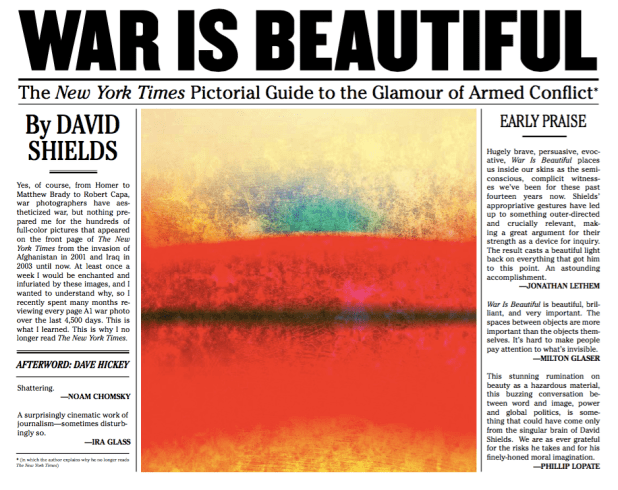
WarisBeautifulYes, of course, from Homer to Mathew Brady to Robert Capa, war photographers have aestheticized war, but nothing prepared me for the hundreds of full-color pictures that appeared on the front page of The New York Times from the invasion of Afghanistan in 2001 and Iraq in 2003 until now. At least once a week I would be enchanted and infuriated by these images, and I wanted to understand why, so I recently spent many months reviewing every page A1 war photo over the last 4,500 days. This is what I learned. This is why I no longer read The New York Times.” David Shields, War is Beautiful

In an interview with PBS/KCTS 9, Shields, a former “life-long subscriber of The New York Times,” discussed his motivation for writing War is Beautiful: “As the Homeland Security slogan goes, ‘If you see something, say something.’ I felt like I was seeing something and I felt compelled as a democratic citizen to say something.”

In War is Beautiful: The New York Times Pictorial Guide to the Glamour of Armed Conflict, bestseller David Shields critiques over a decade of “extraordinarily beautiful and. . .little war-like” war images.  The book contains 64 full-color photographs featured on the cover of the Times between 2001 and 2013.  During the interview, Shields states, “The book is meant to be problematically beautiful. I mean to ask of myself and my fellow citizens and fellow readers how much beauty are we prepared to swallow in the name of glorifying war.”  Watch the interview in its entirety visit PBS/KCTS 9.

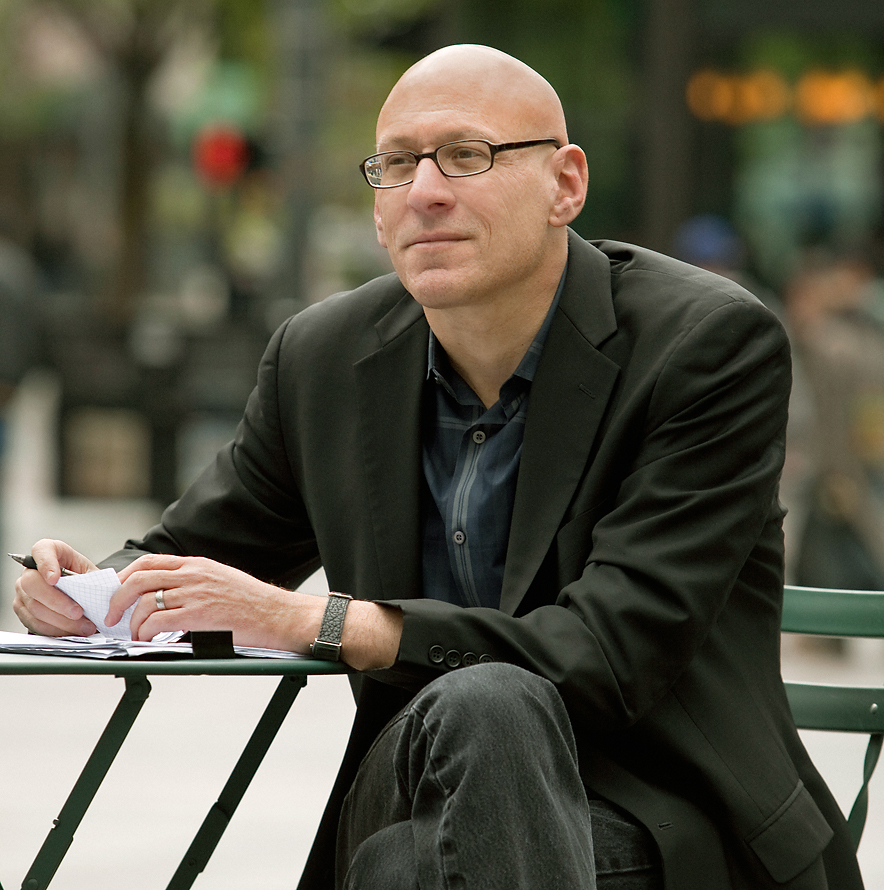
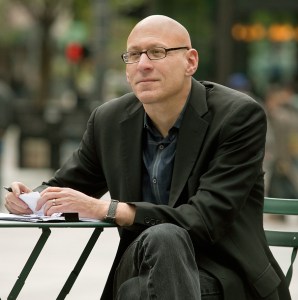
Author photo of David Shields, 2012.David Shields is the internationally bestselling author of twenty books, including Reality Hunger (named one of the best books of 2010 by more than thirty publications), The Thing About Life Is That One Day You’ll Be Dead (New York Times bestseller), and Black Planet (finalist for the National Book Critics Circle Award). Forthcoming from Knopf in February 2017 is Other People: Takes & Mistakes. The recipient of Guggenheim and NEA fellowships, Shields has published essays and stories in the New York Times Magazine, Harper’s, Esquire, Yale Review, Village Voice, Salon, Slate, McSweeney’s, and Believer. His work has been translated into twenty languages.  He is teaching at the Cambridge Writers’ Workshop Summer in Barcelona and South of France (July 18-26, 2016) and Summer in Granada (July 28 – August 5, 2016) Writing Retreats.


Robin Lindley interviews David Shields on the New York Times Glamorization of War

WarisBeautiful

Bestselling author and our featured nonfiction faculty David Shields argues in his new book, War is Beautiful: The New York Times Pictorial Guide to the Glamour of Armed Conflict (Power House Books), that The New York Times glamorized acts of war by using images that softened the terror of battle. The book grew out of Shields’ concern with the paper’s compelling front-page war photos. To better understand how the Times portrayed war, he analyzed thousands of front-page photographs, and particularly full-color photos since 2001 of the wars in Afghanistan and Iraq. David Shields discusses this process and topic in the following excerpt of his interview with History News Network Features Editor Robin Lindley. 

David Shields will teach during our Summer in Barcelona & South of France Writing Retreat (July 18 – 26, 2016) and during our Summer in Granada Writing Retreat (July 28 – August 5, 2016). To apply, visit cww.submittable.com by March 15, 2016.

Robin Lindley: You make a case that The New York Times is complicit with power, particularly with the wars in the Middle East. You compare some of the photos you feature to recruiting posters. How is the Times’ relationship with power revealed in its history?

David Shields: That’s a complicated argument, but I ask what is the Times doing here, and what is the context of that? A good book about the history of the Times is called The Trust, and I quote the coauthors throughout the book.

The Times was founded in 1851 by a German-Jewish family. Anti-Semitism in the U.S., which was much more virulent than it is now, was visited against The New York Times, and it was accused of being “too Jewish” a newspaper.

There’s a strong argument to be made that the Times during the Holocaust, under this German-Jewish family, deliberately underreported the full extent of the atrocities. Afterward, the Times was properly criticized for underreporting those crimes against humanity.

My argument is that the Times has wildly overcorrected. The Times always wants to be at the dead center of American culture—to be complicit with American power and American government and to be always at the center of the conversation. That’s the Times’ brand.

With only a very few exceptions, the Times has rather aggressively supported every American military misadventure since World War II, to the point of having their editorial columnists like James Reston advising John F. Kennedy and at the same time editorializing in favor of the man who he was advising. This continued with Thomas Friedman who still advises Obama. And there was William Safire who advised Bush and editorialized in favor of Bush and Reagan.

So the point is that the Times underreported the Holocaust and was widely criticized for hugely failing in that coverage. Over the last 70 years, the Times has taken a rather bellicose, American masculine, militaristic posture toward war. It supported the Korean War, to a large extent the Vietnam War, and the Afghanistan and Iraq wars. LBJ said, “I can’t win this war without the support of The New York Times.” Only very late in the Vietnam War did the Times join people like Walter Cronkite and express some skepticism.

That provides a socio-historical contextfor why the Times, founded by German Jews and being the victim of a lot of anti-Semitism from say 1850 to 1950, then overcorrected after World War II, and ever since has made sure it does not stray from a complicit bargain with the powers that be. For example,they’ll bury an article on page 27 that may have a slightly negative information about the war, but that front page, A1 photo, has huge power and sets the entire argument that the war is a sacrifice worth making, that the war is noble and dignified, and in a way a beautiful cultural enterprise.

I don’t know how conscious all of this is, but it seems almost a willful visual gesture that sends an unmistakable message to the powers that be and the culture as a whole that the war is a worthy sacrifice.

Robin Lindley: Stephen Colbert called the press, like Times’ reporter Judith Miller, “stenographers” for Bush and Cheney at a White House gala.

David Shields: That’s a point I try to make in the book. The reporting of [Times’ reporter] John F. Burns was disastrously credulous on the Iraq invasion, and with Judith Miller, he carried water for Bush-Cheney. These pictures are the visual equivalent.

My beef is less with the photographers and far more with the photo editors and page A1 editor. Photographers have told me off-the-record that they’re sending hundreds if not thousands of photos every week to the Times and every other institution. These pictures are criticized often for being “too violent,” of all things. Most people know that war is violent. Or pictures may be seen as “in bad taste.” But, as Picasso said, “the enemy of great art is good taste.” What I try to point out is how ludicrously tasteful these pictures are. It’s as if they’re covering war through a thick film of Vaseline—there’s very little war here.

I think some of the photographers are struck by how predictable it is that their less revelatory pictures and their more blandly compositionally beautiful pictures are the photos that get chosen, rather than the photos that more faithfully document the actual horror of war. It seems the Times is looking for pictures that aestheticize war rather that those that show what war is like.

Robin Lindley: I’ve interviewed some combat photojournalists, such as Michael Kamber, who edited an anthology of Iraq War photos called Photojournalists on War, and Peter van Agtmael on Disco Night 9/11, his book of photos on the Middle East wars abroad and at home. They both noted that photographers were frustrated by censorship at both ends—by the military abroad and by editors at home who seem to want to shield readers from the human reality of modern war.

David Shields: Exactly. I’ve been doing readings of the book around the country, and quite a few veterans and photographers come up to me and express gratitude for the book, and say the idea that these pictures say anything about war is so ludicrous, and it’s important to point out what an absolute horror storm war is. Some of them show me photos on their phones or physical photographs.

General Sherman said, “War is Hell,” and it would be good if these pictures pointed that out. The underlying message of the photos that the Times ran is that war is a very pretty and very distant event. There’s no hell here; just a mild heck. That seems to me worth pointing out because who knows when the next run up to the next war is, and who knows what country the U.S. will invade.

It would be good if we knew by what process we get sold the next war. One of the many ways war gets sold is in prominent magazines and newspapers. The New York Times disseminates a certain image and it really matters—unlike USA Today, the Wall Street Journal, or Fox News—because the Times is understood as being in the center or center-left, and the Times carries important cultural symbolism so it seems an important task to pull out these images from the so-called “Paper of Record” that is sending out unmistakably flag-waving, cheer-leading, pro-war messages through these pictures.

You mentioned censorship. A crucial part of the censorship and self-censorship is the military’s brilliant, Machiavellian move to embed and keep journalists and photojournalists from direct battle and to get the agreement of the media to, for example, not show pictures of caskets coming back from war.

These [policies] have created censorship as well as self-censorship for journalists and photojournalists sending material back home. They don’t have access to stories or situations that are terribly revelatory.

Robin Lindley: The Times seemed particularly reluctant to show images of wounded or dead American troops, whereas such images of Iraqis or Afghanis have been run. That reluctance may be an issue in every war. In World War II, Life magazine didn’t show images of dead Americans until 1943, with a photo of dead soldiers on a beach in New Guinea. And more recently, a Seattle photographer was officially reprimanded for photographing flag-draped coffins of American dead from Iraq.

David Shields: It’s a military policy I guess not to allow the media to show caskets coming back from war. And you have the embedding of journalists and photojournalists, and then you get the censorship. And then the Times is working overtime to access the highest levels of government and to deepen its brand as a quasi-Paper of Record.

Adding up all of these things, there’s almost nothing left. There’s no war there. There’s no attempt to document reality. It’s basically the war as screen saver, as wallpaper—a very distant aesthetic experience. Certainly, part of that is not to show the American dead except in a posture of composed relief. It seems the grief is kept out of frame in any true sense of agony or viscera or blood.

Some people criticize media outlets for showing gruesome images, and then there’s the Times at the other end in which there is a highly aestheticized and “dignified” war that is fought. It’s not that I have it all figured out or have found a newspaper or magazine that has embodied a perfect duration of these photographs. Certainly, after the Paris attacks, the BBC website and the Daily Telegraph of the U.K. showed more direct images. A Danish blogger also showed strikingly more revealing images than the Times with its self-periodically and comically glamorizing photos of Paris post-bombing.

In the book, the last few images are of a dead Iraqi soldiers left behind.

I think what’s so insidious is that it’s not as if the Times is overtly disseminating the most obvious propaganda by only showing dead soldiers of the enemy. The Times is much more subtle, and that bears mentioning. These pictures are not overt propaganda, as you might have seen in World War II, but I argue they are a not too oblique propaganda with the beautifying, sanctifying photographs.

Robin Lindley: Do you believe your book may prompt a change in how the Times and other publications decide on the images of war to carry—photos that capture the human consequences of war?

David Shields: That would be interesting. I saw the book as a long letter to the editor. I don’t read the Times anymore. I had read it for more than 40 years.

I ask that the Times think about the kind of power it has. It’s not what it had 30 or 40 years ago, or even ten years ago, but it has a certain power. So on some level this is an attempt to urge the Times to rethink its role, and to urge other similar newspapers and magazines to rethink their roles. I urge them also to depend less on complicit institutional journalism and more on independent thinkers and journalists and authors who are not beholden to institutional powers.

Read the full interview on History News Network here.

Robin Lindley is a Seattle-based writer and attorney, and the features editor of the History News Network (hnn.us). His articles have appeared in HNN, Crosscut, Salon, Real Change, Documentary, Writer’s Chronicle, and others. He has a special interest in the history of conflict and human rights. His email: robinlindley@gmail.com.

David Shields is the internationally bestselling author of twenty books, including Reality Hunger (named one of the best books of 2010 by more than thirty publications), The Thing About Life Is That One Day You’ll Be Dead (New York Times bestseller), and Black Planet (finalist for the National Book Critics Circle Award). Forthcoming from Knopf in February 2017 is Other People: Takes & Mistakes. The recipient of Guggenheim and NEA fellowships, Shields has published essays and stories in the New York Times Magazine, Harper’s, Esquire, Yale Review, Village Voice, Salon, Slate, McSweeney’s, and Believer. His work has been translated into twenty languages.  He is teaching at the Cambridge Writers’ Workshop Summer in Barcelona and South of France (July 18-26, 2016) and Summer in Granada (July 28 – August 5, 2016) Writing Retreats.

CWW Interview with David Shields, Essayist, Paris Instructor, & Author of I Think You’re Totally Wrong (2015)

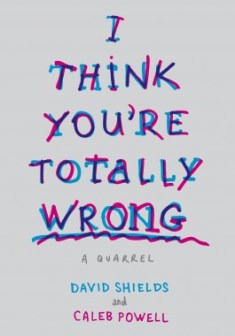
Author photo of David Shields, 2012.This year, the Cambridge Writers’ Workshop’s Summer in Paris Writing Retreat will take place from July 22-30, 2015. At the event, we’ll be hosting a wide variety of craft of writing seminars, creative writing workshops, and special readings from our Paris 2015 faculty, which includes David Shields, Kathleen Spivack, Rita Banerjee, Diana Norma Szokolyai, Jessica Reidy, and Elissa Lewis. One of our featured faculty members, David Shields, an essayist and nonfiction writer, recently co-authored a new book with Caleb Powell titled I Think You’re Totally Wrong: A Quarrel. The Cambridge Writers’ Workshop’s Alex Carrigan sat down to speak with David for an interview. Read below to see the interview, and be sure to register for our Summer in Paris Writing Retreat t by May 5, 2015!

AC: Your writing style is said to be very much like a “collage,” in that you blur genre, autobiography, fiction, and essay. How did you develop the form of the literary collage?

DS: I wrote three novels that were relatively traditional, although increasingly left. I wrote a book called Heroes, a very traditional novel, a growing-up novel called Dead Languages and then a book of stories called Handbook for Drowning. I was trying to write my fourth novel, a book called Remote, and I found all the traditional gestures of the novel just really were not conveying what I wanted to convey.

I was watching a lot of self-reflective documentary films, especially films by Ross McElwee who is from Cambridge. I was reading a lot of anthropological autobiographies by people like Renata Adler and George W.S. Trow and listening and watching a lot of performance art and stand-up comedy.

What was going to be my fourth novel became my first work of literary collage called Remote: Reflections on Life in the Shadow of Celebrity, published in 1996. Ever since then, I’ve been continuing to explore boundary jumping work, the limits of autobiography, and the limits of genre-jamming. By no means am I the progenitor of literary collage. Collage is an ancient form going back to Heraclides’ Fragment 3,000 years ago and coming up to all the way to, say, Maggie Nelson’s Bluets. It’s a beautiful form that lets me do what I want to do on the page.
ITYTW-hi-res-265x380

AC: How did the idea of I Think You’re Totally Wrong develop?

DS: A lot of what I do on the page is to question myself. I write what I call “self-deconstructive non-fiction.” It’s a term someone applied to my work. I’m interested in exploring myself but also in demolishing myself as a way to get at large cultural and human questions. The canvas in my work is myself, only as an avenue to approach broader questions. I’m not interesting in anything like conventional autobiography or conventional memoir.

In a way, I was tired of debating myself in my work, in books from Remote to How Literature Saved My Life. I wanted to have somebody embody the opposition. I have always been a fan of books of dialogue from Plato and Socrates in Plato’s Dialogues all the way up through The Magliozzi Brothers in Car Talk. I just love the form of two guys arguing.

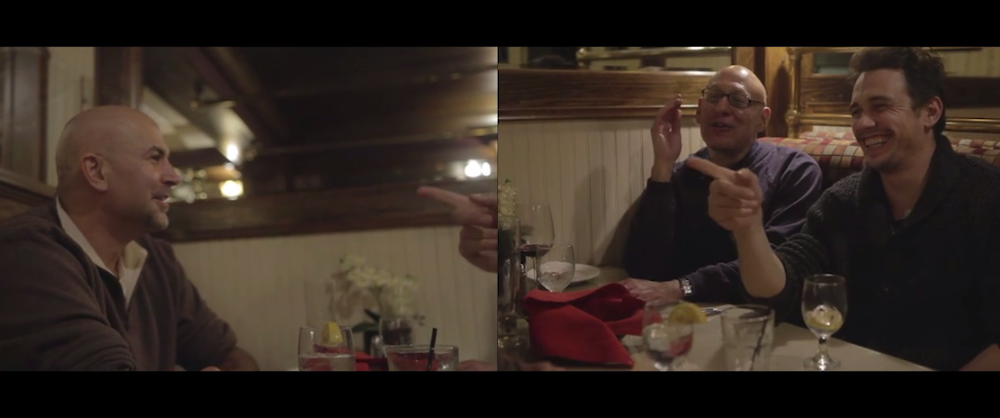
I sought out a former student of mine (Caleb Powell) who tends to have a different point of view from me. Three years ago, we went off to a cabin and argued for four days. Then we radically edited the transcript into a book, then we took the book and made it into a film with my former student, James Franco, directing the film.

AC: The book references My Dinner with Andre’ and The Trip as influences for the novel. What aspects of those works do you feel I Think You’re Totally Wrong best encapsulates? Do you feel the book does something those works didn’t?

My_Dinner_with_Andre_1981_film_theatrical_release_poster

DS: It seems sort of foolish to not acknowledge the predecessors from Boswell and Johnson, Rosencrantz and Guildenstern, Laurel and Hardy, Car Talk, Sideways, and The Trip. A wonderful book I really love is David Lipsky’s book on David Foster Wallace in which the two of them argue for three or four hundred pages.

It’s not up to me to say what the book does better or worse, or what the film does better and worse than previous ones. The challenge I placed before myself and Caleb was to make it… I think what our book and film do well is being more naked, more raw, or more vulnerable. A few of these other projects, they might have more talented performers or whatever.

There’s a wonderful quote on the back of the book by Peter Brooks, my former teacher. He says “Confession makes sense only when it costs something, when it’s courting disaster; I found that risk-taking in this book, and it’s bracing.” That’s a very generous quote, and it goes to what we were trying to do. In a way, we wanted to court disaster, where something like The Trip is never seriously courting disaster. Even My Dinner with Andre’ is an incredibly polished performance.

I’m very fond of this quote by Walter Benjamin: “A work of literature should either invent a genre or dissolve one.” Our attempt was… to dissolve a genre or extend it, by making the quarrel between two people be just unusually naked and raw and vulnerable and discomforting. That’s our attempt at contribution.

AC: In the book, you and Powell briefly criticize the notion of “show, don’t tell.” Was that something that played into how you presented I Think You’re Totally Wrong since the book presents almost entire transcripts of your conversations?

I think it’s because I’m very invested in the essay and the contemplation, the meditation. In our book, it’s beside the point to do long description of what the woods look like. It’s essentially a play or screenplay.

It’s mainly “show, don’t tell,” because it’s two guys arguing. Any time Caleb goes to too great length on a story, I always imagine asking him “Okay, but what’s the point?” I think the book embodies “tell, don’t show” not because we don’t give scene descriptions, but because we don’t waste time doing a lot of dialogue. We’re trying to cut to what actually matters and to contemplate existence directly.

AC: Do you ever see yourself going on a trip similar to the one in I Think You’re Totally Wrong ever again, even if it’s not to write a book?

DS: No. Everything I do is related to books, and I guess that’s part of the comedy of this project. I’m really busy; I teach, I write, and a lot of the book is about how I really like to write. I might go off with my wife and daughter to hang out. To me, words are very precious, and I don’t give them to people for the hell of it. If I’m trying to use words well, I want to make it part of a book. I’m not going to spend five days thinking about existence and not try to make it part of a literary project.
DavidShields_DirectorFranco

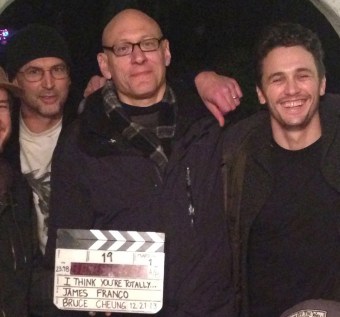
David Shields with Caleb Powell & James Franco

AC: How did the film version of the book come to be?

DS: James [Franco] was my student at Warren Wilson College (Masters of Fine Arts: Low Residency program). James is an actor, a writer, and a director. We were getting to know each other better, and we both share an interest in self exposure, nakedness, recollection, awkwardness, and in breaking the fourth wall. We have a shared aesthetic, so that we’re working not only on this film (which is completed) but also with two other books of mine that we’re making into film. We have a kind of shared ethos in self-deconstructive non-fiction. That’s not all I’m interested or all James is interested in, but it’s a shared interest.

James wanted to do a film of one of my books. I showed him I Think You’re Totally Wrong, and he said, “this is a movie, let’s do it.” Caleb and I wrote a screenplay, a scene sheet, a beat sheet, and a treatment. The irony of it, which I sort of love, was that on the first day of shooting, we wound up throwing away the script because a real life, real time argument broke out on the first day which was all about what can and what can’t be used in the film. It was a perfect embodiment about the whole life/art debate, which was what the book and film are actually about. We stumbled quite serendipitously into an actual argument and we filmed the actual argument.

AC: In the film, you and Powell play yourselves. Was there anything challenging about becoming “actors” and reliving the weekend?

DS: In many ways, it wasn’t reliving. It wasn’t like we act out our scenes from the book, which is what we thought we’d do. We created an entirely new work, which has a relationship to the book, but we basically started arguing on camera.  Franco and I started yelling at Caleb; Franco and Caleb started yelling at me. Ot was a real argument about a real thing.

I was just being myself and wanted to win the argument. You have to be aware there is a camera and that you are trying to make a good movie. Just like I do on the page, I took who I naturally am and was aware of projecting, amplifying, and exaggerating that for drama, which I think is what any personal essayist does.
dinner-iv

AC: Was there anything that had to greatly changed in the adaptation of the book, such as certain scenes that had to be cut or reworked?

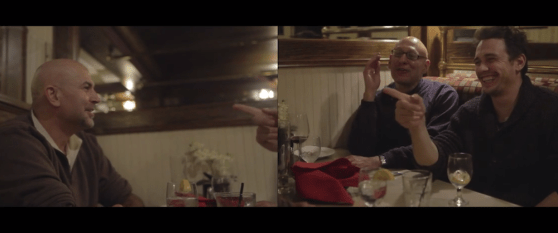
DS: It’s an entirely different narrative that has a whole different strategy and purpose. It’s about an argument that develops when James and I urge Caleb to incorporate certain material into the movie. He refuses, I feel awful about badgering and bullying Caleb, then I apologize to Caleb, then James accuses me of being a theoretician and not a practitioner of riffs, then I accuse James of the same, then Caleb has a meltdown as he recounts this war movie he is telling us about, then we all worry that we don’t have an ending, and then out of nowhere we find an ending by, in a way, rediscovering what the whole film was about.

I think it’s a lovely little film and I’m quite proud of it. We were writing the film hour by hour over the four days that we shot it. Any time that we weren’t shooting I was madly scribbling notes about what we should do next. On one hand, I was trying to respond to the actual argument and on the other, I was trying to make a film. It was a completely different experience, much different from the book in my view.

AC: Do you have any upcoming works you’d like to talk about?

I have four books coming out in the next year. I Think You’re Totally Wrong just came out and the film will be out this spring. In April, I have a book coming out with Hawthorne Books called Life is Short- Art is Shorter: In Praise of Brevity. I’m the co-author of that book with Elizabeth Cooperman. In June, I have a book coming out with McSweeney’s Books called That Thing You Do With Your Mouth: The Sexual Autobiography of Samantha Matthews As Told to David Shields. It was kind of an amazing project.

life_is_short_247_400_80

In next September, I have a book with Powerhouse Books which is a photography and art publisher called War Is Beautiful: A Pictorial Guide to the Glamor of Armed Conflict. It’s a book about war photography. Then in January of 2016, I have a book coming out with Knopf again called Other People: A Remix. I’ve taken about 60 essays of mine that I’ve written over the last 30 year and rewritten them all to make an entirely new book with a contemplation on a particular theme.

Those are all keeping me busy for the next year, just ushering these new books to print.

AC: Since you’re going to be coming on our Paris retreat later this year, what are you looking forward to and what are you planning to teach?

DS: I’m looking forward to meeting my French publisher. I’m looking forward to meeting some friends I know in Paris. I’m looking forward to giving a reading at Shakespeare and Co. Those are the side things.

The core of the experience is the Cambridge conference. I look forward to talking about brevity; I’ll be using my brevity book as the core of that seminar. I’m going to talk about collage, and I’m going to talk about collaboration. Three of the things I’m most passionate about (collage, brevity, and collaboration) will form the basis for three workshops. I’m still working out exactly what, but I teach out of my passion, and those are three of my literary passions.

AC: Do you have any advice for aspiring writers?

The best thing I can think of comes from a wonderful line of William Butler Yeats who said “Out of the quarrel with others we make politics; out of the quarrel with ourselves we make poetry.” That’s sort of the essence of what I’m interest in: to harvest the arguments with yourself, and out of that to create what you hope is memorable.

Author photo of David Shields, 2012.David Shields is the internationally bestselling author of twenty books, including Reality Hunger (named one of the best books of 2010 by more than thirty publications), The Thing About Life Is That One Day You’ll Be Dead (New York Times bestseller), and Black Planet (finalist for the National Book Critics Circle Award). Forthcoming are War Is Beautiful (powerHouse, November 2015), Flip-Side (powerHouse, March 2016) and Other People (Knopf, 2017). The recipient of Guggenheim and NEA fellowships, Shields has published essays and stories in the New York Times Magazine, Harper’s, Esquire, Yale Review, Village Voice, Salon, Slate, McSweeney’s, and Believer. His work has been translated into twenty languages.

I Think You’re Totally Wrong: A Quarrel, can be purchased on Amazon. The book was named one of Amazon’s Ten Best Nonfiction Books for January, 2015 and one of Powell’s Books Favorites for January, 2015. The film version will be premiering at Vancouver’s DOXA Documentary Film Festival in April, 2015.