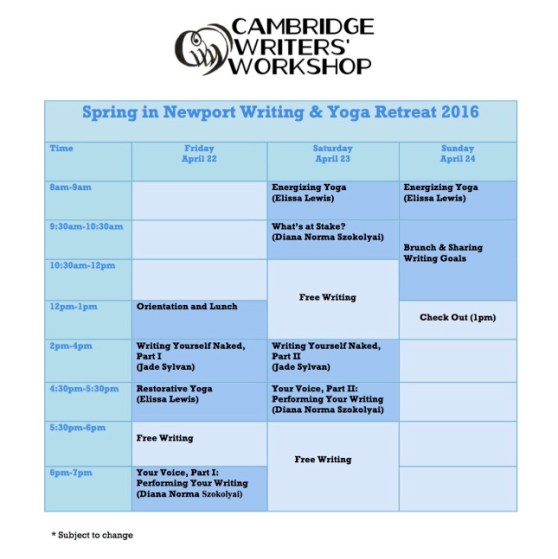
Write Yourself Naked with Jade Sylvan, find out What’s at Stake with Diana Norma Szokolyai, and take Energizing Yoga with Elissa Lewis in Newport.
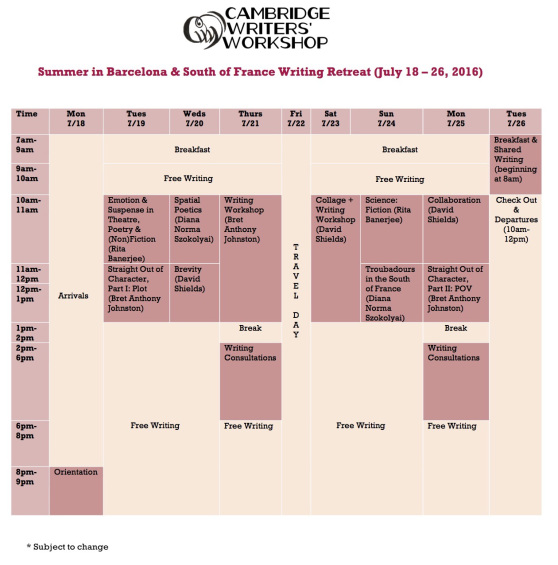
In Barcelona & the South of France, experience Brevity with David Shields, go Straight Outta Character with Bret Anthony Johnston, create Emotion & Suspense in Theatre with Rita Banerjee, and delve into the Troubadours in the South of France with Diana Norma Szokolyai.
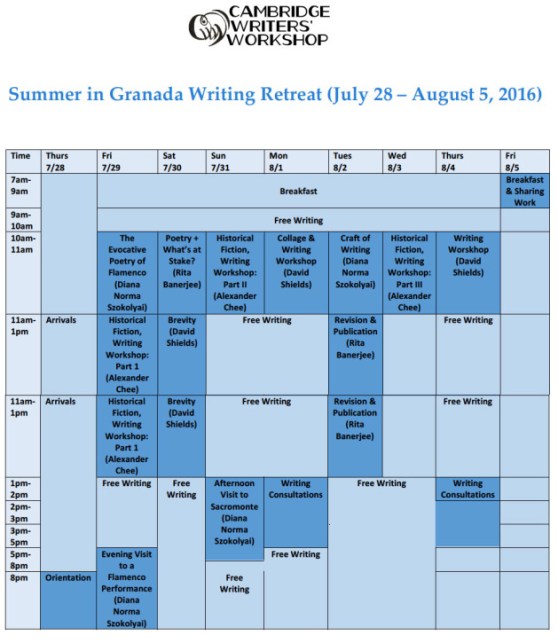
Finally, discuss Historical Fiction with Alexander Chee, piece together Collage with David Shields, immerse yourself in the Evocative Poetry of Flamenco with Diana Norma Szokolyai, and explore Revision & Publication techniques with Rita Banerjee in Granada.
Below you’ll find our Spring and Summer Retreat Schedules along with course descriptions and faculty bios.
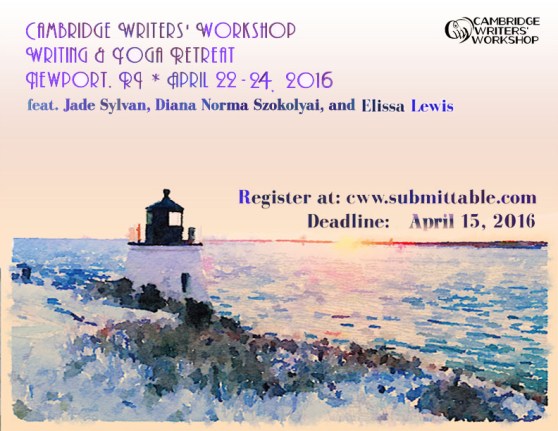
If you would like to join us on any of our retreats, please apply online at cww.submittable.com by April 15, 2016, and include a $5 application screening fee, along with a writing sample of either five pages of poetry or ten pages of prose. (Due to limited seats, early applications are encouraged, but check for rolling admission after deadline, depending on availability).
 Deadline: April 15, 2016
Spring in Newport, Rhode Island (April 22-24, 2016)
Class Descriptions:
Writing Yourself Naked (with Jade Sylvan)
From nonfiction memoirs to poetry, from sci-fi to fantasy, it can be hard to wade through all of our associations, defenses, and unconscious belief systems to find what we really want to say. Through a series of writing and personal reflection exercises, we will begin to slough off the layers of social, environmental, and biological noise to excavate the core of our authentic voice.
What’s at Stake? (with Diana Norma Szokolyai)
Any good piece of writing makes clear to the writer what is at stake. But how do we, as authors, clarify what is at stake? In this craft of writing seminar, we will examine the central driving force of our narratives. Taking examples from literature and applying them to our own writing, we will explore what is at stake in terms of several paradigms: the personal, professional, social, and ideological.
Your Voice: Performing Your Words (with Diana Norma Szokolyai)
In this workshop, we will examine the elements of voice related to performing our work. Whether you are a performance poet or doing a reading at a local library from a short story, novel, or nonfiction work, it is useful to think about how you can craft the delivery of your performance and leave the audience wanting more. We will analyze the performances of several established writers and performers as well as experiment with recording and performing our own work.
Energizing Yoga (with Elissa Lewis)
Expect a breath-centered vinyasa class designed to bring clarity and lift your spirits. A morning yoga practice is a lovely way to begin your day! We will end on a relaxed note; with some combination of meditation and writing in your journal.
Restorative Yoga (with Elissa Lewis)
Gentle yoga to alleviate stress in the body. Expect foundational and restorative poses as well as breathing exercises. Class will end with some combination of meditation and journaling.
Summer in Barcelona & South of France (July 18-26, 2016)
Class Descriptions:
Brevity (with David Shields)
Lecture. Exegesis. In-class writing/critique.
A sustained argument for the excitement and urgency of literary brevity in a hyper-digital, post-religious age; a rally for compression, concision, and velocity; and a meditation on the brevity of human existence. We are mortal beings. There is no god. We live in a digital culture. Art is related to the body and to the culture. Art should reflect these things. Brevity rules.
Collage (with David Shields)
Lecture. Exegesis. In-class writing/critique.
The novel is dead; long live the anti-novel, built from scraps./I’m not interested in collage as the refuge of the compositionally disabled. I’m interested in collage as an evolution beyond narrative./A great painting comes together, just barely./It may be that nowadays in order to move us, abstract pictures need if not humor then at least some admission of their own absurdity-expressed in genuine awkwardness or in an authentic disorder./These fragments I have shored against my ruins./Collage is the primary art form of the twenty-first century.
Collaboration (with David Shields)
Lecture. Exegesis. In-class writing/critique.
A class on kinds of collaboration: collaboration with yourself, with your own material, with other texts, with other people, and the world in general. I’ll talk for a while about the kinds of collaboration I’ve done and ask people in the class to bring in an idea for how they might collaborate on their next project.
Straight Outta Character (with Bret Anthony Johnston)
This course will be a hands-on and practical exploration of how writers create characters in narrative. Using classic and contemporary examples of dynamic characters and a good many craft-based writing exercises, we will develop strategies and techniques to create nuanced characters in our own work. We will consider how other elements of successful narratives are formed and informed by choices of character. If character is fate, and of course it is, then character is also plot, setting, and point-of-view. Our goal is to find the means to surrender to our characters, to find the courage to let them quicken to life in our and our readers’ imagination, and to find the faith to follow—rather than lead—them through the stories that they’re using us to tell.
Spatial Poetics: (with Diana Norma Szokolyai)
In this craft of writing seminar, we will examine how theories in spatial poetics apply to the structure of our writing. Using literary theory, elements of visual design, sociological paradigms, and our imaginations, we will explore the concept of spatial form in our narratives as it relates to concrete and abstract places and spaces.
Troubadours in the South of France: (with Diana Norma Szokolyai)
The south of France was once a land rich with the culture of the troubadours, and these poets spoke in the local vernacular, Occitan. “Troubadour” comes from the Occitan, trobar, meaning “to invent, to compose, or to find.” In this class, we will learn about the rich traditions of the troubadours and their influence on French poetry.
Science: Fiction – How to Build Literary Worlds (with Rita Banerjee)
In this class, we will explore how the fabric and rules of literary worlds in realist and speculative fiction are created. By examining the parameters of social and behavioral codes, human interactions and psychology, and the materiality of worlds, we’ll explore that volatile space where truth and lie meet, where conflicts crystallize, and where storytelling disturbs and delights.
Emotion & Suspense in Theatre, Poetry and (Non)fiction: (with Rita Banerjee)
Plato argues that human behavior flows from three main sources: desire, emotion, and knowledge. And before staging Kalidasa’s The Recognition of Śākuntalā, the director challenges his actress-lover: “As though in a painting, the entire audience has had their emotion colored through your melody. So now—what shall we perform to sustain the mood?” In this class, we will explore how creating vivid emotional worlds between characters and within storylines can build suspense, sustain drama, and lure the reader deeper in.
Summer in Granada (July 28-August 5, 2016)
Class Descriptions:
Brevity (with David Shields)
Lecture. Exegesis. In-class writing/critique.
A sustained argument for the excitement and urgency of literary brevity in a hyper-digital, post-religious age; a rally for compression, concision, and velocity; and a meditation on the brevity of human existence. We are mortal beings. There is no god. We live in a digital culture. Art is related to the body and to the culture. Art should reflect these things. Brevity rules.
Collage (with David Shields)
Lecture. Exegesis. In-class writing/critique.
The novel is dead; long live the anti-novel, built from scraps./I’m not interested in collage as the refuge of the compositionally disabled. I’m interested in collage as an evolution beyond narrative./A great painting comes together, just barely./It may be that nowadays in order to move us, abstract pictures need if not humor then at least some admission of their own absurdity-expressed in genuine awkwardness or in an authentic disorder./These fragments I have shored against my ruins./Collage is the primary art form of the twenty-first century.
Historical Fiction (with Alexander Chee)
War and Peace holds a strange place in literary history, participating in the crowning of realism as a substantial and serious literary mode in America, even as the novel also contributed to the argument that historical fiction could be by nature dangerous, illegitimate, and inaccurate. This is the reason historical fiction is sometimes reviewed by historians, who may evaluate the novel for how much it has gotten right, instead of for its literary merit—as if the only thing for a historical novel to do is to authentically replicate the past. In this class, we will explore what historical fiction is and how to write it.
The Evocative Poetry of Flamenco (with Diana Norma Szokolyai)
In this class, we will explore the fantastically concise and heel-to-floor transmission of passion through the lyrics of flamenco music. Packed with intense rhythms, rhymes, and imagery to match the intensity of the music, flamenco songs are a form ofpoetry developed by Romani people to express the deepest human experiences of love, death, and oppression. We will examine symbols and structures in the poetry of flamenco, learning the distinctions between siguiriya, tango, playera, soleá, and carcelera. Complementary to the class, we will visit an authentic flamenco performance and get a tour of the Museo Cuevas del Sacromonte, where Romani people have traditionally lived in cave dwellings and practiced the art of flamenco.
Poetry & What’s at Stake (with Rita Banerjee)
“What’s at stake” reveals how and why a poem is being told. What’s at Stake builds urgency, conflict, and pivotal turns within a lyrical or narrative poem, and drives engagement. It reveals what’s on the line for the speaker and the reader in terms of personal, emotional, psychological, physical, social, and political investments. In this class will read work by poets such as Elizabeth Bishop, Allen Ginsberg, Jamaal May, and Ocean Vuong, and will explore how writers and readers become more invested in a poem, its performance, and its narrative by raising the stakes.
Revision & Publication (with Rita Banerjee)
In this class, we will explore techniques for revisions, effective methods for submitting work, resources for publication, and of course, post-publication escapades.
Featured Faculty:
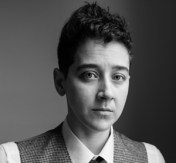 Jade Sylvan (they/them/their), called a “risqué queer icon” by The Boston Globe, is an award-winning author, poet, screenwriter, producer, and performing artist heavily rooted in the literary and performance community of Cambridge and Somerville, Massachusetts. Jade’s most recent book, Kissing Oscar Wilde (Write Bloody, 2013), a novelized memoir about the author’s experience as a touring poet in Paris (sponsored by a travel grant from The Foundation of Contemporary Arts), was a finalist for the New England Book Award and the Bisexual Book Award. Other work has appeared in The Washington Post, Buzzfeed, The Toast, Mudfish, Lady Churchill’s Rosebud Wristlet, and many other publications. Jade has toured extensively, performing their work to audiences across the United States, Canada, and Europe. They are currently overseeing the production of their first full-length stage play, Spider Cult the Musical, opening June 24th, 2016 at Oberon Theater in Harvard Square.
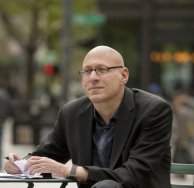 David Shields is the internationally bestselling author of twenty books, including Reality Hunger (named one of the best books of 2010 by more than thirty publications), The Thing About Life Is That One Day You’ll Be Dead (New YorkTimes bestseller), and Black Planet (finalist for the National Book Critics Circle Award). Forthcoming from Knopf in February 2017 is Other People: Takes & Mistakes. The recipient of Guggenheim and NEA fellowships, Shields has published essays and stories in the New York Times Magazine, Harper’s, Esquire, Yale Review, Village Voice, Salon, Slate, McSweeney’s, and Believer. His work has been translated into twenty languages.
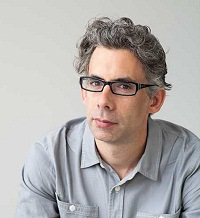 Bret Anthony Johnston is the author of the internationally best-selling novel Remember Me Like This, and author of the award-winning Corpus Christi: Stories, which was named a Best Book of the Year by The Independent (London) and The Irish Times, and the editor of Naming the World and Other Exercises for the Creative Writer. His work appears in The Atlantic Monthly, Esquire, The Paris Review, Glimmer Train Stories, Virginia Quarterly Review, The Best American Short Stories, and elsewhere. His awards include the Pushcart Prize, the Glasgow Prize for Emerging Writers, the Stephen Turner Award, the Cohen Prize, a James Michener Fellowship, the Kay Cattarulla Prize for short fiction, and many more. His nonfiction has appeared in The New York Times, the New York Times Magazine, The Wall Street Journal, Tin House, The Best American Sports Writing, and on NPR’s All Things Considered. A graduate of the Iowa Writers’ Workshop, he’s the recipient of a National Endowment for the Arts Literature Fellowship and a 5 Under 35 honor from the National Book Foundation. He wrote the documentary film Waiting for Lightning, which was released in theaters around the world by Samuel Goldwyn Films. He teaches in the Bennington Writing Seminars and at Harvard University, where he is the Director of Creative Writing.
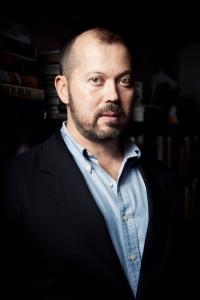
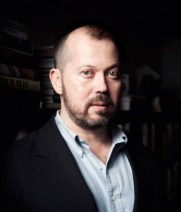 Alexander Chee was born in Rhode Island, and raised in South Korea, Guam and Maine. He is a recipient of the 2003 Whiting Writers’ Award, a 2004 NEA Fellowship in Fiction, and residency fellowships from the MacDowell Colony, the VCCA, Ledig House, the Hermitage and Civitella Ranieri. His first novel, Edinburgh (Picador, 2002), is a winner of the Michener Copernicus Prize, the AAWW Lit Award and the Lambda Editor’s Choice Prize, and was a Publisher’s Weekly Best Book of the Year and a Booksense 76 selection. In 2003, Out Magazine honored him as one of their 100 Most Influential People of the Year. His essays and stories have appeared in Granta.com, Out, The Man I Might Become, Loss Within Loss, Men On Men 2000, His 3 and Boys Like Us. He has taught fiction and nonfiction writing at the New School University, Wesleyan University, Amherst College, and the Fiction program at the Iowa Writers’ Workshop. He lives in New York City and blogs at Koreanish.
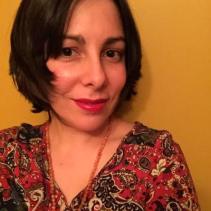 Diana Norma Szokolyai is a writer/interdisciplinary artist/educator and Executive Artistic Director of Cambridge Writers’ Workshop. Based in Brooklyn, NY, she is author of the poetry collections Parallel Sparrows (honorable mention for Best Poetry Book in the 2014 Paris Book Festival) and Roses in the Snow (first runner-up Best Poetry Book at the 2009 DIY Book Festival). She also records her poetry with musicians and has collaborated with several composers. Her poetry-music collaboration with Flux Without Pause led to their collaboration “Space Mothlight” hitting #16 on the Creative Commons Hot 100 list in 2015, and can be found in the curated WFMU Free Music Archive. Szokolyai’s work has been published in Quail Bell Magazine, Lyre Lyre, The Fiction Project, The Boston Globe, Dr. Hurley’s Snake Oil Cure, and Up the Staircase Quarterly, as well as anthologized in The Highwaymen NYC #2, Other Countries: Contemporary Poets Rewiring History, Always Wondering and Teachers as Writers. Szokolyai earned her Ed.M. in Arts in Education from Harvard University and her M.A. in French Literature from the University of Connecticut, while she completed coursework at the Sorbonne and original research in Paris for two years. She is currently at work on three books and recording an album of poetry & music.
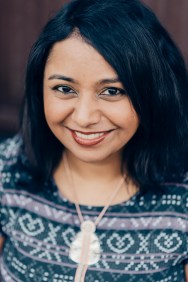 Rita Banerjee received her doctorate in Comparative Literature from Harvard and her MFA in Creative Writing from the University of Washington. Her writing has been published or is forthcoming in the Los Angeles Review of Books, Electric Literature, VIDA: Women in Literary Arts, AWP WC&C Quarterly, Queen Mob’s Tea House, Riot Grrrl Magazine, Poets for Living Waters, The Monarch Review, The Fiction Project, Quail Bell Magazine, Jaggery, Catamaran, The Crab Creek Review, The Dudley Review, Objet d’Art, Amethyst Arsenic, Vox Populi, Dr. Hurley’s Snake-Oil Cure, Chrysanthemum, and on KBOO Radio’s APA Compass in Portland, Oregon. Her first collection of poems, Cracklers at Night, was published by Finishing Line Press and received First Honorable Mention for Best Poetry Book of 2011-2012 at the Los Angeles Book Festival, and her novella, A Night with Kali, is forthcoming from Spider Road Press in 2016. Creative Director of the Cambridge Writers’ Workshop, she is currently working on a novel and a book of lyric essays.
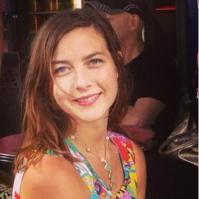 Elissa Lewis is the Yoga & Arts Coordinator of the Cambridge Writers’ Workshop. She began her journey with yoga in 2006, when she moved to France and made the practice part of her daily routine. She saw yoga as a lifestyle, not only a class, helping her to clear her mind and have more compassion for herself and others. In 2010 she moved to New York and completed her teacher training at Laughing Lotus, a creative, soulful yoga studio that teaches the student to ‘move like yourself.’ She’s taught private and group classes in Manhattan and Brooklyn ever since. Visit her website for informative yoga sequences and information.


 Julialicia Case’s
 Ariana Kelly
 Gwen E. Kirby
 Ondrej Pazdirek
  Heather Aimee O’Neill
 Brenda Peynado’s
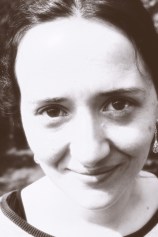 Esther Pfaff is a Munich based fiction-writer focusing on contemporary stories on personal development and family psychology. Her current projects involve a short story collection and a novel. In daily life, she divides her time between her job as an IP lawyer and her home-based writing studio. Esther is a member of the Cambridge Writers Workshop since 2015 and was a student at a Master Class by Julia Cho, Hedgebrook (Seattle) December 5 to 14, 2015.
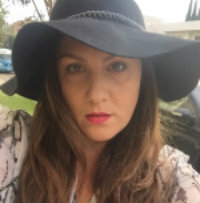 Jessica Piazza
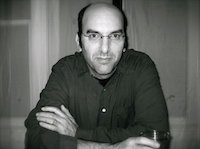 Jonathan Shapiro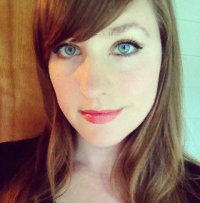
 Emily Smith


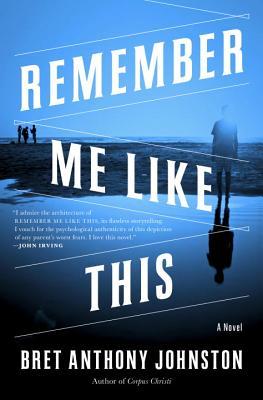
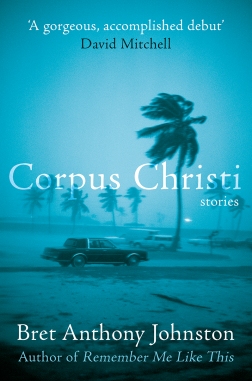 ES: Many of your stories are set in Texas. Aside from growing up in Corpus Christi, what do you think continues to draw your stories back to the state?
 Cambridge Writers' Workshop