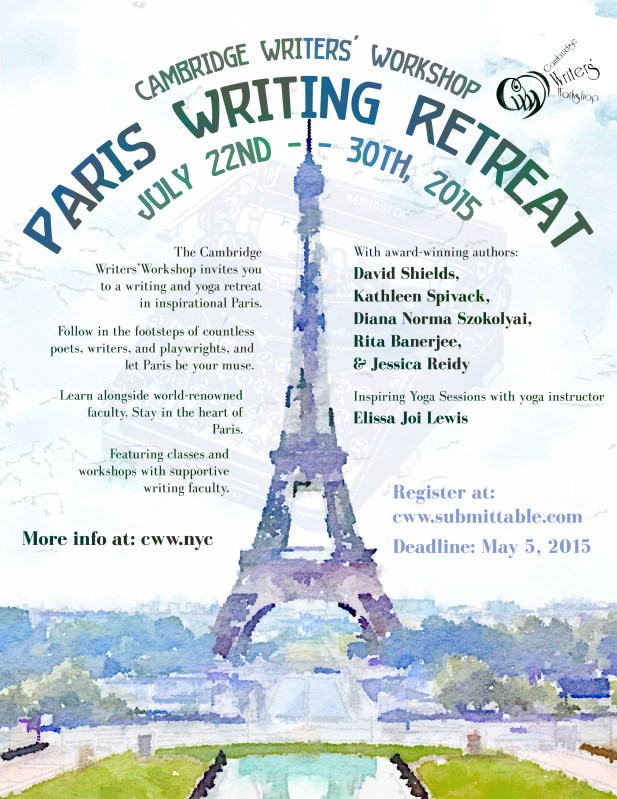
Register Now for CWW Summer in Paris Writing Retreat (July 22-30, 2015)

CWW-Paris2015

The Cambridge Writers’ Workshop Summer in Paris Writing Retreat will take place July 22-30, 2015 in France. The retreat offers participating writers of all genres and levels to work alongside award-winning authors and editors. Participating writers will hone their craft and expand their writing skills, while working on new or existing projects.  There will also be time to explore the city of Paris in all of its historical, literary, and romantic charm. Situated in heart of Paris’ Montparnasse neighborhood, amongst the fresh and popular open air markets and charming boutiques, the hotel where we will stay is full of charm and our Moroccan themed classroom will offer a wonderful oasis to practice the writing life.  Faculty includes internationally renowned author and writing coach Kathleen Spivack (fiction, poetry, nonfiction), David Shields (nonfiction, book-length essay), Diana Norma Szokoloyai (poetry, nonfiction), Rita Banerjee (poetry, fiction), Jessica Reidy (fiction, poetry), and Elissa Lewis (yoga, meditation).  If you’d like to join us in Paris, please apply online at cww.submittable.com by May 5, 2015.

CWW Interview with David Shields, Essayist, Paris Instructor, & Author of I Think You’re Totally Wrong (2015)

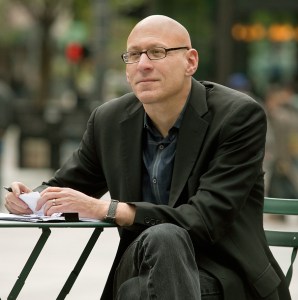
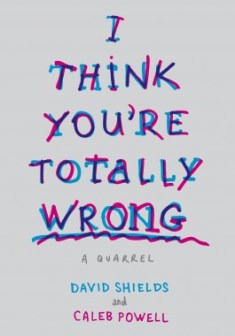
Author photo of David Shields, 2012.This year, the Cambridge Writers’ Workshop’s Summer in Paris Writing Retreat will take place from July 22-30, 2015. At the event, we’ll be hosting a wide variety of craft of writing seminars, creative writing workshops, and special readings from our Paris 2015 faculty, which includes David Shields, Kathleen Spivack, Rita Banerjee, Diana Norma Szokolyai, Jessica Reidy, and Elissa Lewis. One of our featured faculty members, David Shields, an essayist and nonfiction writer, recently co-authored a new book with Caleb Powell titled I Think You’re Totally Wrong: A Quarrel. The Cambridge Writers’ Workshop’s Alex Carrigan sat down to speak with David for an interview. Read below to see the interview, and be sure to register for our Summer in Paris Writing Retreat t by May 5, 2015!

AC: Your writing style is said to be very much like a “collage,” in that you blur genre, autobiography, fiction, and essay. How did you develop the form of the literary collage?

DS: I wrote three novels that were relatively traditional, although increasingly left. I wrote a book called Heroes, a very traditional novel, a growing-up novel called Dead Languages and then a book of stories called Handbook for Drowning. I was trying to write my fourth novel, a book called Remote, and I found all the traditional gestures of the novel just really were not conveying what I wanted to convey.

I was watching a lot of self-reflective documentary films, especially films by Ross McElwee who is from Cambridge. I was reading a lot of anthropological autobiographies by people like Renata Adler and George W.S. Trow and listening and watching a lot of performance art and stand-up comedy.

What was going to be my fourth novel became my first work of literary collage called Remote: Reflections on Life in the Shadow of Celebrity, published in 1996. Ever since then, I’ve been continuing to explore boundary jumping work, the limits of autobiography, and the limits of genre-jamming. By no means am I the progenitor of literary collage. Collage is an ancient form going back to Heraclides’ Fragment 3,000 years ago and coming up to all the way to, say, Maggie Nelson’s Bluets. It’s a beautiful form that lets me do what I want to do on the page.
ITYTW-hi-res-265x380

AC: How did the idea of I Think You’re Totally Wrong develop?

DS: A lot of what I do on the page is to question myself. I write what I call “self-deconstructive non-fiction.” It’s a term someone applied to my work. I’m interested in exploring myself but also in demolishing myself as a way to get at large cultural and human questions. The canvas in my work is myself, only as an avenue to approach broader questions. I’m not interesting in anything like conventional autobiography or conventional memoir.

In a way, I was tired of debating myself in my work, in books from Remote to How Literature Saved My Life. I wanted to have somebody embody the opposition. I have always been a fan of books of dialogue from Plato and Socrates in Plato’s Dialogues all the way up through The Magliozzi Brothers in Car Talk. I just love the form of two guys arguing.

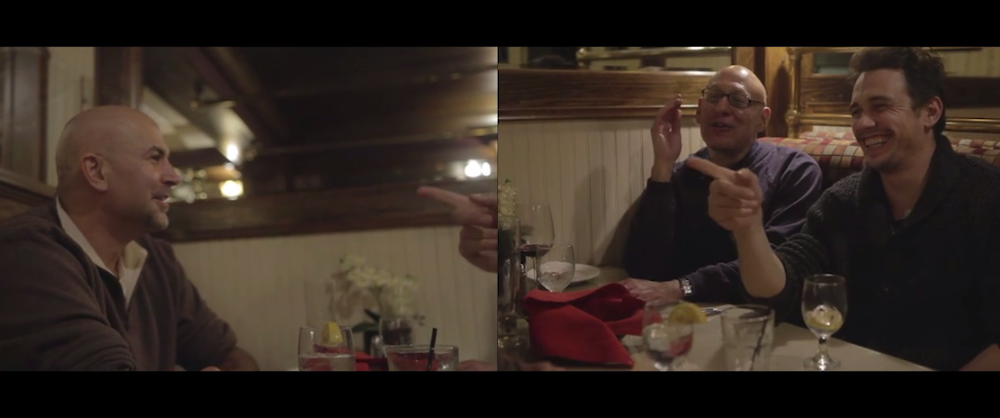
I sought out a former student of mine (Caleb Powell) who tends to have a different point of view from me. Three years ago, we went off to a cabin and argued for four days. Then we radically edited the transcript into a book, then we took the book and made it into a film with my former student, James Franco, directing the film.

AC: The book references My Dinner with Andre’ and The Trip as influences for the novel. What aspects of those works do you feel I Think You’re Totally Wrong best encapsulates? Do you feel the book does something those works didn’t?

My_Dinner_with_Andre_1981_film_theatrical_release_poster

DS: It seems sort of foolish to not acknowledge the predecessors from Boswell and Johnson, Rosencrantz and Guildenstern, Laurel and Hardy, Car Talk, Sideways, and The Trip. A wonderful book I really love is David Lipsky’s book on David Foster Wallace in which the two of them argue for three or four hundred pages.

It’s not up to me to say what the book does better or worse, or what the film does better and worse than previous ones. The challenge I placed before myself and Caleb was to make it… I think what our book and film do well is being more naked, more raw, or more vulnerable. A few of these other projects, they might have more talented performers or whatever.

There’s a wonderful quote on the back of the book by Peter Brooks, my former teacher. He says “Confession makes sense only when it costs something, when it’s courting disaster; I found that risk-taking in this book, and it’s bracing.” That’s a very generous quote, and it goes to what we were trying to do. In a way, we wanted to court disaster, where something like The Trip is never seriously courting disaster. Even My Dinner with Andre’ is an incredibly polished performance.

I’m very fond of this quote by Walter Benjamin: “A work of literature should either invent a genre or dissolve one.” Our attempt was… to dissolve a genre or extend it, by making the quarrel between two people be just unusually naked and raw and vulnerable and discomforting. That’s our attempt at contribution.

AC: In the book, you and Powell briefly criticize the notion of “show, don’t tell.” Was that something that played into how you presented I Think You’re Totally Wrong since the book presents almost entire transcripts of your conversations?

I think it’s because I’m very invested in the essay and the contemplation, the meditation. In our book, it’s beside the point to do long description of what the woods look like. It’s essentially a play or screenplay.

It’s mainly “show, don’t tell,” because it’s two guys arguing. Any time Caleb goes to too great length on a story, I always imagine asking him “Okay, but what’s the point?” I think the book embodies “tell, don’t show” not because we don’t give scene descriptions, but because we don’t waste time doing a lot of dialogue. We’re trying to cut to what actually matters and to contemplate existence directly.

AC: Do you ever see yourself going on a trip similar to the one in I Think You’re Totally Wrong ever again, even if it’s not to write a book?

DS: No. Everything I do is related to books, and I guess that’s part of the comedy of this project. I’m really busy; I teach, I write, and a lot of the book is about how I really like to write. I might go off with my wife and daughter to hang out. To me, words are very precious, and I don’t give them to people for the hell of it. If I’m trying to use words well, I want to make it part of a book. I’m not going to spend five days thinking about existence and not try to make it part of a literary project.
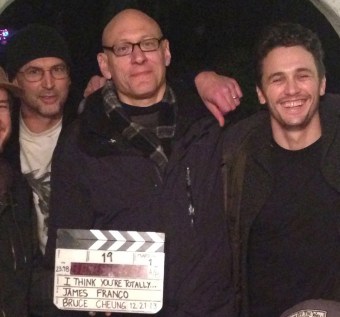
DavidShields_DirectorFranco

David Shields with Caleb Powell & James Franco

AC: How did the film version of the book come to be?

DS: James [Franco] was my student at Warren Wilson College (Masters of Fine Arts: Low Residency program). James is an actor, a writer, and a director. We were getting to know each other better, and we both share an interest in self exposure, nakedness, recollection, awkwardness, and in breaking the fourth wall. We have a shared aesthetic, so that we’re working not only on this film (which is completed) but also with two other books of mine that we’re making into film. We have a kind of shared ethos in self-deconstructive non-fiction. That’s not all I’m interested or all James is interested in, but it’s a shared interest.

James wanted to do a film of one of my books. I showed him I Think You’re Totally Wrong, and he said, “this is a movie, let’s do it.” Caleb and I wrote a screenplay, a scene sheet, a beat sheet, and a treatment. The irony of it, which I sort of love, was that on the first day of shooting, we wound up throwing away the script because a real life, real time argument broke out on the first day which was all about what can and what can’t be used in the film. It was a perfect embodiment about the whole life/art debate, which was what the book and film are actually about. We stumbled quite serendipitously into an actual argument and we filmed the actual argument.

AC: In the film, you and Powell play yourselves. Was there anything challenging about becoming “actors” and reliving the weekend?

DS: In many ways, it wasn’t reliving. It wasn’t like we act out our scenes from the book, which is what we thought we’d do. We created an entirely new work, which has a relationship to the book, but we basically started arguing on camera.  Franco and I started yelling at Caleb; Franco and Caleb started yelling at me. Ot was a real argument about a real thing.

I was just being myself and wanted to win the argument. You have to be aware there is a camera and that you are trying to make a good movie. Just like I do on the page, I took who I naturally am and was aware of projecting, amplifying, and exaggerating that for drama, which I think is what any personal essayist does.
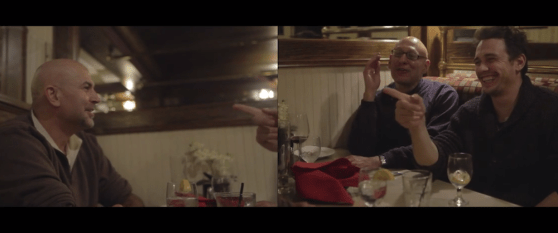
dinner-iv

AC: Was there anything that had to greatly changed in the adaptation of the book, such as certain scenes that had to be cut or reworked?

DS: It’s an entirely different narrative that has a whole different strategy and purpose. It’s about an argument that develops when James and I urge Caleb to incorporate certain material into the movie. He refuses, I feel awful about badgering and bullying Caleb, then I apologize to Caleb, then James accuses me of being a theoretician and not a practitioner of riffs, then I accuse James of the same, then Caleb has a meltdown as he recounts this war movie he is telling us about, then we all worry that we don’t have an ending, and then out of nowhere we find an ending by, in a way, rediscovering what the whole film was about.

I think it’s a lovely little film and I’m quite proud of it. We were writing the film hour by hour over the four days that we shot it. Any time that we weren’t shooting I was madly scribbling notes about what we should do next. On one hand, I was trying to respond to the actual argument and on the other, I was trying to make a film. It was a completely different experience, much different from the book in my view.

AC: Do you have any upcoming works you’d like to talk about?

I have four books coming out in the next year. I Think You’re Totally Wrong just came out and the film will be out this spring. In April, I have a book coming out with Hawthorne Books called Life is Short- Art is Shorter: In Praise of Brevity. I’m the co-author of that book with Elizabeth Cooperman. In June, I have a book coming out with McSweeney’s Books called That Thing You Do With Your Mouth: The Sexual Autobiography of Samantha Matthews As Told to David Shields. It was kind of an amazing project.

life_is_short_247_400_80

In next September, I have a book with Powerhouse Books which is a photography and art publisher called War Is Beautiful: A Pictorial Guide to the Glamor of Armed Conflict. It’s a book about war photography. Then in January of 2016, I have a book coming out with Knopf again called Other People: A Remix. I’ve taken about 60 essays of mine that I’ve written over the last 30 year and rewritten them all to make an entirely new book with a contemplation on a particular theme.

Those are all keeping me busy for the next year, just ushering these new books to print.

AC: Since you’re going to be coming on our Paris retreat later this year, what are you looking forward to and what are you planning to teach?

DS: I’m looking forward to meeting my French publisher. I’m looking forward to meeting some friends I know in Paris. I’m looking forward to giving a reading at Shakespeare and Co. Those are the side things.

The core of the experience is the Cambridge conference. I look forward to talking about brevity; I’ll be using my brevity book as the core of that seminar. I’m going to talk about collage, and I’m going to talk about collaboration. Three of the things I’m most passionate about (collage, brevity, and collaboration) will form the basis for three workshops. I’m still working out exactly what, but I teach out of my passion, and those are three of my literary passions.

AC: Do you have any advice for aspiring writers?

The best thing I can think of comes from a wonderful line of William Butler Yeats who said “Out of the quarrel with others we make politics; out of the quarrel with ourselves we make poetry.” That’s sort of the essence of what I’m interest in: to harvest the arguments with yourself, and out of that to create what you hope is memorable.
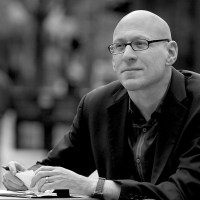
Author photo of David Shields, 2012.David Shields is the internationally bestselling author of twenty books, including Reality Hunger (named one of the best books of 2010 by more than thirty publications), The Thing About Life Is That One Day You’ll Be Dead (New York Times bestseller), and Black Planet (finalist for the National Book Critics Circle Award). Forthcoming are War Is Beautiful (powerHouse, November 2015), Flip-Side (powerHouse, March 2016) and Other People (Knopf, 2017). The recipient of Guggenheim and NEA fellowships, Shields has published essays and stories in the New York Times Magazine, Harper’s, Esquire, Yale Review, Village Voice, Salon, Slate, McSweeney’s, and Believer. His work has been translated into twenty languages.

I Think You’re Totally Wrong: A Quarrel, can be purchased on Amazon. The book was named one of Amazon’s Ten Best Nonfiction Books for January, 2015 and one of Powell’s Books Favorites for January, 2015. The film version will be premiering at Vancouver’s DOXA Documentary Film Festival in April, 2015.
Echo in Four Beats – An Evening of Poetry & Fiction by Rita Banerjee – Feb 7, 2015

EchoSaturday February 7, 2015 * 19:00-20:30
The Munich Readery * Augustenstraße 104 München, Germany

Join the Munich Readery for an evening of original poetry and fiction by writer and creative writing instructor, Rita Banerjee. Rita Banerjee will be reading from her poetry collection, Cracklers at Night, and her new poetry manuscript, Echo in Four Beats. She will also read excerpts from her novel manuscript, Mélusine, as well as her selections of her short fiction.

ritaRita Banerjee is a writer and creative writing instructor at the Munich Readery. She received her PhD in Comparative Literature from Harvard University and her writing has been published in Poets for Living Waters, The New Renaissance, The Fiction Project, Jaggery: A DesiLit Arts and Literature Journal, Catamaran, Amethyst Arsenic, The Crab Creek Review, The Dudley Review, Objet d’Art, Vox Populi, Dr. Hurley’s Snake-Oil Cure, and Chrysanthemum. Her first collection of poems, Cracklers at Night, received First Honorable Mention for Best Poetry Book at the Los Angeles Book Festival. Her novella, A Night with Kali, was digitized by the Brooklyn Art-house Co-op. She is Executive Creative Director of the Cambridge Writers’ Workshop, and her writing has also been recently featured in VIDA: Women in Literary Arts, Quail Bell Magazine, Speaking of Marvels, and on KBOO Radio’s APA Compass in Portland, Oregon.

CWW Interview with Stephen Aubrey, Newport, Rhode Island Instructor & Playwright

stephen AubreyThe Cambridge Writers’ Workshop is proud to introduce Stephen Aubrey, who will be teaching classes on theatre, performance, screenwriting, and playwriting at our Writing and Yoga Retreat in Newport, Rhode Island (April 2-5, 2015).  The Cambridge Writers’ Workshop’s Megan Tilley sat down to interview Stephen Aubrey.  Check out Megan’s interview with Stephen below, and be sure to apply for our Newport Retreat by February 20, 2015!

We-Cant-Reach-You-Hartford

MT: How did you get into playwriting?  What were some of the early plays or performances which inspired you to write?

SA: My life as a playwright owes more to serendipity than anything else. Growing up, theater had always interested me. I was obsessed with Spalding Gray and I hung out with a lot of the theater kids in high school, but my complete incompetence as an actor meant that I was usually an audience member rather than a performer (save for one disastrous turn as Francis Nurse in The Crucible in 11th grade). Playwriting (and writing in general) never exactly occurred to me as something I could do.

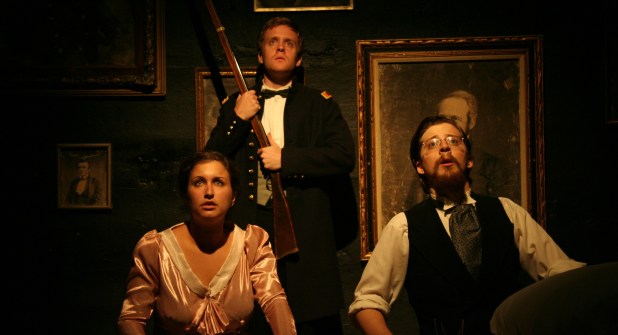
In college, I took a lot of philosophy and history courses, which exposed me to a wealth of interesting stories and ideas and very slowly, I became interested in writing short stories my senior year of college. About this time, I was approached by a director I knew from a fiction workshop I was taking. She was interested in developing a documentary play about a historical event and asked me if I knew of any good source material. After batting around a couple of ideas, I told her about the Hartford Circus Fire of 1944. She was hooked on the idea immediately and we decided to round up a couple of actors and co-write the play.

I thought this was going to be a one-shot deal. I really thought of myself as an academic and was seriously considering getting a PhD in history after I graduated college. Slowly, however, writing got its claws in me. We brought our play to the Edinburgh Fringe Festival that summer where it was well-received and nominated for a prestigious award. When I came back from Scotland, I moved to New York and started thinking seriously about writing plays. The group of people who traveled to Scotland asked me to write another play to perform the next summer and we slowly coalesced into a theater company.

Since I came to playwriting somewhat late, most of the formative plays in my life haven’t been ones I studied in a classroom (though I love some plays I happened to study in school, mostly the Greeks and Shakespeare) but rather, ones I saw performed when I first moved to New York. I didn’t have very much money when I first came to the city. All those big sexy expensive shows were out of the question so I ended up exposing myself to the weird, scrappy stuff you can find downtown where the tickets cost the same as a beer at one of the ritzy joints. When I had been at the Fringe Festival doing my show, I had seen the TEAM’s Particularly in the Heartland which really blew me away (I think I’ve ended up seeing it 5 times in total in a bunch of different theaters over the years) and showed me how adventurous and alive and surprising theater could be. Nearly 10 years later, it’s still one of the most amazing pieces I’ve seen. So when I was trying to acquaint myself with what was happening in the theater world, I sought out more people like the TEAM. After seeing a few shows that interested me, I started lurking around theaters that I thought were curating interesting work–The Ontological-Hysteric [R.I.P.], The Ohio, PS122–and becoming aware of groups like Elevator Repair Service, 13P, and Pig Iron that were doing things I found really interesting. I think I learned a lot from these groups, but above all, my downtown education taught me to take risks and embrace the idiosyncrasies of my voice, things that are in abundance downtown and less so once you get above 14th street.

Daguerrotype

MT: You’re the cofounder of The Assembly Theater Company in New York – what lead you to create the group, and how has it impacted your writing?

SA: The simplest explanation for why I created the group was that it was the easiest way to make theater in New York. Especially when you’re just starting out and have very limited resources, it really does take a village to make a play. Doing it alone is, well, lonely. It can be incredibly discouraging for the first few years as you try to break into the community and are dealing with expensive yet somehow filthy black boxes you can only half-fill with friends and loved ones you’ve coerced into buying a ticket. It helps to have comrades.

I was lucky enough to find a group of collaborators in college who have similar interests and aesthetic senses and whom I genuinely care about. We formed the company fresh out of college; there have been some personnel changes as we all learned what the life of a young theater artist entailed, but a core group has remained over the years which has been a wonderful resource to have as I tried to find my artistic identity.

As we’ve grown and developed as a company, we’ve worked towards a truly collaborative way of working together that has become fundamental to the way I think about my writing. After my first few plays, I became disenchanted with the way new plays were developed and also with the way that certain voices (namely straight white men like myself) were overrepresented. At the same time, I was being exposed to a lot of alternative ways of making work–chief among them devised theater–that seemed new and fresh. The Assembly’s four artistic directors are a director, a designer, an actor, and a writer (that’s me); the idea is that by working together as equal partners in series of development periods over the course of a year or two (rather than the typical new play process in which a playwright writes a script, a director decides to work on it and then hires a cast and crew who rehearses for a few weeks) we can create plays where every part of the production is realized in harmony. Even more recently, we’ve been working with group-writing where I write the script along with the actors so that as they get deeper into their characters and make interesting discoveries, we can integrate these into the script.

I’ve found that working this way has really opened up my writing. The plurality of voices and concerns you have to contend with when working in this way can be really overwhelming and intimidating, but it’s incredibly satisfying when it all comes together. It can get messy and heated sometimes in the rehearsal room, but the kind of work I’m creating now–where I’m a main voice, but by no means the primary one–seems important to me. I think we live in a complicated world, one where we need to be aware of and sensitive to alternative perspectives, especially ones that we don’t normally encounter on stage.

OntologicalHysteric

MT: You’ve written plays that have been performed at venues from The Ontological-Hysteric in Manhattan to The Brick Theater in Brooklyn. What was the process like for putting on plays at these venues?

SA: When I first started, my company had to work very hard to find theaters to do our plays in. Being curated by a theater was ideal, but more often than not, we had to rent the theater (which is a huge financial burden). I was very lucky to be able perform in venues like The Brick or The Ontological-Hysteric; both of those came about by applying to programs or festivals like the Short-Form Series or the Video Game Festival. In those instances, the theater was given to me free of charge (though I was financially responsible for everything else). There were a few other fortuitous opportunities like the year-long residency The Assembly had at Horse Trade Theater Group, but for the most part, putting on a play at a venue in New York requires producing it yourself. At least at the beginning, that’s going to be the case. But these things tend to snowball. If you produce a play yourself, and you invite the right people to come see it (or the right people wander into the theater on their own, which is a rare, but beautiful thing), it’s possible that you will be accepted to a festival or residency somewhere down the road. Making a career from theater is largely about using each opportunity to springboard to the next. Once you start generating interest in your work, things get a little easier.

But what has been true throughout is that, even if we were given the space, my company has always been responsible for making the play happen. We have been responsible for finding a cast and design team, for doing the brunt of the fundraising, grant writing and marketing (or paying for our own press agent if we had the money). I’m also forgetting a thousand other small, obnoxious tasks that also fall to us. It’s a DIY world. Making theater requires initiative and a bit of humility; you may be the Writer, but you also have to be The One Who Takes a Vacation Day to Drive the U-Haul to The Storage Unit in New Jersey and Sit in Traffic for the Better Part of the Afternoon. Unless you’re at a theater with a lot of money and resources, that’s the reality of theater.  

MT: How would you compare your writing process for fiction versus screenwriting?

SA: In my mind, the difference is about a visual language versus a written language. In fiction, you can get so much deeper into a character’s mind. You can linger or digress in a way that screenwriting or playwriting cannot. Fiction necessarily requires narration which is something that doesn’t usually work on the screen. A voice-over is so often the sign of an insecure screenwriter, someone who isn’t thinking about a visual language. Because when you’re writing for the screen, you need to be thinking about the audience’s gaze. “Show, don’t tell” is one of those writing cliches I hate throwing around, but it’s an essential tip for screenwriting. Whether it’s through sharp dialogue or a clever structure, you need to find a way to dazzle the senses.

MT: What kinds of workshops are you planning to offer at our Newport, Rhode Island Retreat, and what would you say is the most important part of the workshop experience?

SA: I’m offering three workshops at Newport: one on world-building and the importance of defining space in playwriting and screenwriting; one on “impossible theater,” which is all about pushing yourself away from Realism and thinking in terms of visual and symbolic gestures; and a third on Aristotelian and anti-Aristotelian narrative structures and the opportunities that each affords a writer.

I think the most important part of the workshop experience is meeting other writers. Writing can be a lonely pursuit at times and community is very important. It’s helpful to know that there are other people also sitting at their desks staring at a blinking cursor for hours at a time. Sharing your work with other writers also exposes you to a lot of different styles and perspectives; other writers can show you tricks and tactics and solutions that would never have occurred to you. Finding your co-travelers is an immensely important task and the workshop is a great place to do it.

MT: What advice do you have for budding playwrights and screenwriters?

SA: The most important piece of advice I can give is: Learn how to produce your own work. It’s very difficult to find people willing to take a chance on your writing, financially or artistically, if you’re untested. No one is going to believe in your work, in your words, more than you. You are your own best ambassador for your art, and you need to learn how to present it and talk about it. If you keep at it, people will begin to pay attention, but they need to see your work first. You can apply to contests and festivals (in fact, you should apply to contests and festivals), but it takes a lot of time and patience to work through the system. You could spend that time waiting for a response, or you can take the matter into your own hands and make the work you want to make.

Stephen Aubrey descends from hardy New England stock. He is a Brooklyn-based writer, editor, dramaturg, lecturer, storyteller and recovering medievalist. His writing has appeared in Publishing Genius, Commonweal, The Brooklyn Review, Pomp & Circumstance, Forté and The Outlet. He is a co-founder and the resident dramaturg and playwright of The Assembly Theater Company. His plays have been produced at The New Ohio Theater, The Living Theater, The Ontological-Hysteric Theater, The Flea Theater, The Collapsable Hole, Wesleyan University, The Tank, The Brick Theater, Symphony Space, the Abingdon Theater Complex, UNDER St Marks, The Philly Fringe and the Edinburgh Fringe Festival where his original play, We Can’t Reach You, Hartford, was nominated for a 2006 Fringe First Award. He is also the editor of two ‘pataphysic books, Suspicious Anatomy and Suspicious Zoology, both published by the Hollow Earth Society. He has an MFA from Brooklyn College where he received the Himan Brown Prize and the Ross Feld Writing Award and a BA with Honors from the College of Letters at Wesleyan University. He is an instructor of English at Brooklyn College and holds the dubious distinction of having coined the word “playlistism” in 2003.

Schedule for CWW Pre-Thanksgiving Yoga and Creative Writing Cleanse

GaneshFinalPosterNov23&24retreat

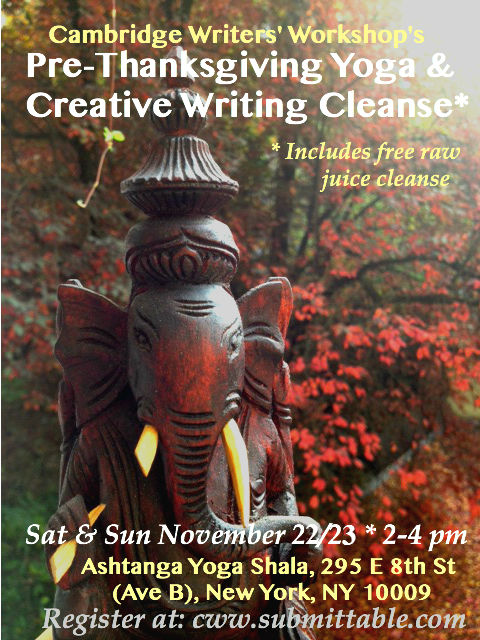
Hello everyone! We’re about a week away from our Pre-Thanksgiving Yoga and Creative Writing Cleanse at Ashtanga Yoga Shala. We hope you’re as excited for this event as we are. There are still spots to register, which you can do here. We’ve just released our schedule for the two day event. It’s $50 a day, but you should try to come to both days.  Here’s the schedule for the weekend:

* SPECIAL OFFER: Register BETWEEN 11 p.m. Mon 11/17 & 11 p.m. Thurs. NOV. 20 for $35 /day ( or $75 for both)*

SATURDAY Nov. 22:  2pm-4 pm

*  YOGA with Elissa Lewis
*  “The Art of Witholding in Creative Writing” with Jessica Reidy
*  Raw Juice Cleanse
*  “Sense of Smell, Memory, & Narrative Part I” (includes an aromatherapy session with essential oils) with Diana Norma Szokolyai

SUNDAY Nov. 24: 2 pm-4pm

*  YOGA with Elissa Lewis
*  “The Art of Revision” with Jonah Kruvant
*  Raw Juice Cleanse
*  “Sense of Smell, Memory, & Narrative Part II” (includes an aromatherapy session with essential oils) with Diana Norma Szokolyai

Here’s some info about the people involved with the workshop:

Diana Norma Szkoloyai is author of the poetry books Roses in the Snow and Parallel Sparrows (Finishing Line Press). Her writing and hybrid art have appeared in Lyre Lyre, Dr. Hurley’s Snake Oil Cure, The Fiction Project, Teachers as Writers, Polarity, The Boston Globe, The Dudley Review, Up the Staircase, Area Zinc Art Magazine, Belltower & the Beach, and Human Rights News. Founding Literary Arts Director of Chagall Performance Art Collaborative and co-director of the Cambridge Writer’s Workshop, she holds an Ed.M from Harvard and an M.A. in French Literature from the University of Connecticut.  She is also a certified reiki healer and uses essential oils aromatherapy daily.

Norma will be leading a two part workshop over the weekend, using aromatherapy as part of her workshop “Sense of Smell, Memory, and Narrative.”

Elissa Lewis is the Yoga & Arts Coordinator of the Cambridge Writers’ Workshop.  She began her journey with yoga in 2006, when she moved to France and made the practice part of her daily routine. She saw yoga as a lifestyle, not only a class, helping her to clear her mind and have more compassion for herself and others. In 2010 she moved to New York and completed her teacher training at Laughing Lotus, a creative, soulful yoga studio that teaches the student to ‘move like yourself.’ She’s taught private and group classes in Manhattan and Brooklyn ever since. Visit her website for informative yoga sequences and information. Elissa will be leading our yoga workshops at this event.

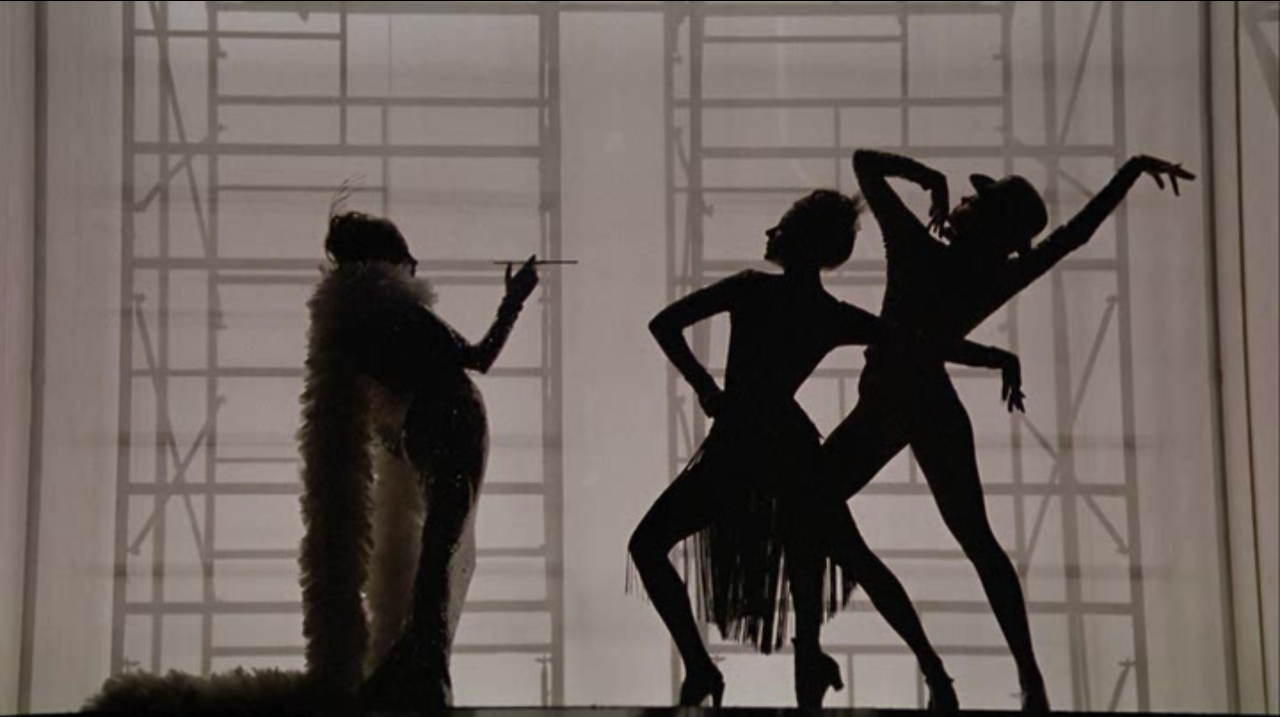
Jessica Reidy is a mixed-Romani (Gypsy) heritage writer from New Hampshire. She earned her MFA in Fiction at Florida State University and a B.A. from Hollins University. Her work has been nominated for a Pushcart, and has appeared in Narrative Magazine as Short Story of the Week, The Los Angeles Review, Arsenic Lobster, and other journals. She’s a staff-writer and Outreach Editor for Quail Bell Magazine, Managing Editor for VIDA: Women in the Literary Arts, Visiting Professor for the Cambridge Writer’s Workshop retreats, and Art Editor for The Southeast Review. She also teaches yoga and occasionally still works her family trades, fortune telling and dance. Jessica is currently working on her first novel set in post-WWII Paris about Coco Charbonneau, a half-Romani burlesque dancer and fortune teller of Zenith Circus, who becomes a Nazi hunter.

Jessica will lead a workshop on Saturday titled “The Art of Withholding in Creative Writing.”

Jonah Kruvant is one of the Cambridge Writers’ Workshop’s  NYC area program organizers and is also a teacher, performer, writer, and student of the world.  He used to live in Costa Rica, where he wrote a popular blog, “From Gaijin to Gringo: Living Abroad in Costa Rica.”  His writing has been published in Digital Americana, and you can read about his adventures in Latin America here: http://costaricagringo.blogspot.com/.

Jonah will be leading a workshop on Sunday called “The Art of Revision.”

Alex Carrigan is from Newport News, Virginia and attended college at Virginia Commonwealth University.  He graduated this year with a degree in print/online journalism and a minor in world cinema.  He is currently an intern for the Cambridge Writers’ Workshop, as well as Staff Film Reviewer for Quail BellMagazine.  He has written articles for The Commonwealth Times and has had work featured in Luna Luna Magazine. He is also a creative writer and has had work published in Amendment Literary Journal and in Poictesme Literary Journal, of which he was a staff member for four years, two years in which he was deputy editor-in-chief.

Alex will be assisting with the running of the weekend event, ensuring everyone has all the materials and juice they need.

If you would still like to sign up, click here to learn how to sign up. You can also email us at directors@cambridgewritersworkshop.org if you have any specific questions.  Follow us on Facebook, Twitter, and Tumblr for more information and to learn more about upcoming events.

CWW Intern, Megan Tilley’s writing featured in Fictionvale

Our inFictionValetern, Megan Tilley, has a short story coming out in thelatest episode of Fictionvale!  She would like to thank their wonderful staff and editors for giving her this opportunity.  Megan Tilley is a recent graduate from Florida State University with a degree in Creative Writing.  She has been published in The Rectangle, The Kudzu Review, and Wiley Writer’s online podcast.  She was senior editor at Live Music Media for three years, and also edited for The Kudzu Review.  Writing and editing has always been her passion, and Megan is excited to be able to expand her experience with editing, among other things, while working with the Cambridge Writer’s Workshop.

Cambridge Writers’ Workshop #NaNoWriMo 2014 Writing Challenge!!

nanowrimoNovember is National Novel Writing Month (NaNoWriMo), and our CWW staff is up for an exciting writing challenge! We have the entire month of November to write draft, sketch, and complete the first versions of our novels.  The goal is to get to over 50,000 words by November 30.  We at the Cambridge Writers’ Workshop are working on our novel projects a little bit everday.  For food for thought and writing inspiration, we’re turning into @NaNoWriMo, @NaNoWordSprints, and all the amazing writers participating in #NaNoWriMo on Twitter!  Here’s what our staff members are doing and our current word counts:

Rita Banerjee:

“I am currently working on my first novel project, a dystopian futuristic novel, which focuses on the trials and tribulations of a young female anti-hero, Mel Cassin. Her life is routine and mundane until one day her university-age brother, Lou, goes missing. This is the second person in her life who has disappeared. The first was her mother, who vanished from the Cassin family home when Mel was just a girl. Her younger brother, Lou, suspicious of the government’s involvement in the disappearance of his mother, attempted to join protests for social reform in college. It is in this moment of youthful rebellion, that Lou, too, disappears from sight, and Mel must find out what has happened to her mother and her brother, in order to understand the veils which disguise the machinations of her own government, the import of her own family and past, and the potential and ambiguity of her own individual agency.” – RB, Word Count as of 11/11: 8,568 Words

Diana Norma Szokolyai

“I am working on a novel called Last Gypsy in Paris.  Set in present day Paris, Lavinia is a teenage, Romani girl who works as an aerialist in her family’s “Old Gypsy Circus” traveling act.  She is torn between the world of the gadjé (non Gypsies) when, while attending French school, she develops passions for literature and a French boy, Julien.  Julien comes from an elitist, right wing French family who want to eradicate Gypsies from France, while Mateo, Lavinia’s father, struggles to keep the old Romani traditions alive in his family by protecting everyone he loves from the world of the gadjé.  When tragedy strikes the family circus, Lavinia must make difficult choices about her future that will ultimately effect her identity.  She is guided by her close friends Elsa, Fisco, Popo the parrot, and Mermeyí, her wise grandmother, who is a fortune teller. – DNS, Word Count as of 11/11: 9,009 Words

Alex Carrigan:

“I’m trying something really strange this month and attempting to write a Young Adult book. I know, it’s crazy. I never see YA about nerdy characters, so I’m making the main characters all members of a high school anime club. It’s a first person story from the perspective of Ashley, a high school junior and active member of the club. Her club is trying to sell anime goods at an upcoming anime convention, and Ashley is tasked to make a dating simulator video game for the table. When her best friend starts dating another guy in the club, Ashley tries to follow them on dates to use for inspiration, while also trying to push other romantic pairings around her in hopes of being able to use it for the club. Unfortunately, this does lead to some issues and causes some things to get crazy when Ashley starts to get too into those around her. I’m excited for the project since I get to make a fleshed out character with Ashley and really try to write from the perspective of an outspoken nerdy teenage girl. Plus, as an anime fan, I get to reference tons of the stuff in the story, which is always fun.” -AC, Word Count as of 11/11: 13,855 words

Jessica Reidy:

“I’m working on my novel, currently titled Zenith, about Coco, a half Romani (Gypsy) burlesque dancer and fortune teller at a Parisian circus who reluctantly becomes a Nazi hunter. Wanting clarity and guidance and without anyone else to turn to, Coco reads her own tarot cards, a forbidden act that always obscures the truth with the seeker’s own fears and desires. Coco’s target is her own uncle, Botho, a Romani man who turned traitor and set thousands of Roma to the gas chambers. And yet, Botho is the same man who spared Coco and her estranged mother, Mina, from the concentration camps, but abused his position to torture them both. While Coco makes her life at the strange and beautiful circus, Mina is living out her days in a mental institution, and keeping her identity as the famed Romani poet exiled from her community under wraps. But when Mina’s journals and her book of poetry appear on Coco’s doorstep, Coco discovers brutal family secrets and finds that she is not the only hunter in her family. Her choice between family or justice throws her own life in the balance while her desires and fears run wild among the circus.” –JR, Word Count as of 11/11: approximately 35,000 words

Megan Tilley:

“For NaNoWriMo this year, I’m working on a YA fantasy novel about the personification of Death and his familiar, a girl named Mira. It follows Mira as she gets accustomed to being Death’s familiar and the complications that come with that, including the struggle with her self identity and personal freedom, while also balancing a budding romance with her childhood friend. Urban fantasy and magical realism are my favorite genres, and I’m really excited to explore the world I’m making! I’m thrilled to be able to work with a unique character like the personification of Death, as well as the internal struggle Mira has to deal with.” – MT, Word Count as of 11/11: 24,574 words

Rita Banerjee teaches Character Development Workshop at the Munich Readery – October 12

CharacterDevelopment

Character Devleopment & Playing with Persona Workshop
Sunday, October 12, 2014 * 14:00-16:30
The Munich Readery, Augustenstraße 104, 80798 München

Femme fatales, gumshoe detectives, star-crossed lovers, wicked stepmothers, wise fools, empathetic anti-heroes: dynamic and archetypal characters can be key to making a good story or lyrical piece tick and pulling in the reader deeper into your creative work. In this workshop, we will discuss how dynamic and archetypal characters can help structure stories, propel narratives forwards, and how they can provide interesting ethical dilemmas and emotional spectrums to narratives and verse. We will learn about the building blocks of creating strong, unforgettable characters, and learn how playing with persona can help liberate nonfictional stories and lyrical poems. So if you’re currently working on a short story, novel, screenplay, theatre play, lyrical essay, memoir, or poem which has a strong and unique character at is heart, come stop by the Munich Readery on Sunday October 12 for our next creative writing workshop led by Rita Banerjee, Cambridge Writers Workshop’s Creative Director. Workshop fee: €25. To register, send an email to store@themunichreadery.com by October 8.

Rita Banerjee is a writer, and received her PhD in Comparative Literature from Harvard University. She holds an MFA in Poetry and her writing has been published in Poets for Living Waters, The New Renaissance, The Fiction Project, Jaggery, The Crab Creek Review, The Dudley Review, Objet d’Art, Vox Populi, Dr. Hurley’s Snake-Oil Cure, and Chrysanthemum among other journals. Her first collection of poems,Cracklers at Night, was published by Finishing Line Press in 2010 and received First Honorable Mention for Best Poetry Book at the 2011-2012 Los Angeles Book Festival. Her novella, A Night with Kali, was digitized by the Brooklyn Art-house Co-op in 2011. She is a co-director of the Cambridge Writers’ Workshop, and her writing has been recently featured on HER KIND by VIDA: Women in Literary Arts and on KBOO Radio’s APA Compass in Portland, Oregon.

LitCrawl Manhattan: Literary Masquerade – Sept 13, 8pm – presented by the Cambridge Writers’ Workshop

cwwliterarymasquerade2014

Featured in Time Out New York!  

Literary Masquerade

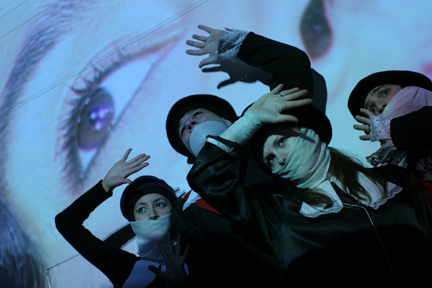
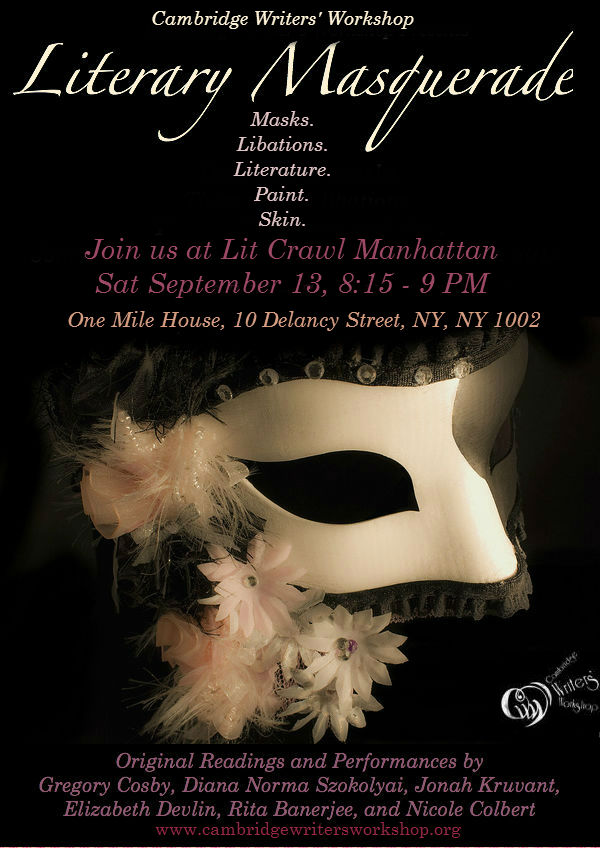
The Cambridge Writers’ Workshop hosts a literary masquerade with writers and performance artists Gregory Crosby, Diana Norma Szokolyai, Jonah Kruvant, Elizabeth Devlin, Rita Banerjee, and Nicole Colbert. Original readings and performances will be intermingled with musings on masks from Pessoa, Kierkegaard, Descartes, Dickinson, de Beer, and more. There will be masks. There will be libations. There will be paint and skin.  Join us at LitCrawl Manhattan.

SAT.  SEPTEMBER 13 * 8:15 p.m.
One Mile House, 10 Delancey St., NY, NY 10002

Gregory Crosby is the author of the chapbook Spooky Action at a Distance (2014, The Operating System); his poetry has appeared in numerous journals, including Court Green, Epiphany, Copper Nickel, Leveler, Sink Review, Ping Pong, & Rattle. In 2002, as a poetry consultant to the City of Las Vegas, he was instrumental in the creation of the Lewis Avenue Poets Bridge, a public art project in downtown Las Vegas. His dedicatory poem for the project, “The Long Shot,” was subsequently reproduced in bronze and installed in the park, and was included in the 2008 anthology Literary Nevada: Writings from the Silver State (University of Nevada Press). He is co-editor of the online poetry journal Lyre Lyre and currently teaches creative writing at Lehman College, City University of New York.

Diana Norma Szokolyai is a writer/performance artist/educator. She teaches 9-12 year-olds in a Montessori learning environment, and is also Artistic Director of Cambridge Writers’ Workshop, where she teaches and organizes writing and yoga retreats for adult writers. She is author of the poetry collections Parallel Sparrows (honorable mention for Best Poetry Book in the 2014 Paris Book Festival) and Roses in the Snow (first runner-up Best Poetry Book at the 2009 DIY Book Festival). She has poetry forthcoming in the anthologies The Highwaymen NYC Annual # 2 and Other Countries: Contemporary Poets Rewiring History and has also had her fiction, essays, and poetry published in The Fiction Project, Lyre Lyre, The Boston Globe, Dr. Hurley’s Snake Oil Cure, and Always Wondering, among others. She performs with Parallel Sonic, ChagallPAC, and the Brooklyn Soundpainting Ensemble.

Elizabeth Devlin is a modern day renaissance woman, if not composing music for the solo, autoharp wielding, singer-songwriter act, ELIZABETH DEVLIN, she can be found crafting Illustrations/Graphi¬cs at DEVLIN DESIGN AND ILLUSTRATION, playing electric bass and singing as front woman for Brooklyn based rock band, VALVED VOICE, or curating a fresh new line-up for the THE HIGHWAYMEN NYC, a Brooklyn based, monthly, poetry reading series that meets on the full moon.

Rita Banerjee is a writer, and received her PhD in Comparative Literature from Harvard University. She holds an MFA in Poetry and her writing has been published in Poets for Living Waters, The New Renaissance, The Fiction Project, Jaggery, The Crab Creek Review, The Dudley Review, Objet d’Art, Vox Populi, Dr. Hurley’s Snake-Oil Cure, and Chrysanthemum among other journals. Her first collection of poems,Cracklers at Night, was published by Finishing Line Press in 2010 and received First Honorable Mention for Best Poetry Book at the 2011-2012 Los Angeles Book Festival. Her novella, A Night with Kali, was digitized by the Brooklyn Art-house Co-op in 2011. She is a co-director of the Cambridge Writers’ Workshop, and her writing has been recently featured on HER KIND by VIDA: Women in Literary Artsand on KBOO Radio’s APA Compass in Portland, Oregon.

Jonah Kruvant is a writer, teacher, and student of the world. He received his Bachelor’s degree from Skidmore College, his Master’s degree in Teaching from Fordham University, and his MFA degree in Creative Writing from Goddard College. After living abroad in four different countries, Jonah settled in New York. The Last Book Ever Written is his first novel. Visit his website at www.jonahk.net.

Nicole Colbert (“Harlequin Loves Columbine”) teaches English at Kingsborough Community College-CUNY. She takes fiction writing classes with Rachel Sherman in Ditmas Park, Brooklyn. Her non-fiction work, including interviews & reviews, has appeared in the Village Voice, Park Slope Reader, and New York Spirit Magazine. As a former dancer and choreographer, she still enjoys performing. She is the proud mother of two very creative children.

August 20 – Bon Voyage, Mes Amis!

August 20 marked the very last day of the 2014 Cambridge Writers’ Workshop Yoga & Writing Retreat at the Château de Verderonne.  The day started early for me at 5:30 am with me bidding adieu to our wonderful and talented intern, Meghan Tilley, as she when to catch her flight at Charles de Gaulle Airport.  By 8 am, all of our terrific writers, artists, and yoga-philes sat down at the great table in the Château de Verderonne hunting lodge to have one last breakfast together.  Our writers would be returning home to the US, the Philippines, the UK, and Germany after this all-too-short and productive retreat.  Breakfast was bittersweet as we all said our fond farewells, exchanged emails, and promised to keep in touch with our writing partners and workshop groups.  We chose November 20 as our first post-retreat rendez-vous date when all of our 2014 retreat participants would meet via Skype to exchange their writing and update us on the projects we had begun at the Château de Verderonne.  Participants began to make their way to the train station and airport around 11 am.  Some writers would be staying a few days extra in Paris while others would do a short tour of Europe before they returned home.

After 11 am, only a few of the participants and instructors remained at the Château de Verderonne.  We thanked Gina & Jessica for their incredibility generosity and fierceness of spirit, which brought a of light and great humor to the retreat.  We walked around the blooming flower gardens and lush green estates of the château one more time together, remembered our meetings on the trampoline, the incredible meals we had made together, and all the writing that was produced on the trip.  We made a pact to not only keep in touch, but to keep each other posted on our creative projects, and to most of all, keep on writing.  The creative energy at the end of the trip was tangible.  And after spending the afternoon working on our own writing and art, Norma, Elissa, and I joined Monsieur and Madame Marié de l’Isle for one last dinner at the château.  Over apéritifs and a wonderful home-cooked meal, we spoke of our favorite French authors and thinkers, the luminaries who had graced the Château de Verderonne, and the exciting plans for the château’s future.

Returning to our rooms late in the evening when the fog and mist had settled over the château’s gardens, we enjoyed one last midnight discussion together, and then rested for the next day we would be heading off to Paris!  In Paris, we met up with Jessica and Antonia Alexandra Klimenko, a celebrated member of SpokenWord Paris and one of the most renowned English-language poets currently living in Paris.  Together, we enjoyed a to-die-for Morrocan meal complete with mouth-watering tajines, delicious couscous, and hot mint tea at La Baracka in Paris.  A black cat with green eyes watched us overhead as we enjoyed our dinner together.  Then we visited L’altelier Charonne which was featuring Jazz Manouche and Tzigane music.  Two of the musicians were of Roma descent and the third was Italian, and together they blended French classical music styles, bossa nova, and traditional Gypsy music themes together beautifully.  After the concert, Jess and Norma had a chance to chat with the Roma musicians as well.

After the amazing concert, we noticed an unmarked building with gorgeous electric lights, dark curtains, and an assortment of odd mid-century modern furniture inside.  The place was actually a tavern called Bar Sans Nom (A Bar With No Name), and as the owner later described it to us, the place purposefully lacked a marquee sign and any exterior indication that it was a bar at all.  In this way, the tavern could be magical.  Hard to spot the first time, and even harder to find the second.  The dark velvet walls seemed to invite.  And sitting there in the middle of old television sets, typewriters, pianofortes, and hard-metal fans, it was easy to wonder if this place was really real, or rather, if it was something we had imagined to entertain one last evening together.

–  Rita Banerjee, Cambridge Writers’ Workshop’s Creative Director