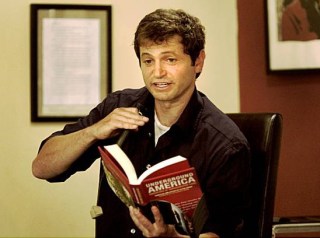
Cambridge Writers’ Workshop takes on AWP 2016 LA!

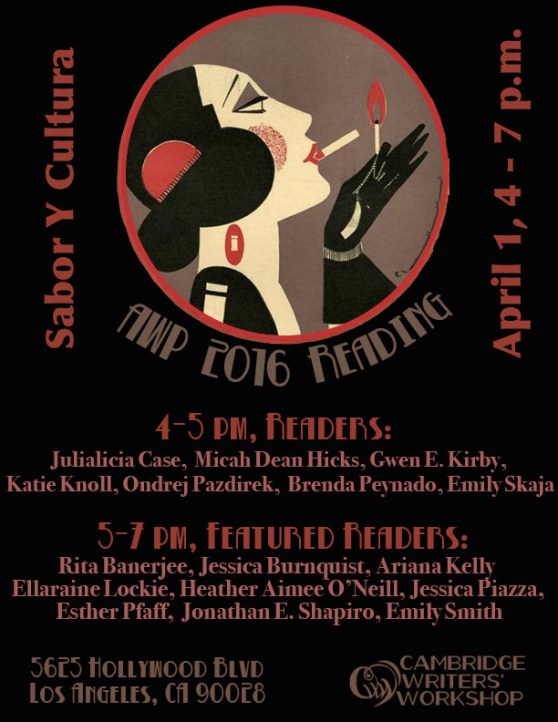
AWP2016Poster2

AWP16LAThe Cambridge Writers’ Workshop is coming to Los Angeles for the AWP Conference (March 30 – April 2, 2016)!! We’ve got some exciting plans for AWP, so anyone who is in Los Angeles for AWP should come see us.  Last year’s AWP  was a success with our bookfair table and reading at Boneshaker Books.

This year, you’ll be able to find us at Table 1157 and find information regarding our upcoming Spring in Newport, Rhode Island (April 22-25, 2016) Summer in Narbonne & Barcelona (July 18-26, 2016), and Summer in Granada, Spain (July  28-August 5, 2016) Writing Retreats. We’ll have updates on CREDO and information for those who want to become a member of the CWW or apply for internships.  We’ll also be hosting our AWP Reading: Cambridge Writers’ Workshop takes on Los Angeles! at Sabor y Cultura (located at 5625 Hollywood BlvdLos Angeles, CA 90028) on Friday, April 1, 2016 from 4-7 pm.  Our featured writers include Rita Banerjee, Jessica BurnquistJulialicia Case,  Micah Dean HicksAriana Kelly, Gwen E. KerbyKatie KnollEllaraine LockieHeather Aimee O’Neill,  Ondrej PazdirekBrenda Peynado, Esther Pfaff, Jessica PiazzaJonathan ShapiroEmily Smith, and Emily Skaja.

We hope to see you there!

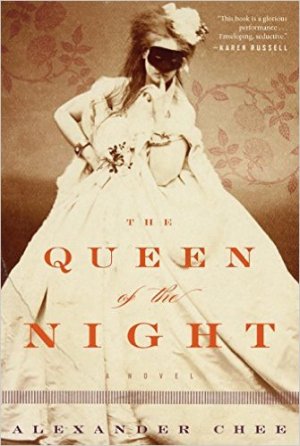
The Queen of the Night, new novel by CWW Fiction Faculty Alexander Chee, debuts Feb 2

QueenoftheNightCongratulations to novelist Alexander Chee, our featured fiction faculty member on our 2016 Summer in Granada Writing Retreat, for his new novel The Queen of the Night, which debuts in bookstores on February 2, 2016! Alexander Chee will be teaching during our Summer in Granada, Andalucía, Spain Writing Retreat (July 28-Aug 5, 2016).

Alexander Chee was born in Rhode Island, and raised in South Korea, Guam and Maine. He is a recipient of the 2003 Whiting Writers’ Award, a 2004 NEA Fellowship in Fiction, and residency fellowships from the MacDowell Colony, the VCCA, Ledig House, the Hermitage and Civitella Ranieri. His first novel, Edinburgh (Picador, 2002), is a winner of the Michener Copernicus Prize, the AAWW Lit Award and the Lambda Editor’s Choice Prize, and was a Publisher’s Weekly Best Book of the Year and a Booksense 76 selection.

In The Queen of the Night, Lilliet Berne is a sensation of the Paris Opera, a legendary soprano with every accolade except an original role, every singer’s chance at immortality. When one is finally offered to her, she realizes with alarm that the libretto is based on a hidden piece of her past. Only four could have betrayed her: one is dead, one loves her, one wants to own her. And one, she hopes, never thinks of her at all.

Read an excerpt from the first chapter of the novel below, and the full first chapter on Longreads:

“…I seemed a stranger to myself, a changeling placed here in my life at some point I couldn’t remem­ber, and the glass of the mirror at the entrance to the palace seemed made from the same amber of the dream that surrounded me, a life that was not life, and which I could not seem to escape no matter where I went or what I sang.

And so their celebration of me that night at the ball, sincere as it was, felt as if it were happening in the life neighboring mine, visible through a glass.

I tell you I was distracted, but it was much more than that. For I was also focused intensely, waiting for one thing and one thing only, my attention turned toward something I couldn’t quite see but was sure was there, coming for me through the days ahead. I’d had a premonition in accepting the role of Marguerite that, in returning to Paris this time, I would be here for a meeting with my destiny. Here I would find what would transform me, what would return me to life and make this life the paradise I was so sure it should be…”

Here is Chee reading an excerpt from the novel at Franklin Park Bar and Beer Garden in Crown Heights, Brooklyn.

Read more here. Join Alexander Chee for his talk at the PEN/Faulkner Reading Series at Bus Boy & Poets on February 11, 2016!

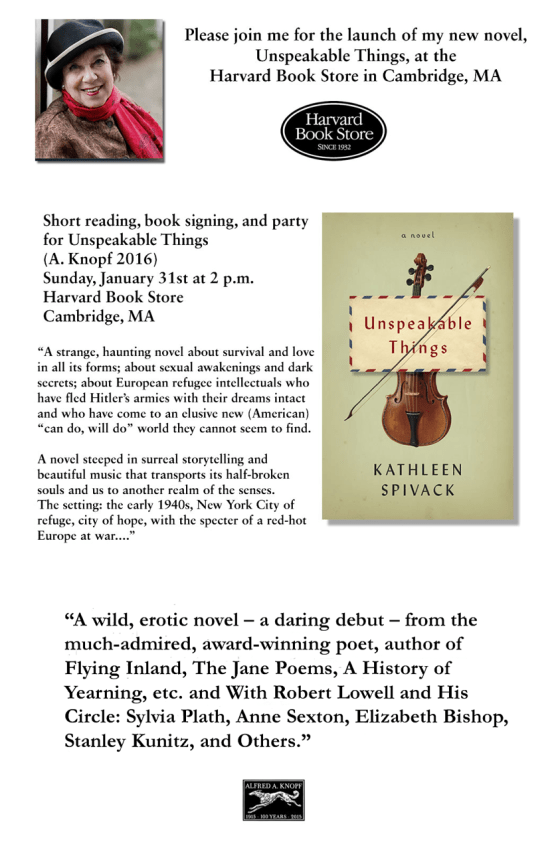
Kathleen Spivack Launches Novel at Harvard Book Store

harvardbook_final1.fw

Join Cambridge Writers’ Workshop faculty member Kathleen Spivack at the Harvard Book Store in Cambridge, MA for the launch of her new book Unspeakable Things. The short reading, book signing, and party will take place on Saturday, January 31 at 2 p.m.

6odLzoK-ReQPwOcvZbfWrdFOulc08fdeMOZ6m28nwOUKathleen Spivack is the author of A History of Yearning, winner of the Sows Ear International Poetry Prize 2010, first runner up in the New England Book Festival, and winner of the London Book Festival; Moments of Past Happiness(Earthwinds/Grolier Editions 2007); The Beds We Lie In (Scarecrow 1986), nominated for a Pulitzer Prize; The Honeymoon (Graywolf 1986); Swimmer in the Spreading Dawn (Applewood 1981); The Jane Poems (Doubleday 1973); Flying Inland (Doubleday 1971); Robert Lowell and His Circle (2011) and a novel, Unspeakable Things. She is a recipient of the Allen Ginsberg Poetry Award 2010, the 2010 Erica Mumford Award, and the 2010 Paumanok Award. Published in numerous magazines and anthologies, some of her work has been translated into French. Other publications include The New Yorker, Ploughshares, The Atlantic Monthly, Poetry, Massachusetts Review, Virginia Quarterly, The Southern Review, Harvard Review, The Paris Review, The Kenyon Review, Agni, New Letters, and others. Her work is featured in numerous anthologies. She has also won several International Solas Prizes for “Best Essays.”

New Fiction from Paris Retreat Participant G. Evelyn Lampart published in Poetica Magazine and in Rozlyn!

Poetica

The Cambridge Writers’ Workshop is proud to announce that one of our 2015 Summer in Paris Writing Retreat participants has had her work published in two new anthologies!  G. Evelyn Lampart recently had two short stories published in Poetica Magazine.  Her stories, “In Jerusalem” and “Be Careful,” are part of the Summer 2015 print edition of Poetica Magazine, a contemporary Jewish literature publication.

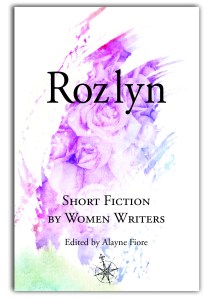
rozlyn-cover


G. Evelyn Lampart also has one of her short stories, “Next Year,” published in Rozlyn: Short Fiction by Women WritersThe Summer 2015 print edition of Poetica is currently sold out but Rozlyn: Short Fiction by Women Writers can be found here.

New Book by Paris Retreat Writer Jonathan De Young

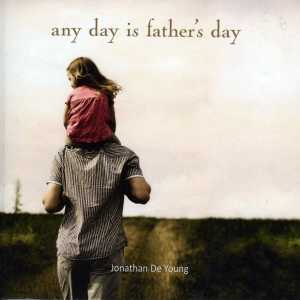
any-day-is-fathers-day book coverAbout Any Day is Father’s Day, Stephen Bloom writes, “A fun, encouraging read, infused with authenticity and humility.  Adventures that will make you smile and, if you’re a dad, knowingly nod your head in cheerful (or sometimes embarrassing) recognition.  Honest tales of real fathering from a guy who obviously loves and appreciates his kids, even in the trying moments.”

Jonathan De Young is the author of Any Day is Father’s DayYou Too Can Write Poetry (on iTunes), Writing Made Simple, and iGrammar.  He is working on a novel set in Paris, inspired by his time at the Cambridge Writers’ Workshop.

Recommended Reading: Celebrating the LGBT+ Community in Literature

In honor of the US Supreme Court’s decision on June 26 to legalize same-sex marriage in all 50 states, here are a few literary works that celebrate the lesbian, gay, bisexual, and transgender community. – Emily Smith, Curator

“Brokeback Mountain” appears as a short story in Annie Proulx’s Close Range: Wyoming Stories. It follows the sexual tension between two ranch hands, Ennis del Mar and Jack Twist, as they care for sheep at a seasonal grazing range. The two finally share an intense night in an isolated tent on the range, then carry on with their lives. Despite both marrying women and starting families, Ennis and Jack sporadically reunite over the course of twenty years. Reflecting on the story, Proulx mused that it explores the difference between who people think they are and what befalls them.


The fairy tale of Peter Pan is retold in Sassafras Lowrey’s Lost Boi – a world in which the orphaned, abandoned and runaways find common ground. Most importantly, the lost bois are trans* kids who were abandoned by their parents or by the failed social services system. In this retelling, Peter Pan is the savior of transgender children. Lowrey, a transgender author, has noted that the story works as part of the transgender civil rights movement in reclaiming mainstream and cultural touchstones.


In Nancy Garden’s controversial novel Annie on My Mind, Annie and Liza meet during a rainy day at the Metropolitan Museum of Art and instantly become friends. Though Liza goes to a private school in an upscale neighborhood and Annie attends a public school “far uptown,” the two grow close and eventually fall in love. Because the book was written for young adults and many copies reside in public school libraries, it is often criticized by parents. During one incident, copies of the book were actually burned; however, the novel is so popular that’s it’s never been out of print.


The Hours, a novel by Michael Cunningham, explores the lives of three different women in three different time periods who are affected by Virginia Woolf’s Mrs. Dalloway. The first is Woolf herself, the second is a closeted housewife reading Mrs. Dalloway in 1949, and the third is socialite and bisexual Clarissa Vaughan who plans a summer party in 2001. The story structure mimics Woolf’s famous stream-of-consciousness style in that the narratives of each woman often flow into each other in unpredictable ways.


Nightwood is a Modernist novel by Djuna Barnes and one of the first to ever explicitly portray gay sex. The story follows Robin Vote and the characters that fall in love with her: her husband Baron Felix Volkbein, as well as her lovers Nora Flood and Jenny Petherbridge. It becomes increasingly obvious throughout the novel that Robin will never settle down, instead radically favoring polyamory. Many of the characters often seek out advice from Matthew O’Connor, a transgender medical student who acts as more of a spiritual doctor than a physical one.


Truman Capote’s Other Voices, Other Rooms is a Southern Gothic that follows the life of Joel Harrison Knox and his experience on an isolated Mississippi plantation. Joel struggles to come to terms with his sexual identity, but finds acceptance to be a liberation and not a surrender.

In 1970, Audre Lorde published Cables to Rage, which featured one of her most famous poems: “Martha.” The poem detailed Lorde’s experience coming out as a lesbian and the recovery of a former lover following a car crash. In the poem, Martha’s family arrives and the narrator sends them away, since both women have sacrificed their traditional family lives to have a relationship with each other. The poem also appeared in Coal.

One of Gertrude Stein’s most notable works on sexuality is “Lifting Belly,” which originally appeared in Bee Time Vine and again in The Yale Gertrude Stein. The substantial poem was heralded as a “lesbian classic” and a gift to women who love women. The poem is most notable for its unabashed approach to lesbian eroticism; however, much of the poem consists merely of dialogue between two women.

Giovanni’s Room focuses on the life of an American man in Paris, especially his relationship with an Italian bartender named Giovanni who works at a gay bar. The tragedy, written by James Baldwin, is remembered by the narrator on the day that Giovanni is executed in France. The novel is often lauded for its complex examination of gay and bisexual men; Baldwin himself was an inspiring gay rights figure, since he was considered the leading literary voice of the civil rights movement.

The Dream of a Common Language is a collection of poetry written by poet and activist Adrienne Rich. The book was published in 1976 following Rich’s announcement that she identified as a lesbian; the second section, “Twenty One Love Poems,” addresses love between two women and the cultural need to recognize that love as valid. Rich’s poems also discuss the alienation and disintegration of lesbian relationships in a social climate that regards them as shameful.

The Munich Readery Presents “An Evening with Peter Orner” – June 30, 2015 * 8 – 9 pm

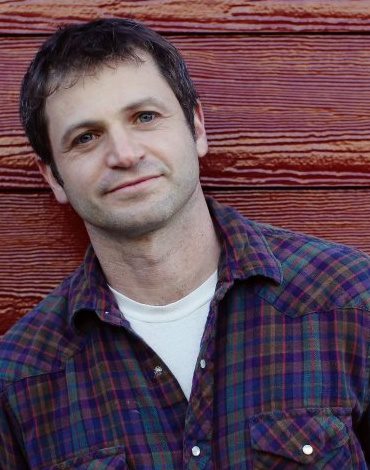
peter-ornerAn Evening with Peter Orner
Moderated by Rita Banerjee
The Munich Readery * 8 – 9 pm
Augustenstr. 104, Munich, Germany

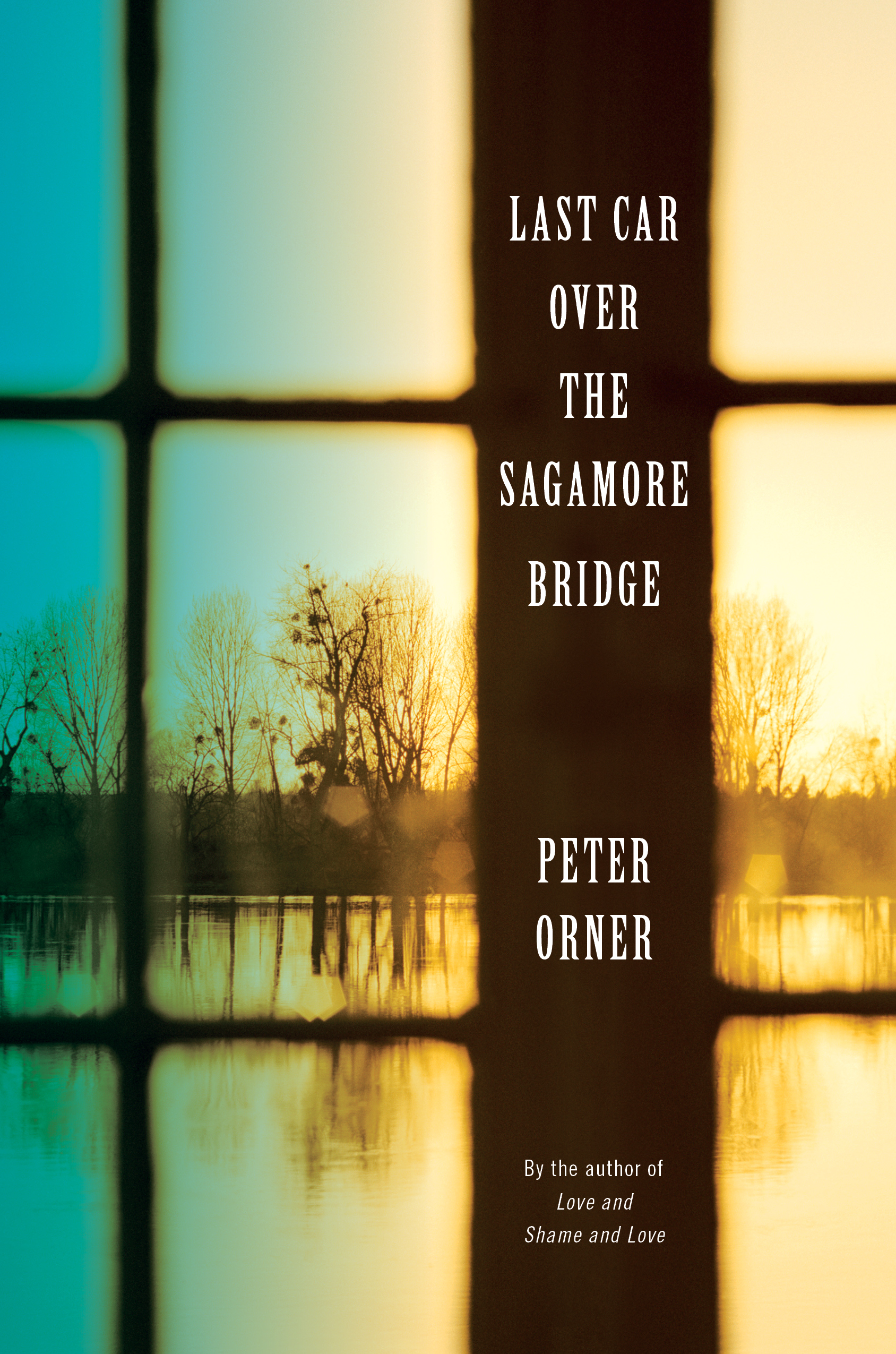
The Munich Readery is proud to host Guggenheim fellow and American fiction writer, Peter Orner on Tuesday June 30 for “An Evening with Peter Orner.”  Orner be reading from the novel Love and Shame and Love as well as from the story collection, Last Car Over the Sagamore Bridge.  “I am very happy about coming back to Munich, a city I’ve always admired for its sense of calm, its architecture, food, and kind people. It’s a city I also love to wander around in and have been happily lost on its streets a number of times….” – Peter Orner

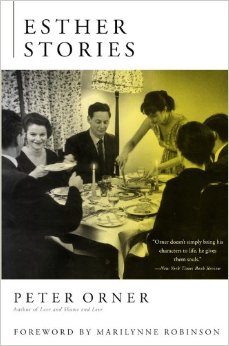
Peter Orner is an American writer and the author of four books of fiction. His first book, Esther Stories was a Finalist for the Pen Hemingway Award and Winner of the Rome Prize from the American Academy of Arts and Letters, and has been recently re-issued with a new introduction by Marilynne Robinson. His novel, The Second Coming of Mavala Shikongo, set in Namibia, has been translated widely, including in German by Hanser. Love and Shame and Love, Orner’s second novel, has also recently been published in German by Hanser. Orner’s most recent book, a collection of stories, Last Car Over the Sagamore Bridge was named a New York Times Editor’s Choice Book last year. Orner has also published two books of non-fiction, a book on immigration in the U.S. and another about political violence in Zimbabwe. Orner is a Guggenheim Fellowship recipient, and has taught at The University of Iowa Writers’ Workshop, Bard College, The University of Montana, and teaches in the MFA Program at San Francisco State University. He lives in Bolinas, California where he is a proud member of the Bolinas Volunteer Fire Department.

CWW Interview with Peter Orner, Novelist, Guggenheim Fellow, & Granada Instructor

peter-ornerThis year, the Cambridge Writers’ Workshop’s Summer Writing Retreat in Granada, Spain, will take place from August 3-10, 2015. At the event, we’ll be hosting a wide variety of craft of writing seminars, creative writing workshops, and special readings from our Granada 2015 faculty, which includes Peter Orner, Rita Banerjee, Diana Norma Szokolyai, Jessica Reidy, and Elissa Lewis. One of our featured faculty members is Peter Ornera novelist and short story writer and winner of a Guggenheim Fellowship. The Cambridge Writers’ Workshop’s Katy Miller sat down to speak with Peter for an interview. Read below to see the interview, and be sure to register for our Granada retreat by April 20!

KM: You’ve taught many writing courses from the Iowa Writers’ Workshop to Charles University in Prague to your current position at San Francisco State. Does teaching affect your own viewpoint of the writing process?

PO: It’s such an honor that people trust me with their stories, and this is something I’ve never taken for granted. While I’m pretty sure writing can’t be taught, being a part of a group of artists who care about literature is in itself a great and often inspiring gift. This is lonely work—I spend so much time alone, either at my desk or wandering around the city.

Teaching has always been a kind of tether to the lives of other people, and like I say I’m very grateful for it. It doesn’t make my own work go any easier but it does help to know that other people – students, colleagues, share the same challenges. We’re all trying to say what maybe can’t be said as best we can…

KM: “Compression” is a word that’s often used when discussing your stories. Do these stories usually start off as clean and short as they end up, or is there a lot of cutting down and revision that goes into them? 

PO: Really depends on the story, sometimes they do start off much longer and then I chip away and chip away. Other times, they come out in sort of one breath, if this makes any sense. I do think if a story or a novel for that matter can be any shorter, I will try and make it so. I don’t like to waste words.
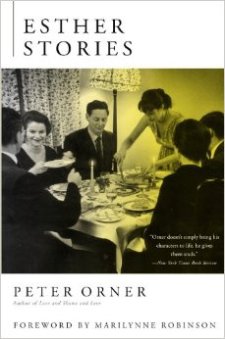
EstherStoriesKM: How would you compare your approach to writing the short story versus writing a novel or writing nonfiction?

PO: With a novel I settle in with my characters for the long haul—and I hope a reader will too. With a story I’m trying, in a sense, to grab onto a moment and hold steady for a bit. I want the moment to last longer, and for it to exist far beyond the page. Non-fiction is a whole different deal, and exciting in its own way. I spend so much time making stuff off, lying basically as a profession. There is something almost liberating about trying to hone as best I can to the truth.

KM: In Esther Stories and Last Car over the Sagamore Bridge, grief and pain in family relationships are recurring themes. What draws you to writing this subject matter?

PO: I think these are the stories that make us us. Our families, our griefs, our pain. Mixed in there, of course, is a great deal of joy and comedy. Got to have comedy. Funerals are always funnier to me than weddings. Am I alone here? And its strange, the comedy, the laughter, only makes the pain, the grief, the loss, more acute and vice versa.

KM: Geography is very present in your stories, from Fall River, Massachusetts to Nova Scotia. Do you begin a story from a sense or place? How do you typically choose a setting?

PO: Yes, I do start very often from place, a real place, and then I do my best to make a myth around that place. So it might be Fall River, or Namibia, or Chicago. I try to know as much as possible about the real place. Only then do I feel free to try to make my own fictional version of these real places.
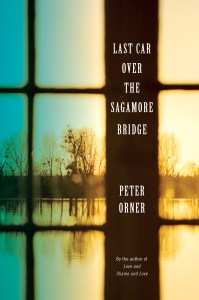
LastCarCoverKM: What made you decide to weave characters from your older works, like the Kaplans, into your newer works like Sagamore?

PO: Sometimes characters just keep talking to me. It’s weird, I think I’m done with a character, like when a character dies for instance. And then the next morning I wake up and that dead character is talking to me again as if I didn’t kill him off. In fiction, you can bring people back to life, which is nice.

KM: Your stories often capture deep emotion but don’t rely on melodrama. Do you have any tips for writing tragedy without drama?

PO: Don’t push anything, don’t try and sell it. Emotion doesn’t need to be sold. I find readers will go with you if you don’t tell them what to feel.

KM: What projects are you currently working on?

PO: Pretty busy with new work, a new fiction, longer stuff and shorter, and new non-fiction, this one set in Haiti.

KM: What kind of workshops do you plan to offer when you join us on our Granada, Spain retreat?

PO: I’m so looking forward to Granada. What an unusual place to write and read. I’m going to do a story writing workshop where participants will leave with a number of stories in progress, as well as a craft/ literature class that will focus on Spanish literature in English translation.

KM: What advice do you have for aspiring writers?

PO: You’ve got time. I’ve never met a writer who says I have enough time to write, but the fact is that you do. We all do. In spite of our lives, our jobs, our families, our responsibilities. Even just a few quiet minutes a day can take you deep into a story. Dawn is always a good time to do some work.
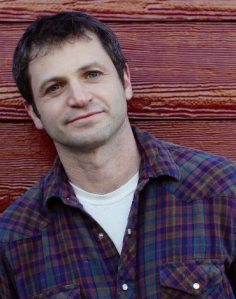
Peter OrnerPeter Orner is the Chicago-born author of two novels, Love and Shame and Love (Little, Brown 2011) and The Second Coming of Mavala Shikongo (Little, Brown, 2006) and two story collections, Esther Stories (Houghton Mifflin 2001/ Little, Brown 2013 with a forward by Marilynne Robinson) and Last Car Over the Sagamore Bridge (Little, Brown, 2013). Orner’s fiction and non-fiction has appeared in the New York Times, the Atlantic Monthly, Granta, The Paris Review, McSweeney’s, Tin House, and has been anthologized in Best American Stories and twice won a Pushcart Prize. Orner was awarded a Guggenheim Fellowship (2006), as well as the two-year Lannan Foundation Literary Fellowship (2007-2008). He is also the editor of two books of non-fiction from McSweeney’s/ Voice of Witness, one about immigration in the U.S., and the other about Zimbabwe, and is currently working on a new volume set in Haiti. A film version of one of Orner’s stories, “The Raft” with a screenplay by Orner and the film’s director, Rob Jones, is currently in production and stars Ed Asner. He has also been awarded the Rome Prize from the American Academy of Arts and Letters, the Goldberg Prize for Jewish Fiction, the California Book Award, and the Bard Fiction Prize. Orner has taught at the University of Iowa Writers’ Workshop, the University of Montana, Bard College, and is currently a professor in the MFA program at San Francisco State University as well as a member of the fiction faculty at Warren Wilson College. He lives in Bolinas, California where he’ also a member of the volunteer fire department. 
Register for CWW Summer Writing Retreat in Granada, Andalucía, Spain by May 1!

GranadaPoster2015May1Deadline

apply

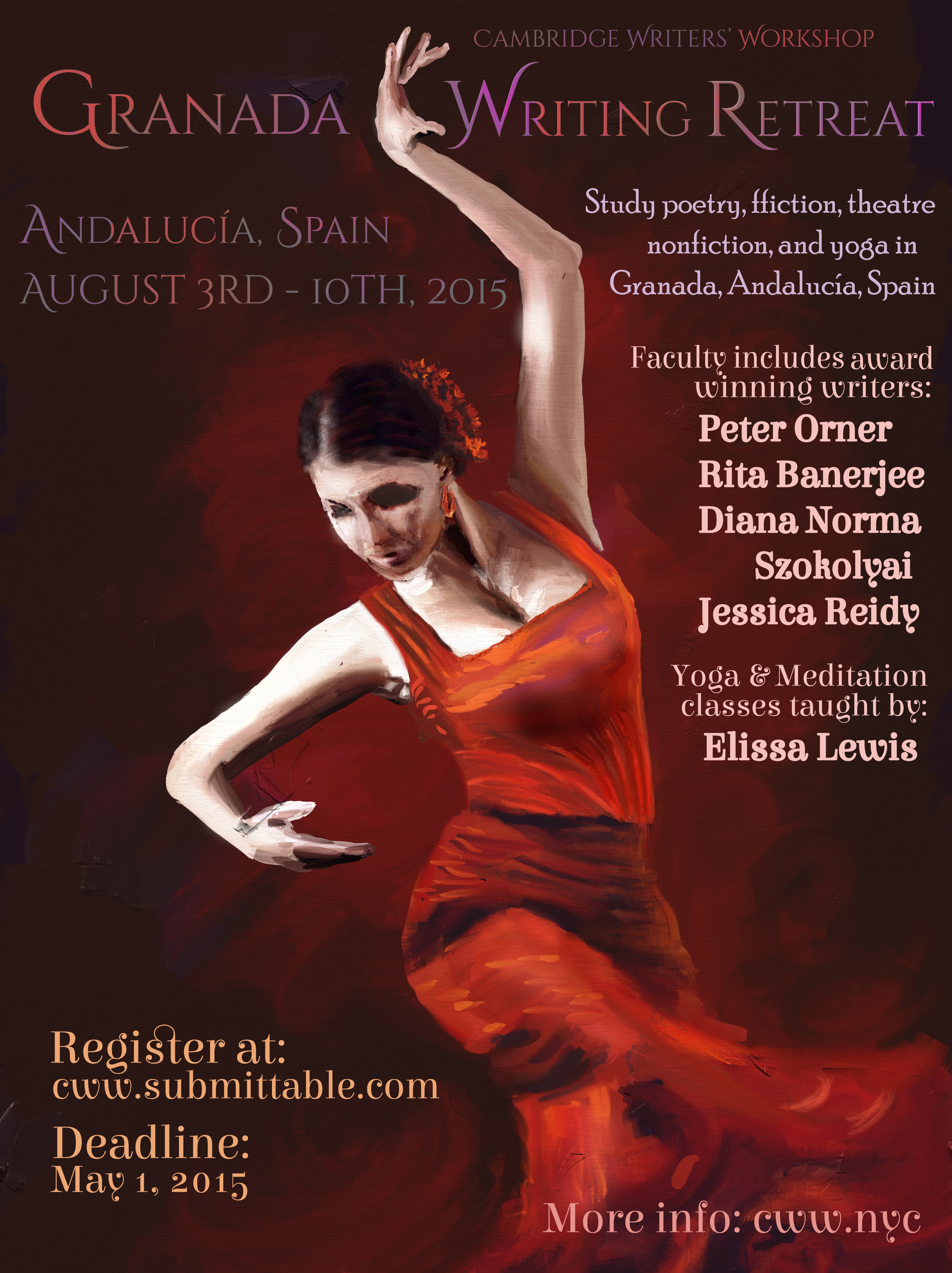
Join the Cambridge Writers’ Workshop on our summer writing & yoga retreat to the cultural oasis of Granada, Spain. Located at the foot of the Sierra Nevada mountains in Andalucía, Granada is one of the gems of Spain and has inspired writers from Washington Irving to Salman Rushdie to Ali Smith. Let the old city stimulate your writing with its winding streets, Moorish history, and evocative landscapes. Or, indulge in delicious Andalucían cuisine and traditional Arab baths. Work on your existing manuscript, or look to the beauty and warmth of Granada to inspire all-new projects.

The retreat offers the opportunity for writers of all genres and levels to work alongside award-winning authors & editors to hone their craft and expand their writing skills, while working on new or existing projects. Our Andalucían writing retreat will take place from August 3-10, 2015, and the cost of the workshop is $2950, which includes lodging, craft of writing seminars and writing workshops, yoga classes, room cleaning, and breakfast. Optional add-ons include reiki healing and aromatherapy sessions.

The retreat will be held at Hotel Guadalupe on Paseo de la Sabica in Granada, Spain.

Faculty includes Peter Orner (fiction, nonfiction), Rita Banerjee (poetry, fiction), Diana Norma Szkoloyai (poetry, nonfiction), Jessica Reidy (fiction, poetry) and Elissa Lewis (yoga, meditation).

If you’d like to join us in Granada, please apply online at cww.submittable.com by May 1, 2015, and include $5 application screening fee and a 5-page writing sample. (Due to limited seats, early applications are encouraged, but check for rolling admission after deadline, depending on availability).

applyDeadline: May 1, 2015

Featured Faculty:

Peter OrnerPeter Orner Chicago born Peter Orner’s fiction and non-fiction has appeared in the New York Times, the Atlantic Monthly, Granta, The Paris Review, McSweeney’s, The Southern Review, The Forward, The San Francisco Chronicle, and Ploughshares. Stories have been anthologized in Best American Stories and twice won a Pushcart Prize. Orner was awarded a Guggenheim Fellowship (2006), as well as the two-year Lannan Foundation Literary Fellowship (2007-2008). A film version of one of Orner’s stories, “The Raft” with a screenplay by Orner and the film’s director, Rob Jones, is currently in production and stars Ed Asner.  Esther Stories (Houghton Mifflin/​ Mariner, 2001) was awarded the Rome Prize from the American Academy of Arts and Letters, the Goldberg Prize for Jewish Fiction, and was a Finalist for the Pen Hemingway Award and the New York Public Library’s Young Lions Award. Esther Stories was a 2001 New York Times Notable Book.

RBRita Banerjee is a writer, and received her PhD in Comparative Literature from Harvard University. She holds an MFA in Poetry and her writing has been published in Poets for Living Waters, The New Renaissance, The Fiction Project, Jaggery, The Crab Creek Review, The Dudley Review, Objet d’Art, Vox Populi, Dr. Hurley’s Snake-Oil Cure, and Chrysanthemum among other journals. Her first collection of poems,Cracklers at Night, was published by Finishing Line Press in 2010 and received First Honorable Mention for Best Poetry Book at the 2011-2012 Los Angeles Book Festival. Her novella, A Night with Kali, was digitized by the Brooklyn Art-house Co-op in 2011. She is a co-director of the Cambridge Writers’ Workshop, and her writing has been recently featured on HER KIND by VIDA: Women in Literary Arts and on KBOO Radio’s APA Compass in Portland, Oregon.

DianaNormaDiana Norma Szkoloyai is author of the poetry books Roses in the Snow and Parallel Sparrows (Finishing Line Press). Her writing and hybrid art have appeared in Lyre Lyre, Dr. Hurley’s Snake Oil Cure, The Fiction Project, Teachers as Writers, Polarity, The Boston Globe, The Dudley Review, Up the Staircase, Area Zinc Art Magazine, Belltower & the Beach, and Human Rights News. Founding Literary Arts Director of Chagall Performance Art Collaborative and co-director of the Cambridge Writer’s Workshop, she holds an Ed.M from Harvard and an M.A. in French Literature from the University of Connecticut.

25ugmblJessica Reidy earned her MFA in Fiction at Florida State University and a B.A. from Hollins University. Her work is Pushcart-nominated and has appeared in Narrative Magazine as Short Story of the Week, The Los Angeles Review, Arsenic Lobster, and other journals. She’s a staff-writer and the Outreach Editor for Quail Bell Magazine, Managing Editor for VIDA: Women in the Literary Arts, Art Editor for The Southeast Review, and Visiting Professor for the Cambridge Writers’ Workshop retreats. She teaches creative writing and is a certified yoga instructor and Reiki Master. Jessica also works her Romani (Gypsy) family trades, fortune telling, energy healing, and dancing. Jessica is currently writing her first novel set in post-WWII Paris about Coco Charbonneau, the half-Romani burlesque dancer and fortune teller of Zenith Circus, who becomes a Nazi hunter. You can learn more at www.jessicareidy.com.

ElissaLewisElissa Lewis is the Yoga & Arts Coordinator of the Cambridge Writers’ Workshop.  She began her journey with yoga in 2006, when she moved to France and made the practice part of her daily routine. She saw yoga as a lifestyle, not only a class, helping her to clear her mind and have more compassion for herself and others. In 2010 she moved to New York and completed her teacher training at Laughing Lotus, a creative, soulful yoga studio that teaches the student to ‘move like yourself.’ She’s taught private and group classes in Manhattan and Brooklyn ever since. Visit her website for informative yoga sequences and information.

Cambridge Writers’ Workshop at AWP 2015 Recap!

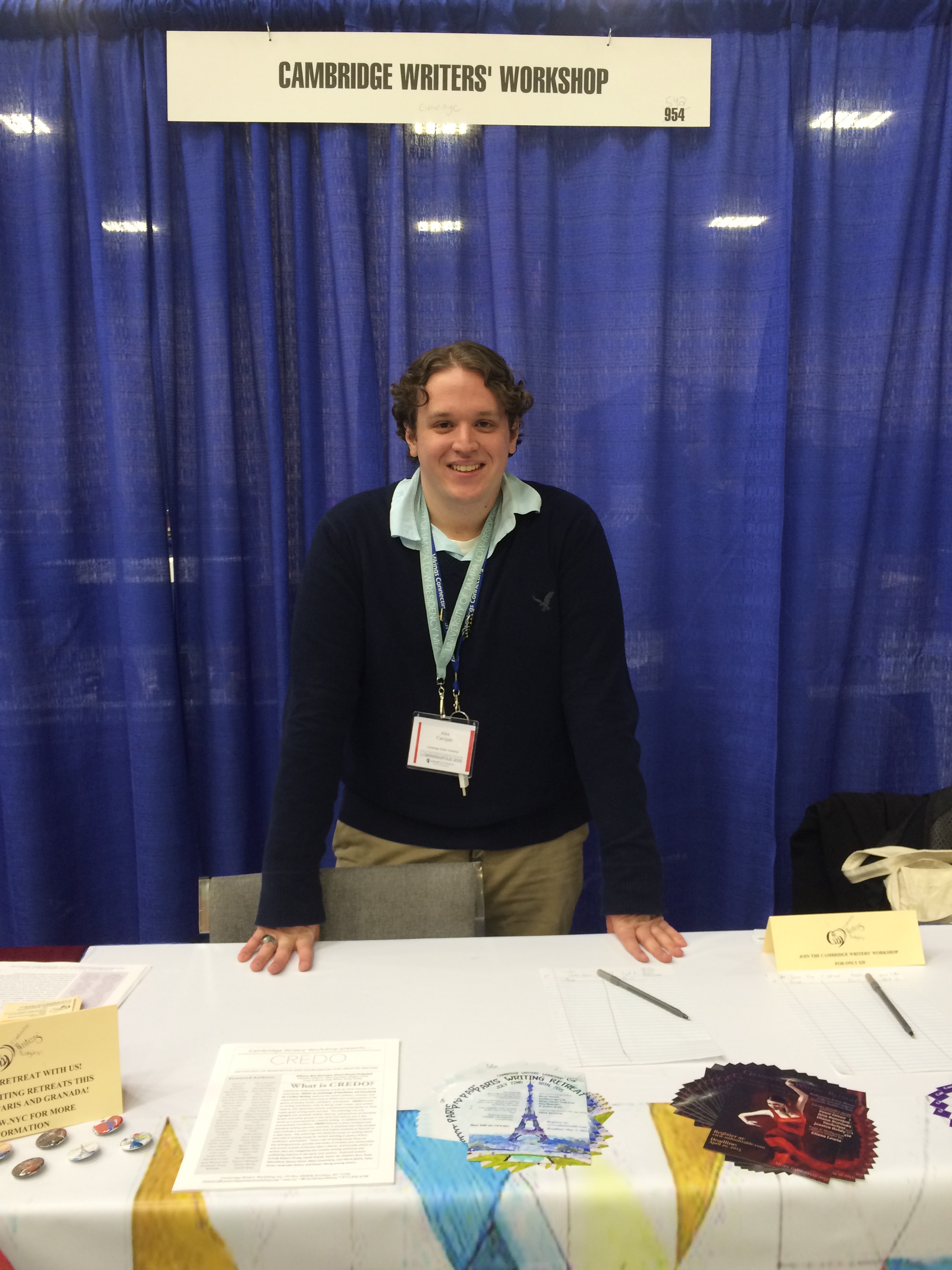
CWW Intern Alex Carrigan manning the booth at AWP 2015.

From April 9-11, the Cambridge Writers’ Workshop was present at the Association of Writers and Writing Programs 2015 conference in Minneapolis, MN. Our organization was there with multiple goals in mind, from promoting our CREDO anthology to presses at the event to advertising our summer retreats in Paris and Granada. Our group was fortunate enough to be upgraded from a table to a full booth, giving us more room to work with and allowing visitors to see more of our materials and programs. Visitors were able to take flyers, CWW buttons, and even contribute to our daily exquisite corpse poems.

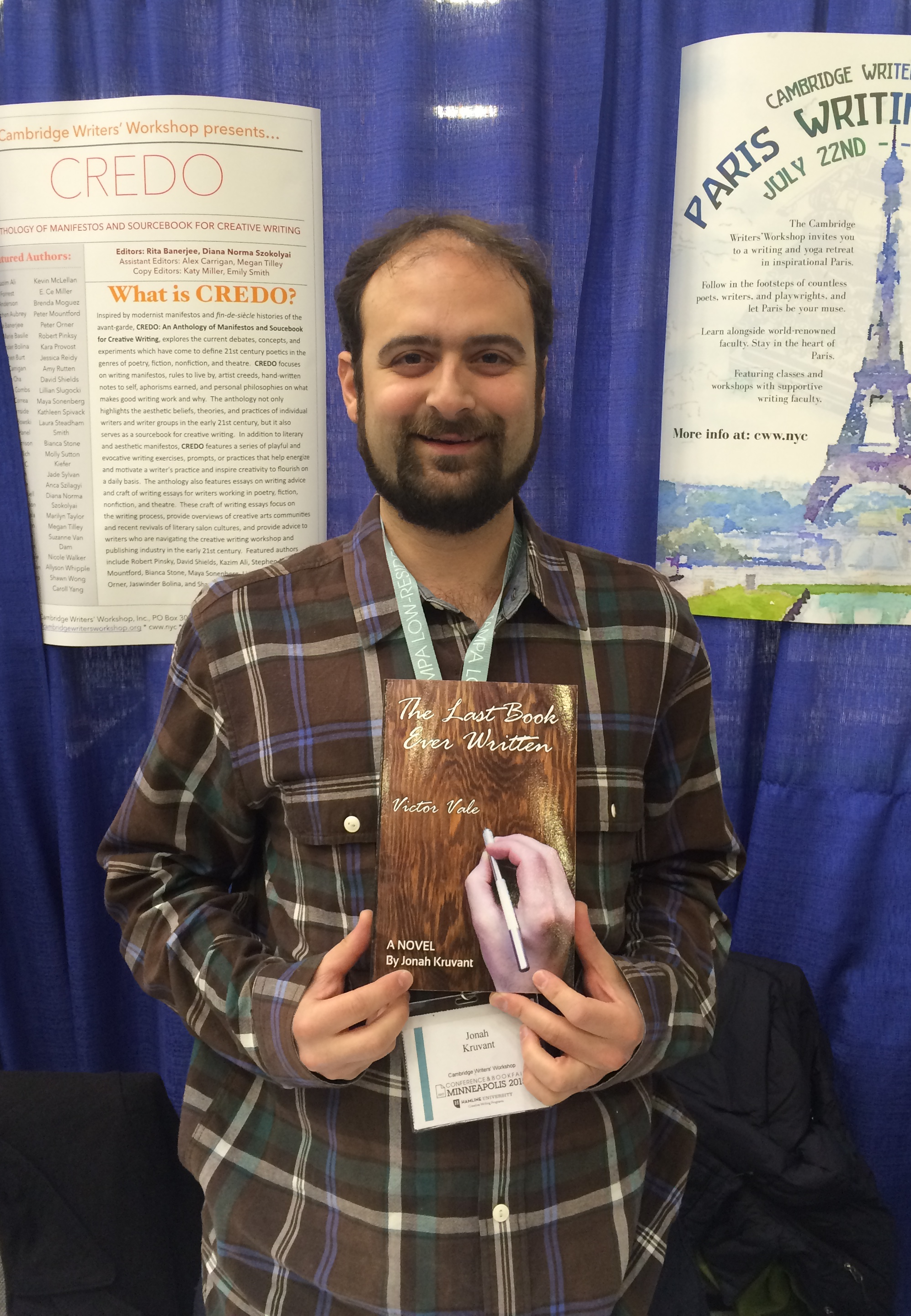
CWW Exec Board member Jonah Kruvant sold his new book, “The Last Book Ever Written,” at our booth.

Our staff for the event included CWW intern Alex Carrigan, who helped set the booth up and ran around networking with various publishers and presses. Executive Board member Jonah Kruvant was also at our table on Friday and Saturday. At the table, Kruvant sold and signed his new book, The Last Book Ever Writtena dystopian satire just released from PanAm Books.

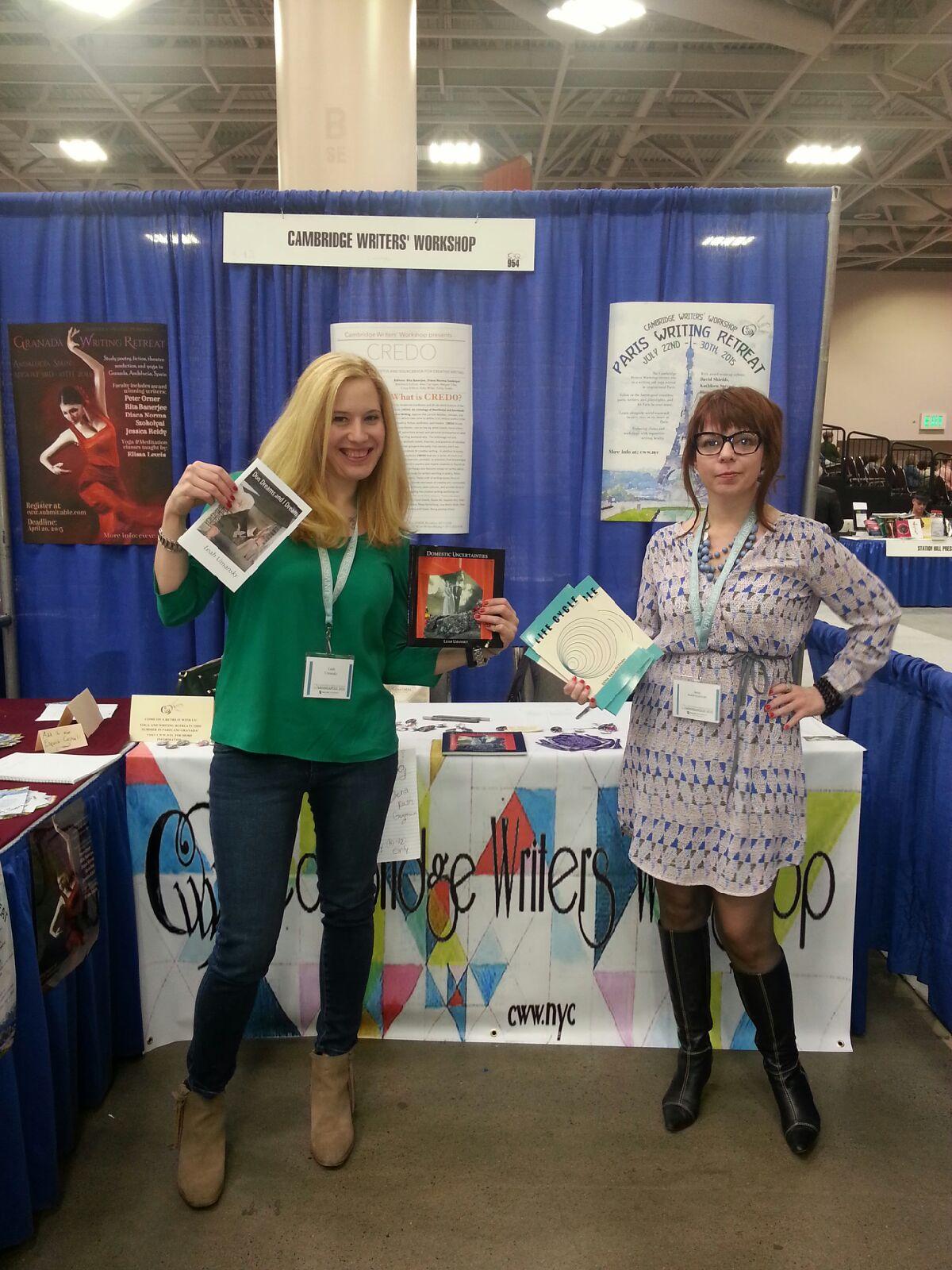
Dena Rash Guzman and Leah Umansky, friends of the CWW, also were also present at our table for selling and signing their works. Umansky sold her Mad Men inspired chapbook, Don Dreams and I Dream, along with her book Domestic Uncertainties. Guzman was there with her poetry collection called Life Cycle, and both authors promoted the CWW-sponsored reading on Saturday.

Leah Umansky and Dena Rash Guzman signed their works at our table on Friday.

Leah Umansky and Dena Rash Guzman signed their works at our table on Friday.

On Saturday, the CWW headed over to Boneshaker Books for our scheduled reading “Books and Bones at Boneshaker Books.” The event featured twelve readers. Along with Carrigan, Kruvant, Guzman, and Umansky, readers included Anca Szilagyi, Micah Dean Hicks, Michele Nereim, Bianca Stone, Jessica Piazza, Jess Burnquist, Sheila McMullin, and Brenda Peynado. The two hour reading featured a great mix of poetry, short fiction, and book excerpts.

We had a great time at AWP, and we can’t wait to see you next year at AWP 2016 in Los Angeles!