Happy New Year 2017! -♥️- Cambridge Writers’ Workshop

happynewyear2017-cwwHappy New Year 2017 from the directors, staff, and board of the Cambridge Writers’ Workshop!  We hope you’re all as excited for 2017 as we are!  We’re planning a delightful, productive year for our writers and artists with plenty of opportunities to travel, write, practice yoga, and network, and we’re looking forward to seeing you at our retreats, workshops, readings, and literary fest events in 2017!

The Cambridge Writers’ Workshop had a wonderful year in 2016.  Over the last twelve months, we’ve had a chance to hold retreats and readings across America and the world, meet exciting writers and artists, and have found new ways to inspire our own writing.  Our year began with  the 2016 Association of Writers and Writing Programs Conference in Los Angeles, California. At AWP 2016, we got a chance to promote CREDO: An Anthology of Manifestos & Sourcebook for Creative Writing, advertise our new literary internships, and discuss our Summer Writing Retreats in Granada, Spain, Barcelona, Spain, and Narbonne, France, as well as our Spring Writing Retreat in Newport, Rhode Island. We also hosted our third AWP event at Sabor y Cultura. At our event, there were featured readings from authors such as Rita BanerjeeJess BurnquistJulialicia CaseAriana KellyGwen E. KirbyKatie KnollEllaraine LockieOndrej PazdirekHeather Aimee O’NeillBrenda Peynado, Esther Pfaff, Jessica PiazzaJonathan ShapiroEmily Skaja, and Emily Smith.

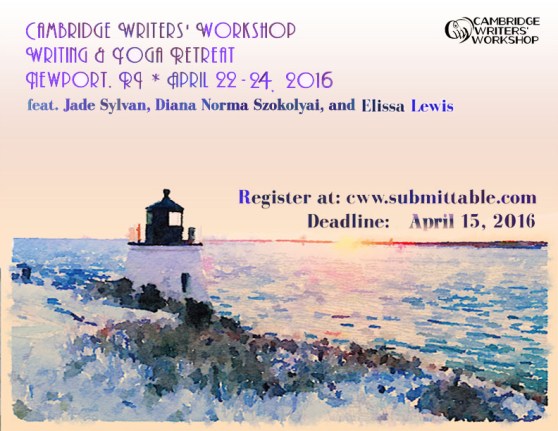
After AWP 2016, we were off to our second annual Spring Writing Retreat in Newport, Rhode Island. We were joined by award-winning and internationally-renowned authors such as Jade SylvanDiana Norma Szokolyai, and CWW yoga instructor Elissa Lewis. The event was a chance for writers to spend a long weekend in historic Newport and near the beach, participating in writing workshops (such as Sylvan’s workshops on “writing yourself naked”) and craft of writing seminars, yoga classes, and cultural tours of the historic Newport village. We live blogged the entire event as well, sharing dozens of photos from our trip while also allowing our writers to share their thoughts on the experience.

During the summer we hosted our Summer in Granada and Summer in Barcelona and Narbonne Writing Retreats. In Barcelona and Narbonne, we explored the cities and all of their historical, literary, and romantic charm. The retreat included craft of writing seminars and creative writing workshops, literary tours of the cities, and one-on-one manuscript consultations. We were also joined by writer and professor Bret Anthony Johnston and literary editor Heidi Pitlor. CWW directors Rita Banerjee and Diana Norma Szokolyai taught workshops on spacial poetics and world building, and also led workshops for participants to share their work and use the Liz Lerman method for critiquing writing. We live blogged our retreat on our website, so be sure to check out the sights and classes from our trip. We were really happy to experience this with all of our participants, who traveled from all over to come write and explore these cities with us.

In Granada, wrote in the city’s winding streets, absorbed its Moorish history, and were inspired by its evocative landscapes. The retreat included craft of writing seminars and writing workshops and yoga classes. We were joined by novelist Alexander Chee and poet and activist Frederick-Douglas Knowles II, who taught classes on historical fiction and hip-hop and poetry, respectively. Rita Banerjee led workshops on narrative stakes and emotion and suspense. We also live blogged this trip, so you can see all the exciting things we did on this trip.

We also hosted creative writing workshops and craft of writing seminars at The Cambridge Center for Adult Education throughout the fall. In addition to Rita Banerjee and Diana Norma Szokolyai, we were joined by Jade Sylvan and Cambridge writer Laura van den Berg for creative writing workshops and craft of writing seminars every other weekend in Cambridge, MA. This is something we hope to repeat this year, and we hope we can bring in new faculty and participants as well.

We hosted a Brooklyn Bookend Reading at Molasses Books during The Brooklyn Book Festival. Some of the writers had emerged onto the literary scene with a bang, while others had recently published their first or second books, and had received prestigious awards in the past. The event featured Stephen AubreyRita BanerjeeMadeleine BarnesEllaraine LockieBen PeaseAnne Malin Ringwalt, Kate McMahon, Emily SmithBianca Stone, and Diana Norma Szokolyai, along with a beautiful interludes of music from accomplished songwriters Erica Buettner and Elizabeth Devlin.

We also hosted a literary crawl event during Lit Crawl NYC 2016. Our Literary Vaudeville event featured performances and readings from Rita Banerjee, Diana Norma Szokolyai, Megan Fernandes, Claire Ince, Emily Smith, Christina M. Rau, and Frederick-Douglass Knowles II.

In 2016, we welcomed our second round of interns to the Cambridge Writers’ Workshop, and these interns include the wonderful AM Ringwalt, Anna-Celestrya Carr, Erynn Porter, and Shannon Sawyer, all of whom have helped the CWW greatly this year. They’ve helped manage our social media and written up posts about our events, shown their talent for graphic design, grant writing, audio/visual media development and corresponding with writers and hosts in French, Spanish, and English, and have provided much valuable assistance on our retreats and literary events this year.  We’re excited to have, on our team, and we can’t wait to show you what they’ve helped us plan for 2016!

* * *

While 2016 proved to be a very exciting year for all of us, our staff is quite ready to move on to our next round of exciting events. The CWW will once again table at AWP in Washington DC from February 8-February 10, 2017, and will be announcing our AWP Reading in downtown Los Angeles shortly!

neworleans2017posterwcThe Cambridge Writers’ Workshop Spring in New Orleans Writing Retreat will take place from March 23-26, 2017, and will coincide with the Tennessee Williams Literary Festival.  Known for its Spanish and French architecture, live jazz, cajun food, and street festivals, New Orleans offers an inspirational and one-of-a-kind environment for creative writers. During the retreat, we will be staying in the lovely Algiers Point neighborhood, just a short ferry ride away from the Historic French Quarter.  Our retreat features multi-genre workshops, as well as craft seminars and time to write.  The faculty includes award-winning writers Dipika Guha, Emily Nemens, Rita Banerjee, and Diana Norma Szokolyai. Genres include playwriting, nonfiction, fiction, and poetry.
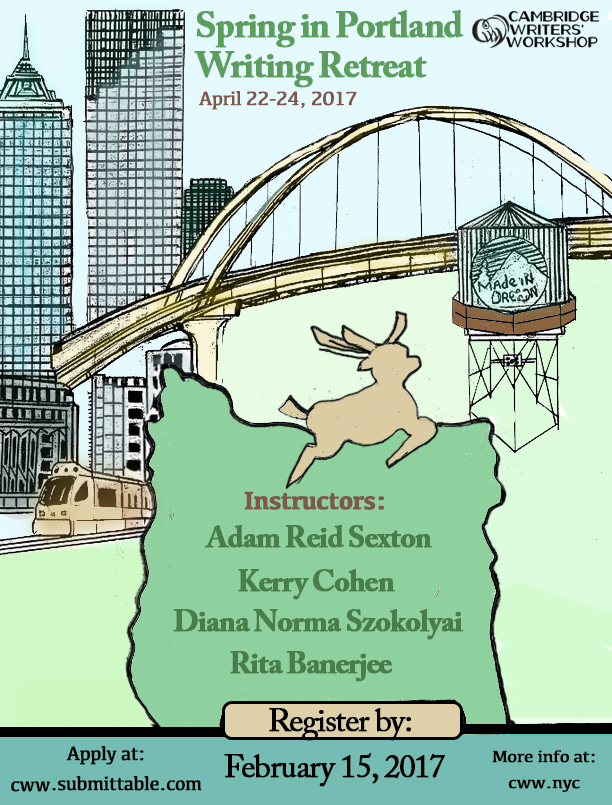
portland2017posterThe Cambridge Writers’ Workshop Spring in Portland Writing Retreat will take place from April 22-24, 2017.  While you’re in the home of writers Cheryl Strayed and Ursula K. Le Guin, feel free to go bicycling and explore the terrain, hike, or relax at local cafes for people watching—no matter how you choose to spend your time, this city is full inspiration. We will be staying in the Alberta Arts District during the retreat, an area that is sure to inspire our participants and help them create.  The retreat offers multi-genre workshops, as well as craft seminars and time to write. The faculty includes award-winning writers Adam Reid Sexton, Kerry Cohen, Rita Banerjee, and Diana Norma Szokolyai. Genres include fiction, nonfiction, and poetry.
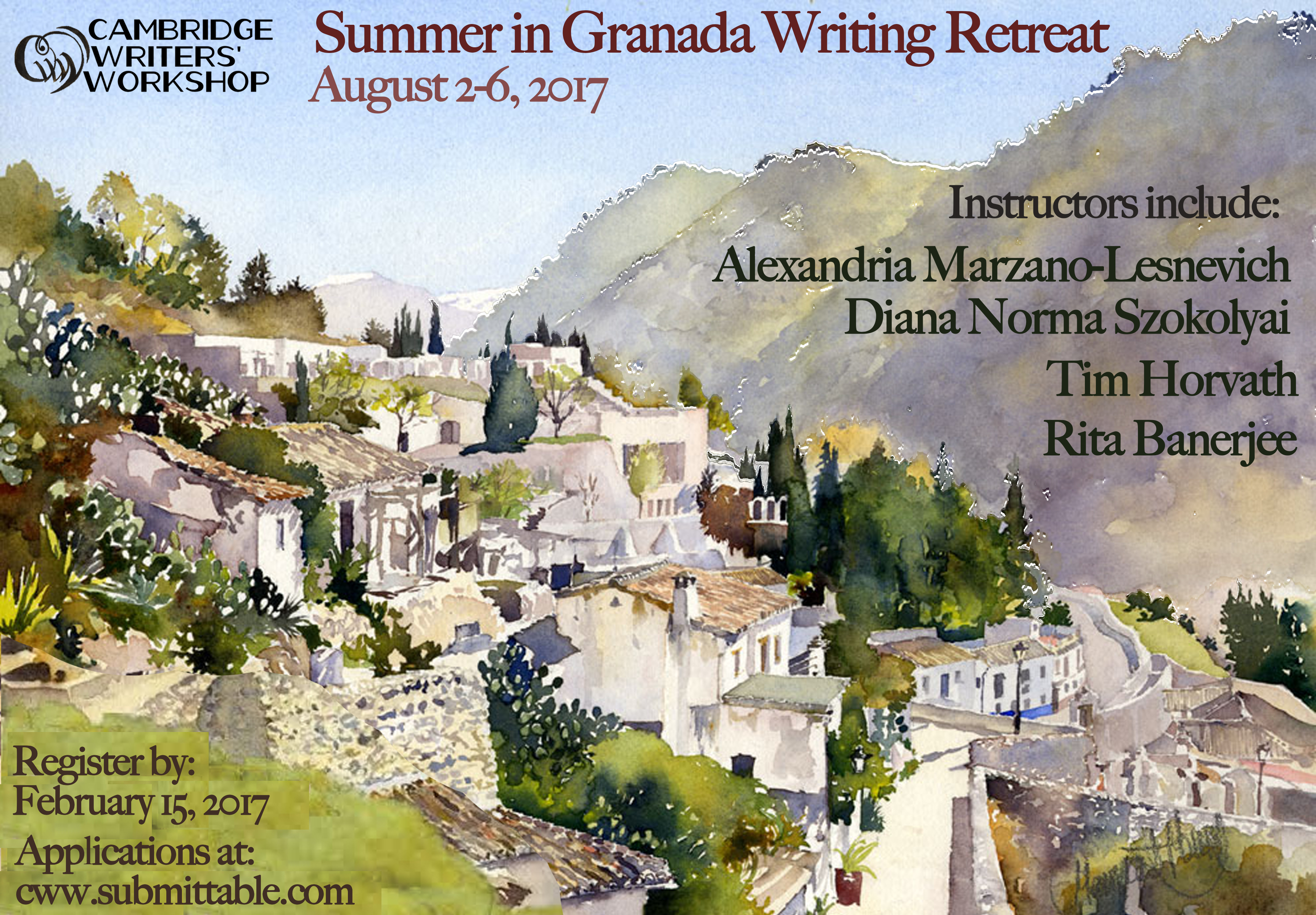
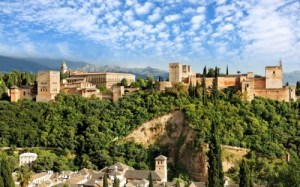
granada2017posterAnd the Cambridge Writers’ Workshop Summer in Granada Writing Retreat will take place from August 2-6, 2017.  Located at the foot of the Sierra Nevada mountains in Andalucía, Granada is one of the gems of Spain and has inspired writers from Washington Irving to Salman Rushdie to Ali Smith. Let the old city stimulate your writing with its winding streets, Moorish history, and evocative landscapes.  Work on your existing manuscript, or look to the beauty and warmth of Granada to inspire all-new projects.  During the retreat, we will be staying at the Hotel Guadalupe, just a short walk from the Alhambra.  The retreat offers multi-genre workshops, as well as craft seminars and time to write. The faculty includes award-winning writers Tim Horvath, Alexandria Marzano-LesnevichRita Banerjee, and Diana Norma Szokolyai. Genres include fiction, nonfiction, and poetry.

We hope you are all as excited for our 2017 events as we are. If you have any questions we may not have answered, you can email us at info@cambridgewritersworkshop.org, and for inquiries, please email the CWW Directors, Rita Banerjee and Diana Norma Szokolyai, at directors@cambridgewritersworkshop.org.  You can also follow us on FacebookTumblr, and Twitter for more information and updates on any of these events. We look forward to making 2017 a year full of creativity, writing, and renewal, so join us as we make 2017 rock!

— Alex Carrigan, CWW Managing Intern

Applications for Cambridge Writers’ Workshop Spring & Summer 2017 Retreats Open!

The Cambridge Writers’ Workshop is delighted to announce our upcoming Spring and Summer 2017 Writing Retreats.

The Cambridge Writers’ Workshop Spring in New Orleans Writing Retreat will take place from March 23-26, 2017, and will coincide with the Tennessee Williams Literary Festival.  Known for its Spanish and French architecture, live jazz, cajun food, and street festivals, New Orleans offers an inspirational and one-of-a-kind environment for creative writers. During the retreat, we will be staying in the lovely Algiers Point neighborhood, just a short ferry ride away from the Historic French Quarter.  Our retreat features multi-genre workshops, as well as craft seminars and time to write.  The faculty includes award-winning writers Dipika Guha, Emily Nemens, Rita Banerjee, and Diana Norma Szokolyai. Genres include playwriting, nonfiction, fiction, and poetry.  The cost of the retreat is $750, which includes tuition, lodging, and some meals.

The Cambridge Writers’ Workshop Spring in Portland Writing Retreat will take place from April 22-24, 2017.  While you’re in the home of writers Cheryl Strayed and Ursula K. Le Guin, feel free to go bicycling and explore the terrain, hike, or relax at local cafes for people watching—no matter how you choose to spend your time, this city is full inspiration. We will be staying in the Alberta Arts District during the retreat, an area that is sure to inspire our participants and help them create.  The retreat offers multi-genre workshops, as well as craft seminars and time to write. The faculty includes award-winning writers Adam Reid Sexton, Kerry Cohen, Rita Banerjee, and Diana Norma Szokolyai. Genres include fiction, nonfiction, and poetry.  The cost of the retreat is $750, which includes tuition, lodging, and some meals.

granada2017poster

And the Cambridge Writers’ Workshop Summer in Granada Writing Retreat will take place from August 2-6, 2017.  Located at the foot of the Sierra Nevada mountains in Andalucía, Granada is one of the gems of Spain and has inspired writers from Washington Irving to Salman Rushdie to Ali Smith. Let the old city stimulate your writing with its winding streets, Moorish history, and evocative landscapes.  Work on your existing manuscript, or look to the beauty and warmth of Granada to inspire all-new projects.  During the retreat, we will be staying at the Hotel Guadalupe, just a short walk from the Alhambra.  The retreat offers multi-genre workshops, as well as craft seminars and time to write. The faculty includes award-winning writers Tim Horvath, Alexandria Marzano-LesnevichRita Banerjee, and Diana Norma Szokolyai. Genres include fiction, nonfiction, and poetry.  The cost of the retreat is $2950, which includes tuition, lodging, and daily breakfast.

Writers are welcome to register for all retreats at cww.submittable.com by the early deadline of February 15, 2017!

applyDeadline: February 15, 2017

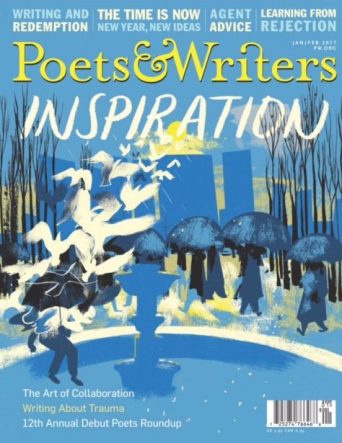
Rita Banerjee’s essay, “Emotion and Suspense: The Essence of Rasa Theory,” now available in Poets & Writers Magazine

Rita Banerjee‘s essay, “Emotion and Suspense: The Essence of Rasa Theory” now appears in the January/February 2017 Inspiration Issue of Poets & Writers Magazine.  An excerpt from the article follows below:

“Rasa theory centers on taste. Not taste in the sense of sophistication or composure or discernment. Not taste in the sense of good or bad. But taste in its most primal, animalistic, emotive, and provocative form.

Rasa is what happens to you, spectator, reader, part-time lover, when you watch or read a work of art with intensity. Rasa is the flavor of the art experience. It is the feeling produced in the viewer when a work of art is at its most potent and devastating form. Rasa is the immediate, unfettered emotional reaction produced in the spectator when a work of art has left her breathless or yearning for more. Rasa means to savor, to bring a work of art within the body, to let words linger on the tongue. Rasa is a shot to the heart, it’s a festering wound, it’s the mind at unrest, and it is nobody’s captive. It can be dangerous. It can be pleasurable. A visceral form of taste, rasa tends to resist cultivation and containment. Rasa is what happens to you when you find yourself spellbound and alone, and completely enraptured by a work of art for just a moment. It’s where the emotional, narrative, and lyrical landscape of a work washes over, prickles, or consumes you. It’s the moment where you loose yourself and loosen, and find in your body the first stirrings of emotion…”

To read the full article, please check your local bookstores for the current issue of Poets & Writers Magazine or visit Poets & Writers here.

New Faculty Announced for the Cambridge Writers’ Workshop

The Cambridge Writers’ Workshop is delighted to announce our new faculty members for our upcoming Spring and Summer 2017 Writing Retreats.  The Cambridge Writers’ Workshop Spring in New Orleans Writing Retreat will take place from March 23-26, 2017, and will coincide with the Tennessee Williams Literary Festival.  The faculty includes award-winning writers Dipika Guha, Emily Nemens, Rita Banerjee, and Diana Norma Szokolyai. Genres include playwriting, nonfiction, fiction, and poetry.

The Cambridge Writers’ Workshop Spring in Portland Writing Retreat will take place from April 22-24, 2017.  The faculty includes award-winning writers Adam Reid Sexton, Kerry Cohen, Rita Banerjee, and Diana Norma Szokolyai. Genres include fiction, nonfiction, and poetry.  The Cambridge Writers’ Workshop Summer in Granada Writing Retreat will take place from August 2-6, 2017.  The faculty includes award-winning writers Tim Horvath, Alexandria Marzano-LesnevichRita Banerjee, and Diana Norma Szokolyai. Genres include fiction, nonfiction, and poetry.

Writers are welcome to register for all retreats at cww.submittable.com by the early deadline of February 15, 2017!  We are delighted to work with a talented group of poets, playwrights, essayists, and fiction writers during our Spring and Summer 2017 Writing Retreats.  Please give a warm welcome to our new faculty!

dipikaDipika Guha was born in Calcutta and raised in India, Russia and the United Kingdom. She is the inaugural recipient of the Shakespeare’s Sister Playwriting Award with the Lark Play Development Center, A Room of Her Own and the Hedgebrook Women Playwrights Festival. Her plays include  The Art of Gaman (Berkeley Rep Ground Floor ’16, KILROYS LIST ’16, Relentless Award Semi-Finalist), I Enter the Valley (Theatreworks New Play Festival ’16, Southern Rep New Play Festival‘16), Mechanics of Love (Crowded Fire Theatre, Upcoming: Two by For, NYC) and Blown Youth (Wallflower Theatricals, UK). She is currently working on Yoga Play, a commission for South Coast Repertory Theatre, a translation of Merry Wives of Windsor for Oregon Shakespeare Festival’s PlayOn Project and a play for the McCarter Theatre’s Princeton Slavery Project. Most recently her work has been developed at Playwrights Horizons, Rattlestick Playwrights Theatre, Roundabout Underground, McCarter Theatre’s Sallie B. Goodman Residency, New Georges, Shotgun Players, the Sam French Off Off Broadway Short Play Festival, Southern Rep, 24 Hour Plays on Broadway and the Magic Theatre amongst others. Dipika is currently a visiting artist at the Schell Center for International Human Rights at Yale Law School and a resident playwright at the Playwrights Foundation. MFA: Yale School of Drama under Paula Vogel.  Dipika will be a Hodder Fellow in Playwrighting at Princeton University from 2017-2018.

emilynemens2

Emily Nemens is coeditor and prose editor of The Southern Review, a literary quarterly published at Louisiana State University in Baton Rouge. Her editorial work has been featured in Writer’s Digest, draft: a journal of process, and on LeanIn.org, and her selections from The Southern Review have recently appeared in Best Mystery Writing 2016 and Best American Nonrequired Reading 2015. She studied art history and studio art at Brown University, and before moving to Louisiana to pursue an MFA in creative writing at LSU, she lived in Brooklyn and worked in editorial capacities at the Metropolitan Museum of Art and the Center for Architecture. Alongside her editorial work, Emily maintains active writing and illustration practices. Her fiction and essays have recently appeared in The Gettysburg Review, The Los Angeles Review of Books, and n+1, and she is working on a linked story collection about spring training baseball. As an illustrator she’s collaborated with Harvey Pekar on a Studs Terkel anthology, painted miniature portraits of all the women in Congress, and recently published her first New Yorker cartoon. Follow her at @emilynemens.

adamsextonAdam Reid Sexton
teaches writing at Yale University, where he is a Lecturer in the English Department, a Critic on the faculty of Yale’s School of Art, and a Silliman Residential College Fellow.  He has taught writing at Columbia University and the New School, and he has lectured at the Folger Shakespeare Library, the University of Pennsylvania’s Kelly Writers House, and the University of Alabama, where he delivered the Hudson Strode Lecture in the Age of Shakespeare.  Sexton is the author of Master Class in Fiction Writing: Techniques from Austen, Hemingway and Other Greats, and with a team of graphic artists, he has adapted four of Shakespeare’s tragedies as manga (Japanese-style graphic novels).  His anthology Rap on Rap was acquired by Harvard’s W.E.B. Dubois Institute for African and African American Research, while Desperately Seeking Madonna is in the Rock & Roll Hall of Fame Library and Archive.  Sexton’s fiction, essays, and reviews have been published in the Bellevue Literary Review, the Mississippi Review, and Off Assignment, as well as the Boston Phoenix, the New York Times, and the Village Voice.  For four years Sexton curated a reading series at KGB Bar in New York City.  He has been interviewed on writing and literature by the New York Times, the Washington Post, Time, and npr.com, and one of his classes was broadcast on BBC Radio.

kerrycohen
Kerry Cohen
is the author of 10 books, including the bestselling Loose Girl: A Memoir of Promiscuity and Girl Trouble: An Illustrated Memoir, her most recent book, which came out October 2016. Kerry is faculty at the Red Earth Low Residency MFA program and is a practicing counselor. She lives with her family in Portland, Oregon.


tim_horvath_authorphotoTim Horvath is the author of Understories (Bellevue Literary Press), which won the New Hampshire Literary Award, and Circulation (sunnyoutside). His stories have appeared in Conjunctions, Fiction, The Normal School, Harvard Review, and elsewhere. His story “The Understory” won the Raymond Carver Short Story Award, and “The Conversations” earned a Special Mention in the 2014 Pushcart Prize Anthology; he is also a recipient of a Yaddo Fellowship. He teaches in the BFA and low-residency MFA programs at the New Hampshire Institute of Art, where he coordinates the Visiting Writers Series. He is currently at work on The Spinal Descent, a novel about contemporary classical composers, as well as a second short story collection.

Alexandria-Marzano-Lesnevich_MACD-15-201_414

Alexandria Marzano-Lesnevich’s first book, THE FACT OF A BODY: A Murder and a Memoir, is forthcoming from Flatiron Books (Macmillan) in May 2017, as well as from publishers internationally. The book layers a memoir with an investigation into, and recreation of, a 1992 Louisiana murder and death penalty case. For her work on the book, Marzano-Lesnevich received a National Endowment for the Arts fellowship and a Rona Jaffe Award, and has twice been a fellow at both MacDowell and Yaddo. Other scholarships and fellowships received include those from the Bread Loaf Writers’ Conference, the Millay Colony for the Arts, Blue Mountain Center, Kimmel Harding Nelson Center, Djerassi Resident Artists Program, the Studios at Key West, Vermont Studio Center, and the Alice Hayes Fellowship for Social Justice Writing from the Ragdale Foundation. Her essays appear in The New York Times, Oxford American, Iowa Review, Hotel Amerika, The Rumpus, and the anthologies True Crime and Waveform: Twenty-First Century Essays by Women, among many other publications, and were recognized “notable” in Best American Essays 2013, 2015, and 2016. She was educated at Harvard (JD), Emerson College (MFA), and Columbia University (BA) and now teaches at Grub Street, a nonprofit writing center in Boston, and in the graduate public policy program at Harvard’s Kennedy School of Government.

Only Limited Seats Available for Newport Writing Retreat

Newport2016Horizontal

Only a few seats remain for the Cambridge Writers’ Workshop Spring in Newport, Rhode Island Writing & Yoga Retreat!  The application deadline has been extended to April 15, 2016.  We encourage candidates to apply as soon as possible as registration will close once the retreat has sold out.  Please visit our Newport Retreat page to see when registration has closed.

Our Spring in Newport, Rhode Island Writing & Yoga Retreat will take place April 22-24, 2016, in Newport, RI.  Participants will enjoy craft of writing seminars taught by award-winning authors Jade Sylvan (fiction, nonfiction) and Diana Norma Szokolyai (poetry, nonfiction). Certified yoga instructor Elissa Lewis will guide daily breath-focused movement and meditation classes.  More information about our Spring in Newport, Rhode Island Writing & Yoga Retreat can be found at cww.submittable.com.

CWW Spring and Summer Writing Application Retreats Deadline: April 15, 2016

The Cambridge Writers’ Workshop is excited to be hosting three retreats in spring and summer 2016!

The first, our Spring in Newport, RI Yoga & Writing Retreat, is slated to take place April 22-24, 2016 in Newport, RI.  Participants will work on new and existing writing projects alongside award-winning authors Diana Norma Szokolyai (poetry, nonfiction) and Jade Sylvan (fiction, nonfiction), and practice yoga with Elissa Lewis.  For more information and to apply to our Newport retreat, visit cww.submittable.com.  Applications for this retreat are due April 15, 2016.

Our Summer in Barcelona and South of France Writing Retreat is slated to take place July 18-26, 2016.  Participants will spend three days in Barcelona, Spain and four days in Narbonne, France.  They will work on new and existing writing projects alongside award-winning authors Bret Anthony Johnston (fiction), David Shields (fiction, book-length essay), Rita Banerjee (poetry, fiction), and Diana Norma Szokolyai (poetry, nonfiction).  For more information and to apply to our Summer in Barcelona and South of France Writing Retreat, visit cww.submittable.com.  Applications for this retreat are due April 15, 2016.

Our Summer in Granada, Spain Writing Retreat is slated to take place July 28-August 5, 2016.  Participants will work on new and existing writing projects alongside award-winning authors David Shields (fiction, book-length essay), Alexander Chee (fiction), Rita Banerjee (poetry, fiction), and Diana Norma Szokolyai (poetry, nonfiction).  For more information and to apply to our Summer in Granada, Spain Writing Retreat, visit cww.submittable.com.  Applications for this retreat are due April 15, 2016.

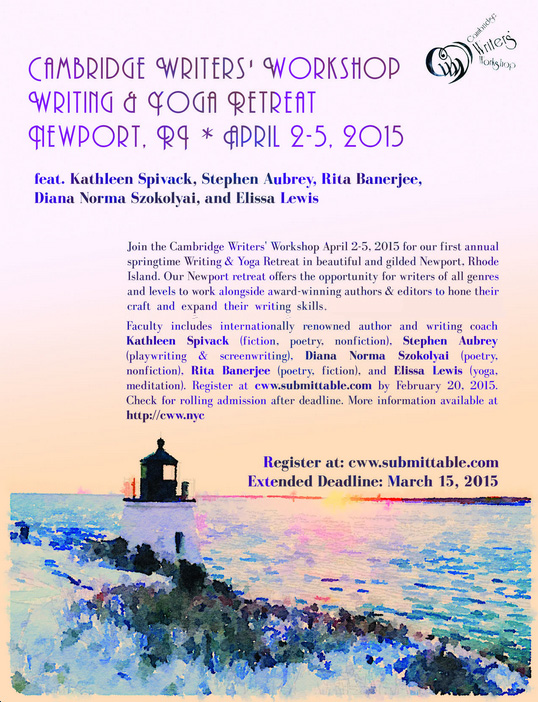
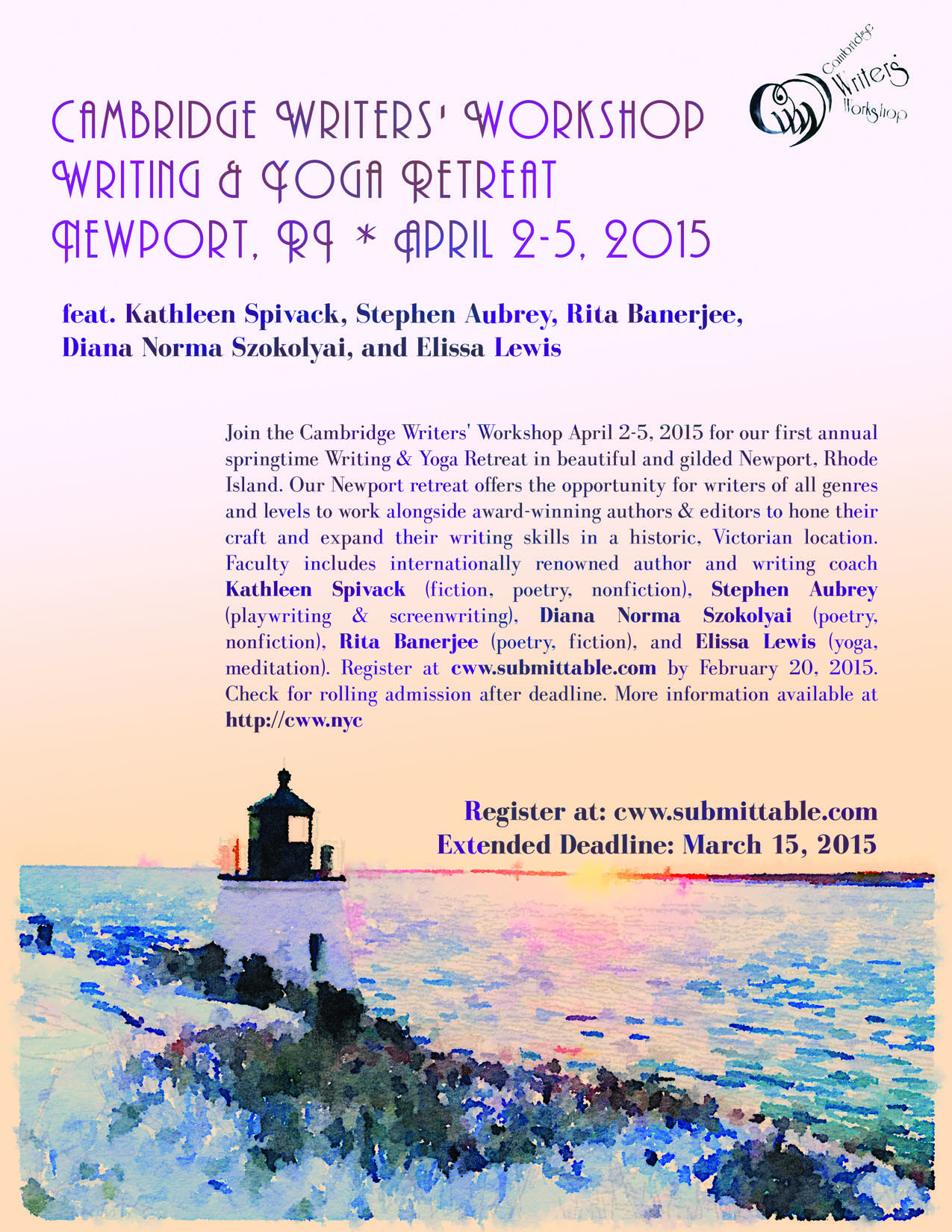
Register by March 15 for our Newport, RI Writing & Yoga Retreat (April 2-5, 2015)

newport2015poster


Join us April 2-5, 2015

Our Newport retreat offers the opportunity for writers of all genres and levels to work alongside award-winning authors & editors to hone their craft and expand their writing skills, while working on new or existing projects. Famous for its seafood and coastline, we chose this location for its inspiring beauty and history. During free sessions in the afternoon, take a mansion tour of gilded-era Newport, visit the Newport Museum, listen to some Newport jazz classics, or just relax beside the ocean watching the sailboats and let the stunning location influence your writing.

Tuition includes:

  • Shared room lodging
  • Daily creative writing workshops 
  • Craft seminars
  • One-on-one manuscript consultations
  • Toasts
  • An orientation dinner
  • A farewell brunch 
  • Yoga and meditation classes

During the retreat, writers and yoga practitioners will learn craft techniques alongside award-winning and internationally-renowned authors such as Kathleen Spivack (fiction, poetry, nonfiction), Stephen Aubrey (playwriting, screenwriting), Rita Banerjee (poetry, fiction), & Diana Norma Szokolyai (poetry, nonfiction).  Yoga and meditation will be lead by Elissa Lewis

Included in the $650 tuition are all daily creative writing workshops, craft of writing seminars, one-on-one manuscript consultation, orientation dinner, toasts, and farewell brunch, plus daily yoga and meditation classes.  Shared room lodging is included. Please send us an email to inquire about partial attendance ($375 or $475 with shared lodging). Please inquire about optional add-ons include aromatherapy, massage, and reiki healing. There are limited seats for this workshop so apply early! There are limited seats, so apply early!  The extended deadline for admittance for our retreat is March 15, 2015.  Apply at cww.submittable.com.

Newport1

Faculty includes internationally renowned author and writing coach Kathleen Spivack (fiction, poetry, nonfiction), Stephen Aubrey (playwriting, screenwriting), Diana Norma Szokolyai (poetry, nonfiction), Rita Banerjee (poetry, fiction), and Elissa Lewis (yoga, meditation).

If you’d like to join us in Newport, please apply online at cww.submittable.com by March 15, 2015 and include $5 application screening fee along with a 5-page writing sample. (Due to limited seats, early applications are encouraged, but check for rolling admission after deadline, depending on availability).

applyExtended Deadline: March 15, 2015

Featured Faculty:

Stephen Aubrey is a Brooklyn-based writer, editor, dramaturg, lecturer, storyteller and recovering medievalist. His writing has appeared in Publishing Genius, CommonwealThe Brooklyn Review, Forté, Pomp & Circumstance, and The Outlet.  He is also a co-founder and the resident dramaturg and playwright of The Assembly Theater Company. His plays have been produced at The Ontological-Hysteric Theater, The Flea Theater, The Collapsable Hole, The Brick Theater, Symphony Space, the Abingdon Theater Complex, UNDER St Marks, The Philly Fringe and the Edinburgh Fringe Festival where his original play, We Can’t Reach You, Hartford, was nominated for a 2006 Fringe First Award.

Kathleen Spivack is the author of A History of Yearning, winner of the Sows Ear International Poetry Prize 2010, first runner up in the New England Book Festival, and winner of the London Book Festival; Moments of Past Happiness (Earthwinds/Grolier Editions 2007); The Beds We Lie In (Scarecrow 1986), nominated for a Pulitzer Prize; The Honeymoon (Graywolf 1986); Swimmer in the Spreading Dawn (Applewood 1981); The Jane Poems (Doubleday 1973); Flying Inland (Doubleday 1971); Robert Lowell and His Circle (2011) and a novel, Unspeakable Things. She is a recipient of the Allen Ginsberg Poetry Award 2010, the 2010 Erica Mumford Award, and the 2010 Paumanok Award. Published in numerous magazines and anthologies, some of her work has been translated into French. Other publications include The New Yorker, Ploughshares, The Atlantic Monthly, Poetry, Massachusetts Review, Virginia Quarterly, The Southern Review, Harvard Review, The Paris Review, The Kenyon Review, Agni, New Letters, and others. Her work is featured in numerous anthologies. She has also won several International Solas Prizes for “Best Essays.”

Diana Norma Szkoloyai is author of the poetry books Roses in the Snow and Parallel Sparrows (Finishing Line Press). Her writing and hybrid art have appeared in Lyre Lyre, Dr. Hurley’s Snake Oil Cure, The Fiction Project, Teachers as Writers, Polarity, The Boston Globe, The Dudley Review, Up the Staircase, Area Zinc Art Magazine, Belltower & the Beach, and Human Rights News. Founding Literary Arts Director of Chagall Performance Art Collaborative and co-director of the Cambridge Writer’s Workshop, she holds an Ed.M from Harvard and an M.A. in French Literature from the University of Connecticut.

Rita Banerjee is a writer, and received her PhD in Comparative Literature from Harvard University. She holds an MFA in Poetry and her writing has been published in Poets for Living Waters, The New Renaissance, The Fiction Project, Jaggery, The Crab Creek Review, The Dudley Review, Objet d’Art, Vox Populi, Dr. Hurley’s Snake-Oil Cure, and Chrysanthemum among other journals. Her first collection of poems,Cracklers at Night, was published by Finishing Line Press in 2010 and received First Honorable Mention for Best Poetry Book at the 2011-2012 Los Angeles Book Festival. Her novella, A Night with Kali, was digitized by the Brooklyn Art-house Co-op in 2011. She is a co-director of the Cambridge Writers’ Workshop, and her writing has been recently featured on HER KIND by VIDA: Women in Literary Arts and on KBOO Radio’s APA Compass in Portland, Oregon.

Elissa Lewis is the Yoga & Arts Coordinator of the Cambridge Writers’ Workshop.  She began her journey with yoga in 2006, when she moved to France and made the practice part of her daily routine. She saw yoga as a lifestyle, not only a class, helping her to clear her mind and have more compassion for herself and others. In 2010 she moved to New York and completed her teacher training at Laughing Lotus, a creative, soulful yoga studio that teaches the student to ‘move like yourself.’ She’s taught private and group classes in Manhattan and Brooklyn ever since. Visit her website for informative yoga sequences and information.

Suggested Accommodations:

We encourage people to stay at the Architect’s Inn, as they are affiliated with Inn Bliss and will make your stay as comfortable as possible.  They are offering a special discount for people on our retreat.  Contact Nick Maione for details at (401)845-2547 and mention that you are with the Cambridge Writers’ Workshop.  Discounts will depend on the particular room and number of nights you are staying between April 2-5, 2015.

(Detailed list with descriptions and locations available here.)

Bed & Breakfast:

Newport Blues Inn, average nightly price from $109-$269
Marshall Slocum Inn, average nightly price from $137-$175
Ivy Lodge, average nightly price from $139-$209
La Farge Perry House, average nightly price from $149-$269
Hydrangea House Inn, average nightly price from $150-$233
Sarah Kendall Houseaverage nightly price from $150-$295
Beech Tree Inn & Cottage, average nightly price from $155-$202
Almondy Inn, average nightly price from $175-$290
Cliffside Inn, average nightly price from $175-$365
Samuel Durfee House, average nightly price from $186-$233
Frances Malbone House, average nightly prices from $207-$395

Mid-Range Hotel:

The Attwater, average nightly price from $119-$409
Newport Harbor Hotel & Marina, average nightly price from $155-$185
Mill Street Inn, average nightly prices from $168-$228
Hyatt Regency Newport, average nightly prices from $229-$379

Budget Hotel:

Mainstay Hotel & Conference Center, average nightly prices from $64-$82
Carriage House Inn, average nightly prices from $99
Courtyard Marriott Newport Middletown, average nightly prices from $99
AirBnb Rentals, prices vary

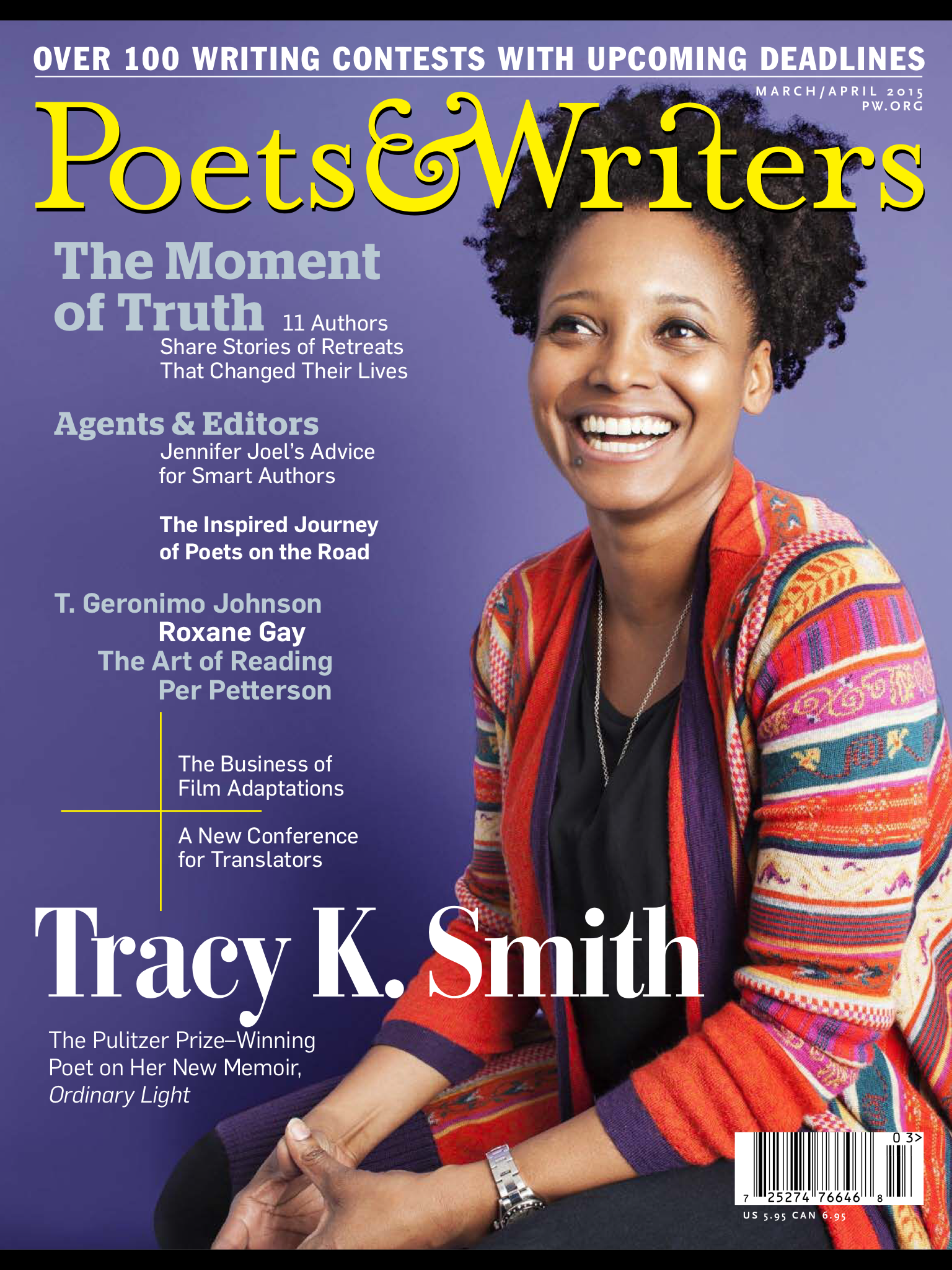
Cambridge Writers’ Workshop 2015 Retreats featured in Poets & Writers Magazine

IMG_0036Writers such as David Shields, Kathleen Spivack, Peter Orner, Rita Banerjee, Diana Norma Szokolyai, Stephen Aubrey, Jessica Reidy, and yoga instructor Elissa Lewis are featured in the March/April 2015 Writers Retreats Issue of Poets & Writers Magazine for their instruction in fiction, nonfiction, poetry, playwriting, screenwriting, and yoga the CWW Newport, RI Writing & Yoga Retreat (April 2-5, 2015), CWW Summer Writing Retreat in Paris (July 22-30, 2015), and CWW Summer Writing Retreat in Granada, Andalucía, Spain (August 3-10, 2015).  In this special issue of Poets & Writers, the “Conferences & Residencies” section features the Cambridge Writers’ Workshop 2015 Spring and Summer Creative Writing Retreats in New England, France, and Spain.   Here’s some more information on each retreat:

CWW Newport, RI Writing & Yoga Retreat (April 2-5, 2015)

NewportThe 2015 Cambridge Writers’ Workshop Writing & Yoga Retreat will be held from April 2 to April 5 in Newport, Rhode Island. The retreat offers workshops in poetry, fiction, and creative nonfiction, as well as craft seminars, manuscript consultations, time to write, daily yoga and meditation classes, and local excursions. The faculty includes poets and prose writers Rita Banerjee, Kathleen Spivack, and Diana Norma Szokolyai; and prose writer Stephen Aubrey. The cost of the retreat is $650, which includes tuition and some meals. Shared room lodging is also included. Using the online submission system, submit five pages of poetry, fiction, or creative nonfiction with a $5 application fee by March 15, 2015. Apply at cww.submittable.com

CWW Summer Writing Retreat in Paris (July 22-30, 2015)

ParisThe 2015 Cambridge Writers’ Workshop Summer in Paris Writing Retreat will be held from July 22 to July 30 at the Hôtel Denfert-Montparnasse in Paris. The retreat offers workshops in poetry, fiction, and creative nonfiction, as well as craft seminars, one-on-one manuscript consultations, time to write, daily yoga and meditation classes, and local excursions. The faculty includes poets and prose writers Rita Banerjee, Kathleen Spivack, Jessica Reidy, and Diana Norma Szokolyai; and fiction and nonfiction writer David Shields. The cost of the retreat is $2,950, which includes tuition, lodging, and some meals. Using the online submission system, submit five pages of poetry, fiction, or creative nonfiction with a $5 application fee by May 5, 2015.  Apply at cww.submittable.com

CWW Summer Writing Retreat in Granada, Andalucía, Spain (August 3-10, 2015)

alhambra-granada-spain-900x1440The 2015 Cambridge Writers’ Workshop Summer in Andalucía Writing Retreat will be held from August 3 to August 10 at the Hotel Gar-Anat in Granada, Spain. The retreat offers workshops in poetry, fiction, and creative nonfiction, as well as craft seminars, time to write, daily yoga and meditation classes, and local excursions. The faculty includes poets and prose writers Peter Orner, Rita Banerjee, Diana Norma Szokolyai, and Jessica Reidy. The cost of the retreat is $2,950, which includes tuition, lodging, and some meals. Using the online submission system, submit five pages of poetry, fiction, or creative nonfiction with a $5 application fee by April 20, 2015.  Apply at cww.submittable.com

CWW Interview with Stephen Aubrey, Newport, Rhode Island Instructor & Playwright

stephen AubreyThe Cambridge Writers’ Workshop is proud to introduce Stephen Aubrey, who will be teaching classes on theatre, performance, screenwriting, and playwriting at our Writing and Yoga Retreat in Newport, Rhode Island (April 2-5, 2015).  The Cambridge Writers’ Workshop’s Megan Tilley sat down to interview Stephen Aubrey.  Check out Megan’s interview with Stephen below, and be sure to apply for our Newport Retreat by February 20, 2015!

We-Cant-Reach-You-Hartford

MT: How did you get into playwriting?  What were some of the early plays or performances which inspired you to write?

SA: My life as a playwright owes more to serendipity than anything else. Growing up, theater had always interested me. I was obsessed with Spalding Gray and I hung out with a lot of the theater kids in high school, but my complete incompetence as an actor meant that I was usually an audience member rather than a performer (save for one disastrous turn as Francis Nurse in The Crucible in 11th grade). Playwriting (and writing in general) never exactly occurred to me as something I could do.

In college, I took a lot of philosophy and history courses, which exposed me to a wealth of interesting stories and ideas and very slowly, I became interested in writing short stories my senior year of college. About this time, I was approached by a director I knew from a fiction workshop I was taking. She was interested in developing a documentary play about a historical event and asked me if I knew of any good source material. After batting around a couple of ideas, I told her about the Hartford Circus Fire of 1944. She was hooked on the idea immediately and we decided to round up a couple of actors and co-write the play.

I thought this was going to be a one-shot deal. I really thought of myself as an academic and was seriously considering getting a PhD in history after I graduated college. Slowly, however, writing got its claws in me. We brought our play to the Edinburgh Fringe Festival that summer where it was well-received and nominated for a prestigious award. When I came back from Scotland, I moved to New York and started thinking seriously about writing plays. The group of people who traveled to Scotland asked me to write another play to perform the next summer and we slowly coalesced into a theater company.

Since I came to playwriting somewhat late, most of the formative plays in my life haven’t been ones I studied in a classroom (though I love some plays I happened to study in school, mostly the Greeks and Shakespeare) but rather, ones I saw performed when I first moved to New York. I didn’t have very much money when I first came to the city. All those big sexy expensive shows were out of the question so I ended up exposing myself to the weird, scrappy stuff you can find downtown where the tickets cost the same as a beer at one of the ritzy joints. When I had been at the Fringe Festival doing my show, I had seen the TEAM’s Particularly in the Heartland which really blew me away (I think I’ve ended up seeing it 5 times in total in a bunch of different theaters over the years) and showed me how adventurous and alive and surprising theater could be. Nearly 10 years later, it’s still one of the most amazing pieces I’ve seen. So when I was trying to acquaint myself with what was happening in the theater world, I sought out more people like the TEAM. After seeing a few shows that interested me, I started lurking around theaters that I thought were curating interesting work–The Ontological-Hysteric [R.I.P.], The Ohio, PS122–and becoming aware of groups like Elevator Repair Service, 13P, and Pig Iron that were doing things I found really interesting. I think I learned a lot from these groups, but above all, my downtown education taught me to take risks and embrace the idiosyncrasies of my voice, things that are in abundance downtown and less so once you get above 14th street.

Daguerrotype

MT: You’re the cofounder of The Assembly Theater Company in New York – what lead you to create the group, and how has it impacted your writing?

SA: The simplest explanation for why I created the group was that it was the easiest way to make theater in New York. Especially when you’re just starting out and have very limited resources, it really does take a village to make a play. Doing it alone is, well, lonely. It can be incredibly discouraging for the first few years as you try to break into the community and are dealing with expensive yet somehow filthy black boxes you can only half-fill with friends and loved ones you’ve coerced into buying a ticket. It helps to have comrades.

I was lucky enough to find a group of collaborators in college who have similar interests and aesthetic senses and whom I genuinely care about. We formed the company fresh out of college; there have been some personnel changes as we all learned what the life of a young theater artist entailed, but a core group has remained over the years which has been a wonderful resource to have as I tried to find my artistic identity.

As we’ve grown and developed as a company, we’ve worked towards a truly collaborative way of working together that has become fundamental to the way I think about my writing. After my first few plays, I became disenchanted with the way new plays were developed and also with the way that certain voices (namely straight white men like myself) were overrepresented. At the same time, I was being exposed to a lot of alternative ways of making work–chief among them devised theater–that seemed new and fresh. The Assembly’s four artistic directors are a director, a designer, an actor, and a writer (that’s me); the idea is that by working together as equal partners in series of development periods over the course of a year or two (rather than the typical new play process in which a playwright writes a script, a director decides to work on it and then hires a cast and crew who rehearses for a few weeks) we can create plays where every part of the production is realized in harmony. Even more recently, we’ve been working with group-writing where I write the script along with the actors so that as they get deeper into their characters and make interesting discoveries, we can integrate these into the script.

I’ve found that working this way has really opened up my writing. The plurality of voices and concerns you have to contend with when working in this way can be really overwhelming and intimidating, but it’s incredibly satisfying when it all comes together. It can get messy and heated sometimes in the rehearsal room, but the kind of work I’m creating now–where I’m a main voice, but by no means the primary one–seems important to me. I think we live in a complicated world, one where we need to be aware of and sensitive to alternative perspectives, especially ones that we don’t normally encounter on stage.

OntologicalHysteric

MT: You’ve written plays that have been performed at venues from The Ontological-Hysteric in Manhattan to The Brick Theater in Brooklyn. What was the process like for putting on plays at these venues?

SA: When I first started, my company had to work very hard to find theaters to do our plays in. Being curated by a theater was ideal, but more often than not, we had to rent the theater (which is a huge financial burden). I was very lucky to be able perform in venues like The Brick or The Ontological-Hysteric; both of those came about by applying to programs or festivals like the Short-Form Series or the Video Game Festival. In those instances, the theater was given to me free of charge (though I was financially responsible for everything else). There were a few other fortuitous opportunities like the year-long residency The Assembly had at Horse Trade Theater Group, but for the most part, putting on a play at a venue in New York requires producing it yourself. At least at the beginning, that’s going to be the case. But these things tend to snowball. If you produce a play yourself, and you invite the right people to come see it (or the right people wander into the theater on their own, which is a rare, but beautiful thing), it’s possible that you will be accepted to a festival or residency somewhere down the road. Making a career from theater is largely about using each opportunity to springboard to the next. Once you start generating interest in your work, things get a little easier.

But what has been true throughout is that, even if we were given the space, my company has always been responsible for making the play happen. We have been responsible for finding a cast and design team, for doing the brunt of the fundraising, grant writing and marketing (or paying for our own press agent if we had the money). I’m also forgetting a thousand other small, obnoxious tasks that also fall to us. It’s a DIY world. Making theater requires initiative and a bit of humility; you may be the Writer, but you also have to be The One Who Takes a Vacation Day to Drive the U-Haul to The Storage Unit in New Jersey and Sit in Traffic for the Better Part of the Afternoon. Unless you’re at a theater with a lot of money and resources, that’s the reality of theater.  

MT: How would you compare your writing process for fiction versus screenwriting?

SA: In my mind, the difference is about a visual language versus a written language. In fiction, you can get so much deeper into a character’s mind. You can linger or digress in a way that screenwriting or playwriting cannot. Fiction necessarily requires narration which is something that doesn’t usually work on the screen. A voice-over is so often the sign of an insecure screenwriter, someone who isn’t thinking about a visual language. Because when you’re writing for the screen, you need to be thinking about the audience’s gaze. “Show, don’t tell” is one of those writing cliches I hate throwing around, but it’s an essential tip for screenwriting. Whether it’s through sharp dialogue or a clever structure, you need to find a way to dazzle the senses.

MT: What kinds of workshops are you planning to offer at our Newport, Rhode Island Retreat, and what would you say is the most important part of the workshop experience?

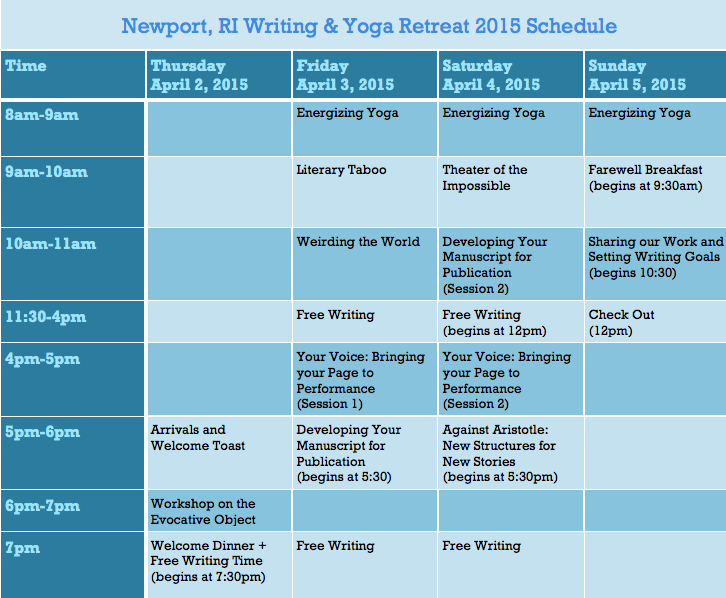
SA: I’m offering three workshops at Newport: one on world-building and the importance of defining space in playwriting and screenwriting; one on “impossible theater,” which is all about pushing yourself away from Realism and thinking in terms of visual and symbolic gestures; and a third on Aristotelian and anti-Aristotelian narrative structures and the opportunities that each affords a writer.

I think the most important part of the workshop experience is meeting other writers. Writing can be a lonely pursuit at times and community is very important. It’s helpful to know that there are other people also sitting at their desks staring at a blinking cursor for hours at a time. Sharing your work with other writers also exposes you to a lot of different styles and perspectives; other writers can show you tricks and tactics and solutions that would never have occurred to you. Finding your co-travelers is an immensely important task and the workshop is a great place to do it.

MT: What advice do you have for budding playwrights and screenwriters?

SA: The most important piece of advice I can give is: Learn how to produce your own work. It’s very difficult to find people willing to take a chance on your writing, financially or artistically, if you’re untested. No one is going to believe in your work, in your words, more than you. You are your own best ambassador for your art, and you need to learn how to present it and talk about it. If you keep at it, people will begin to pay attention, but they need to see your work first. You can apply to contests and festivals (in fact, you should apply to contests and festivals), but it takes a lot of time and patience to work through the system. You could spend that time waiting for a response, or you can take the matter into your own hands and make the work you want to make.

Stephen Aubrey descends from hardy New England stock. He is a Brooklyn-based writer, editor, dramaturg, lecturer, storyteller and recovering medievalist. His writing has appeared in Publishing Genius, Commonweal, The Brooklyn Review, Pomp & Circumstance, Forté and The Outlet. He is a co-founder and the resident dramaturg and playwright of The Assembly Theater Company. His plays have been produced at The New Ohio Theater, The Living Theater, The Ontological-Hysteric Theater, The Flea Theater, The Collapsable Hole, Wesleyan University, The Tank, The Brick Theater, Symphony Space, the Abingdon Theater Complex, UNDER St Marks, The Philly Fringe and the Edinburgh Fringe Festival where his original play, We Can’t Reach You, Hartford, was nominated for a 2006 Fringe First Award. He is also the editor of two ‘pataphysic books, Suspicious Anatomy and Suspicious Zoology, both published by the Hollow Earth Society. He has an MFA from Brooklyn College where he received the Himan Brown Prize and the Ross Feld Writing Award and a BA with Honors from the College of Letters at Wesleyan University. He is an instructor of English at Brooklyn College and holds the dubious distinction of having coined the word “playlistism” in 2003.