CWW Interview with Stephen Aubrey, Newport, Rhode Island Instructor & Playwright

stephen AubreyThe Cambridge Writers’ Workshop is proud to introduce Stephen Aubrey, who will be teaching classes on theatre, performance, screenwriting, and playwriting at our Writing and Yoga Retreat in Newport, Rhode Island (April 2-5, 2015).  The Cambridge Writers’ Workshop’s Megan Tilley sat down to interview Stephen Aubrey.  Check out Megan’s interview with Stephen below, and be sure to apply for our Newport Retreat by February 20, 2015!

We-Cant-Reach-You-Hartford

MT: How did you get into playwriting?  What were some of the early plays or performances which inspired you to write?

SA: My life as a playwright owes more to serendipity than anything else. Growing up, theater had always interested me. I was obsessed with Spalding Gray and I hung out with a lot of the theater kids in high school, but my complete incompetence as an actor meant that I was usually an audience member rather than a performer (save for one disastrous turn as Francis Nurse in The Crucible in 11th grade). Playwriting (and writing in general) never exactly occurred to me as something I could do.

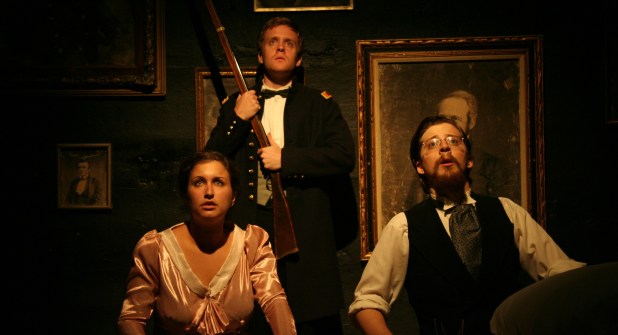
In college, I took a lot of philosophy and history courses, which exposed me to a wealth of interesting stories and ideas and very slowly, I became interested in writing short stories my senior year of college. About this time, I was approached by a director I knew from a fiction workshop I was taking. She was interested in developing a documentary play about a historical event and asked me if I knew of any good source material. After batting around a couple of ideas, I told her about the Hartford Circus Fire of 1944. She was hooked on the idea immediately and we decided to round up a couple of actors and co-write the play.

I thought this was going to be a one-shot deal. I really thought of myself as an academic and was seriously considering getting a PhD in history after I graduated college. Slowly, however, writing got its claws in me. We brought our play to the Edinburgh Fringe Festival that summer where it was well-received and nominated for a prestigious award. When I came back from Scotland, I moved to New York and started thinking seriously about writing plays. The group of people who traveled to Scotland asked me to write another play to perform the next summer and we slowly coalesced into a theater company.

Since I came to playwriting somewhat late, most of the formative plays in my life haven’t been ones I studied in a classroom (though I love some plays I happened to study in school, mostly the Greeks and Shakespeare) but rather, ones I saw performed when I first moved to New York. I didn’t have very much money when I first came to the city. All those big sexy expensive shows were out of the question so I ended up exposing myself to the weird, scrappy stuff you can find downtown where the tickets cost the same as a beer at one of the ritzy joints. When I had been at the Fringe Festival doing my show, I had seen the TEAM’s Particularly in the Heartland which really blew me away (I think I’ve ended up seeing it 5 times in total in a bunch of different theaters over the years) and showed me how adventurous and alive and surprising theater could be. Nearly 10 years later, it’s still one of the most amazing pieces I’ve seen. So when I was trying to acquaint myself with what was happening in the theater world, I sought out more people like the TEAM. After seeing a few shows that interested me, I started lurking around theaters that I thought were curating interesting work–The Ontological-Hysteric [R.I.P.], The Ohio, PS122–and becoming aware of groups like Elevator Repair Service, 13P, and Pig Iron that were doing things I found really interesting. I think I learned a lot from these groups, but above all, my downtown education taught me to take risks and embrace the idiosyncrasies of my voice, things that are in abundance downtown and less so once you get above 14th street.
Daguerrotype

MT: You’re the cofounder of The Assembly Theater Company in New York – what lead you to create the group, and how has it impacted your writing?

SA: The simplest explanation for why I created the group was that it was the easiest way to make theater in New York. Especially when you’re just starting out and have very limited resources, it really does take a village to make a play. Doing it alone is, well, lonely. It can be incredibly discouraging for the first few years as you try to break into the community and are dealing with expensive yet somehow filthy black boxes you can only half-fill with friends and loved ones you’ve coerced into buying a ticket. It helps to have comrades.

I was lucky enough to find a group of collaborators in college who have similar interests and aesthetic senses and whom I genuinely care about. We formed the company fresh out of college; there have been some personnel changes as we all learned what the life of a young theater artist entailed, but a core group has remained over the years which has been a wonderful resource to have as I tried to find my artistic identity.

As we’ve grown and developed as a company, we’ve worked towards a truly collaborative way of working together that has become fundamental to the way I think about my writing. After my first few plays, I became disenchanted with the way new plays were developed and also with the way that certain voices (namely straight white men like myself) were overrepresented. At the same time, I was being exposed to a lot of alternative ways of making work–chief among them devised theater–that seemed new and fresh. The Assembly’s four artistic directors are a director, a designer, an actor, and a writer (that’s me); the idea is that by working together as equal partners in series of development periods over the course of a year or two (rather than the typical new play process in which a playwright writes a script, a director decides to work on it and then hires a cast and crew who rehearses for a few weeks) we can create plays where every part of the production is realized in harmony. Even more recently, we’ve been working with group-writing where I write the script along with the actors so that as they get deeper into their characters and make interesting discoveries, we can integrate these into the script.

I’ve found that working this way has really opened up my writing. The plurality of voices and concerns you have to contend with when working in this way can be really overwhelming and intimidating, but it’s incredibly satisfying when it all comes together. It can get messy and heated sometimes in the rehearsal room, but the kind of work I’m creating now–where I’m a main voice, but by no means the primary one–seems important to me. I think we live in a complicated world, one where we need to be aware of and sensitive to alternative perspectives, especially ones that we don’t normally encounter on stage.
OntologicalHysteric

MT: You’ve written plays that have been performed at venues from The Ontological-Hysteric in Manhattan to The Brick Theater in Brooklyn. What was the process like for putting on plays at these venues?

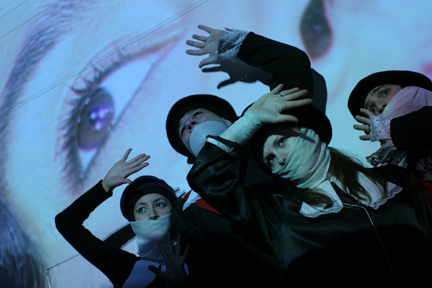
SA: When I first started, my company had to work very hard to find theaters to do our plays in. Being curated by a theater was ideal, but more often than not, we had to rent the theater (which is a huge financial burden). I was very lucky to be able perform in venues like The Brick or The Ontological-Hysteric; both of those came about by applying to programs or festivals like the Short-Form Series or the Video Game Festival. In those instances, the theater was given to me free of charge (though I was financially responsible for everything else). There were a few other fortuitous opportunities like the year-long residency The Assembly had at Horse Trade Theater Group, but for the most part, putting on a play at a venue in New York requires producing it yourself. At least at the beginning, that’s going to be the case. But these things tend to snowball. If you produce a play yourself, and you invite the right people to come see it (or the right people wander into the theater on their own, which is a rare, but beautiful thing), it’s possible that you will be accepted to a festival or residency somewhere down the road. Making a career from theater is largely about using each opportunity to springboard to the next. Once you start generating interest in your work, things get a little easier.

But what has been true throughout is that, even if we were given the space, my company has always been responsible for making the play happen. We have been responsible for finding a cast and design team, for doing the brunt of the fundraising, grant writing and marketing (or paying for our own press agent if we had the money). I’m also forgetting a thousand other small, obnoxious tasks that also fall to us. It’s a DIY world. Making theater requires initiative and a bit of humility; you may be the Writer, but you also have to be The One Who Takes a Vacation Day to Drive the U-Haul to The Storage Unit in New Jersey and Sit in Traffic for the Better Part of the Afternoon. Unless you’re at a theater with a lot of money and resources, that’s the reality of theater.  

MT: How would you compare your writing process for fiction versus screenwriting?

SA: In my mind, the difference is about a visual language versus a written language. In fiction, you can get so much deeper into a character’s mind. You can linger or digress in a way that screenwriting or playwriting cannot. Fiction necessarily requires narration which is something that doesn’t usually work on the screen. A voice-over is so often the sign of an insecure screenwriter, someone who isn’t thinking about a visual language. Because when you’re writing for the screen, you need to be thinking about the audience’s gaze. “Show, don’t tell” is one of those writing cliches I hate throwing around, but it’s an essential tip for screenwriting. Whether it’s through sharp dialogue or a clever structure, you need to find a way to dazzle the senses.

MT: What kinds of workshops are you planning to offer at our Newport, Rhode Island Retreat, and what would you say is the most important part of the workshop experience?

SA: I’m offering three workshops at Newport: one on world-building and the importance of defining space in playwriting and screenwriting; one on “impossible theater,” which is all about pushing yourself away from Realism and thinking in terms of visual and symbolic gestures; and a third on Aristotelian and anti-Aristotelian narrative structures and the opportunities that each affords a writer.

I think the most important part of the workshop experience is meeting other writers. Writing can be a lonely pursuit at times and community is very important. It’s helpful to know that there are other people also sitting at their desks staring at a blinking cursor for hours at a time. Sharing your work with other writers also exposes you to a lot of different styles and perspectives; other writers can show you tricks and tactics and solutions that would never have occurred to you. Finding your co-travelers is an immensely important task and the workshop is a great place to do it.

MT: What advice do you have for budding playwrights and screenwriters?

SA: The most important piece of advice I can give is: Learn how to produce your own work. It’s very difficult to find people willing to take a chance on your writing, financially or artistically, if you’re untested. No one is going to believe in your work, in your words, more than you. You are your own best ambassador for your art, and you need to learn how to present it and talk about it. If you keep at it, people will begin to pay attention, but they need to see your work first. You can apply to contests and festivals (in fact, you should apply to contests and festivals), but it takes a lot of time and patience to work through the system. You could spend that time waiting for a response, or you can take the matter into your own hands and make the work you want to make.

Stephen Aubrey descends from hardy New England stock. He is a Brooklyn-based writer, editor, dramaturg, lecturer, storyteller and recovering medievalist. His writing has appeared in Publishing Genius, Commonweal, The Brooklyn Review, Pomp & Circumstance, Forté and The Outlet. He is a co-founder and the resident dramaturg and playwright of The Assembly Theater Company. His plays have been produced at The New Ohio Theater, The Living Theater, The Ontological-Hysteric Theater, The Flea Theater, The Collapsable Hole, Wesleyan University, The Tank, The Brick Theater, Symphony Space, the Abingdon Theater Complex, UNDER St Marks, The Philly Fringe and the Edinburgh Fringe Festival where his original play, We Can’t Reach You, Hartford, was nominated for a 2006 Fringe First Award. He is also the editor of two ‘pataphysic books, Suspicious Anatomy and Suspicious Zoology, both published by the Hollow Earth Society. He has an MFA from Brooklyn College where he received the Himan Brown Prize and the Ross Feld Writing Award and a BA with Honors from the College of Letters at Wesleyan University. He is an instructor of English at Brooklyn College and holds the dubious distinction of having coined the word “playlistism” in 2003.

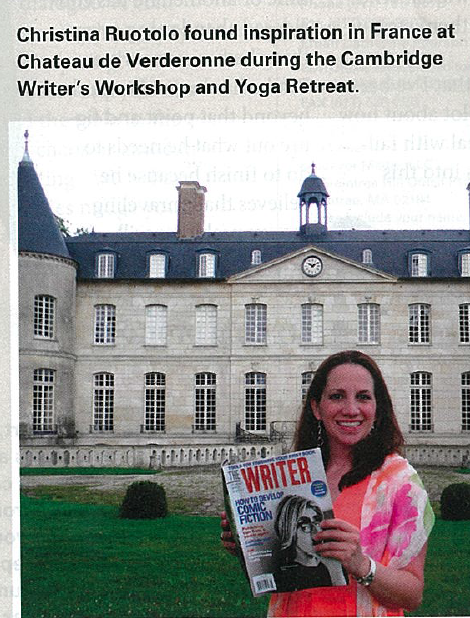
Christina Ruotolo, CWW Château de Verderonne Retreat Participant, featured in The Writer Magazine

Screen Shot 2015-01-18 at 7.08.06 PMChristina Ruotolo, a participant at the  Cambridge Writers’ Workshop 2014 Yoga & Writing Retreat at the Château at Verderonne, has been featured in The Writer Magazine!  In addition to presenting her new creative writing and enjoying hors d’oeuvres and cocktails with her fellow workshop participants, Christina found inspiration for her work when reading The Writer at the Château de Vederonne.  She also very much enjoyed the literary and cultural tours of Paris and Chantilly with the Cambridge Writers’ Workshop as well as her daily yoga classes with Elissa Lewis.

Christina Ruotolo, 36, is a published poet and nonfiction writer who hails from eastern North Carolina.  In 2014, she started a nonfiction blog, The Grief Project, after the loss of her mother in 2013, her father in early 2014, and a miscarriage a few months after that. “I used the blog as a way to navigate through my grief one thought and one word at a time. I want others to share their stories of grief and how they deal with the ups and downs that grief in all forms entail.” When not writing, Christina is an adjunct English instructor and Writing Consultant at Pitt Community College, a Barnes and Noble employee, and hard at work on a poetry chapbook and her first screenplay. If you would like to submit your story of how you dealt with grief to Christina’s blog, please visit the website, www.thegriefproject.blogspot.com.

Happy New Year 2015 from the Cambridge Writers’ Workshop!!

CWW-NY2015 Happy New Year 2015 from the directors and staff of the Cambridge Writers’ Workshop! We hope you’re all as excited for 2015 as we are!  We’re planning a delightful, productive year for our writers and artists with plenty of opportunities to travel, write, practice yoga, and network, and we’re looking forward to seeing you at our retreats, workshops, readings, and literary fest events in 2015!

The Cambridge Writers’ Workshop had a wonderful year in 2014.  Over the last twelve months, we’ve had a chance to hold retreats and readings across America and the world, meet exciting writers, yoga practicioneers, and artists, and have found new ways to inspire our own writing.  Our year began with the 2014 Association of Writers and Writing Programs Conference in Seattle, WA in February. At AWP 2014, we got a chance to announce our CREDO Anthology of Manifestos & Sourcebook for Creative Writing, promote our new literary internships,  and discuss our Summer 2014 Château de Verderonne Yoga & Writing Retreat, and our AWP 2014 A Night at the Victrola Reading. At AWP 2014, CWW Directors, Rita Banerjee and Diana Norma Szokolyai signed copies of their books, Cracklers at Night and Parallel Sparrows, respectively.  And our A Night at the Victrola, featuring readings from authors such as Rita Banerjee, Diana Norma Szokollyai, Peter Mountford, Anca Szilágyi, Nancy Jooyoun Kim, Pattabi Seshadri, Susan Parr, Johnny Horton, Talia Shalev, Leah Umansky, Dena Rash Guzman, Kevin Skiena, Jessica Day, and Carrie Kahler.  Our AWP 2014 literary reading was even featured in Vanguard Seattle as a top AWP reading event.

After AWP 2014, we were off to our annual writing and yoga retreat to the Château de Verderonne in Picardy, France. The event, which was featured in Poets and Writers and Quail Bell Magazine, was a chance for writers to spend two weeks in the French countryside, participating in writing workshops and craft of writing seminars, yoga classes, and culturally tours of Paris and Chantilly. We liveblogged the entire event as well, sharing dozens of photos from our trip while also allowing our writers to share their thoughts on the experience.

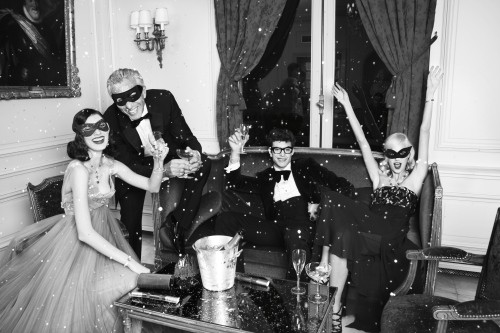
Our New Yorker members also hosted an event as part of LitCrawl Manhattan in September 2014.  Our Literary Masquerade featured readings of poetry, noir, science fiction, and original songs from Diana Norma Szokolyai, Rita Banerjee, Gregory Crosby, Elizabeth Devlin, Jonah Kruvant, and Nicole Colbert.

We also hosted an annual Pre-Thanksgiving Yoga and Writing Cleanse in November 2014. The two day event kicked off with yoga lessons from Elissa Lewis, followed by fresh juice cleanses, and creative writing workshops and craft seminars from Diana Norma Szkolyai, Jessica Reidy, and Jonah Kruvant.  Some of the creative writing classes included on the retreat included “The Art of Withholding,” “The Art of Revision” and “Sense of Smell, Memory, and Narrative.”   Our Pre-Thanksgiving Yoga & Writing Cleanse was an opportunity for the participants to cleanse themselves mentally, spiritually, and creatively before the bustling holiday season, and was even featured in a piece in Quail Bell Magazine.

In 2014, we also began work on CREDO Anthology of Manifestos & Sourcebook for Creative Writing.  The collection will feature personal writer manifestos, essays on writing advice, and writing exercises to help spur creativity. Our staff has greatly enjoyed critiquing and conversing with writers on this publication, and more information about our featured writers will be announced shortly.

In 2014, we also welcomed our first interns to the Cambridge Writers’ Workshop, and these interns include the wonderful  Alex Carrigan, Katy Miller, and Megan Tilley, all of whom have helped the CWW greatly this year. They’ve helped manage our social media and written up post about our events, critiqued and edited submissions for CREDO, shown their talent for graphic design and corresponding with writers and hosts in French, Spanish, and English, and have provided much valuable assistance on our retreats and literary events this year.  We’re excited to have Alex, Katy, and Megan on our team, and we can’t wait to show you what they’ve helped us plan for 2015!

This was also a good year for our individual staff members getting published. Quail Bell Magazine featured plenty of creative writing from our staffers, including Jessica Reidy’s essay on novel research in Paris, Norma and Rita’s Mis/Translation poems, Megan Tilley’s poem “Puddle,” and Alex Carrigan’s poem “When I First Saw Her.” Reidy also had a series of trauma poems featured in Luna Luna Magazine and Tilley was featured in FictionvaleSzokolyai was also named one of twenty Romani authors you should be reading by VIDA and published in the anthology Other Countries: Contemporary Poets Rewiring History.

While 2014 proved to be a very exciting year for all of us, our staff is quite ready to move on to our next round of exciting events. The CWW will once again table at AWP in Minneapolis from April 8-11, 2015 You can find us at the AWP 2015 Bookfair at Table 954. We will also be planning an offsite reading, and more information about that will come as we get closer to the event.

Join us April 2-5, 2015 for our first annual springtime Writing & Yoga Retreat in beautiful and gilded Newport, Rhode Island.  Our Newport retreat offers the opportunity for writers of all genres and levels to work alongside award-winning authors & editors to hone their craft and expand their writing skills, while working on new or existing projects.  Faculty includes internationally renowned author and writing coach Kathleen Spivack (fiction, poetry, nonfiction), Stephen Aubrey (playwriting,  screenwriting), Diana Norma Szokolyai (poetry, nonfiction), Rita Banerjee (poetry, fiction), and Elissa Lewis (yoga, meditation).  Registration closes on February 20, 2015 and spots are limited, so sign up on cww.submittable.com as soon as you can.

The Cambridge Writers’ Workshop Summer in Paris Writing Retreat will take place July 22-30, 2015 in France. The retreat offers participating writers of all genres and levels to work alongside award-winning authors and editors. Participating writers will hone their craft and expand their writing skills, while working on new or existing projects.  There will also be time to explore the city of Paris in all of its historical, literary, and romantic charm. Situated in heart of Paris’ Montparnasse neighborhood, amongst the fresh and popular open air markets and charming boutiques, the hotel where we will stay is full of charm and our Moroccan themed classroom will offer a wonderful oasis to practice the writing life.  Faculty includes internationally renowned author and writing coach Kathleen Spivack (poetry, fiction, nonfiction), David Shields (fiction, book-length essay), Diana Norma Szokolyai (poetry, nonfiction), Rita Banerjee (poetry, fiction), and Elissa Lewis (yoga, meditation).  If you’d like to join us in Paris, please apply online at cww.submittable.com by May 5, 2015.

And from August 3-10. 2015, join the Cambridge Writers’ Workshop on our summer writing retreat to the cultural oasis of Granada, Spain. Located at the foot of the Sierra Nevada mountains in Andalucía, Granada is one of the gems of Spain and has inspired writers from Washington Irving to Salman Rushdie to Ali Smith. Let the old city stimulate your writing with its winding streets, Moorish history, and evocative landscapes. Or, indulge in delicious Andalucían cuisine and traditional Arab baths. Work with world-renowned authors on your manuscript, or look to the beauty and warmth of Granada to inspire all-new projects.  Faculty includes Rita Banerjee (poetry, fiction), Diana Norma Szokolyai (poetry, nonfiction), Jessica Reidy (fiction, poetry) and Elissa Lewis (yoga, meditation).  If you’d like to join us in Granada, please apply online at cww.submittable.com by April 20, 2015.

We hope you are all as excited for our 2015 events as we are. If you have any questions about our upcoming retreats, please view the pages linked above. If you have any questions we may not have answered, you can email us at info@cambridgewritersworkshop.org, and for inquiries, please email the CWW Directors, Rita Banerjee and Diana Norma Szokolyai, at directors@cambridgewritersworkshop.org.  You can also follow us on Facebook, Tumblr, and Twitter for more information and updates on any of these events. We look forward to making 2015 a year full of creativity, writing, and renewal, so join us as we make 2015 rock!

– Alex Carrigan & Rita Banerjee

CWW Pre-Thanksgiving Yoga and Writing Cleanse

GaneshFinalPosterNov23&24retreat

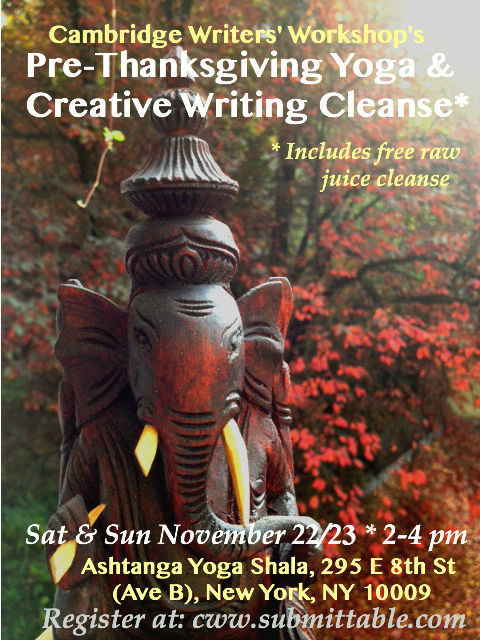
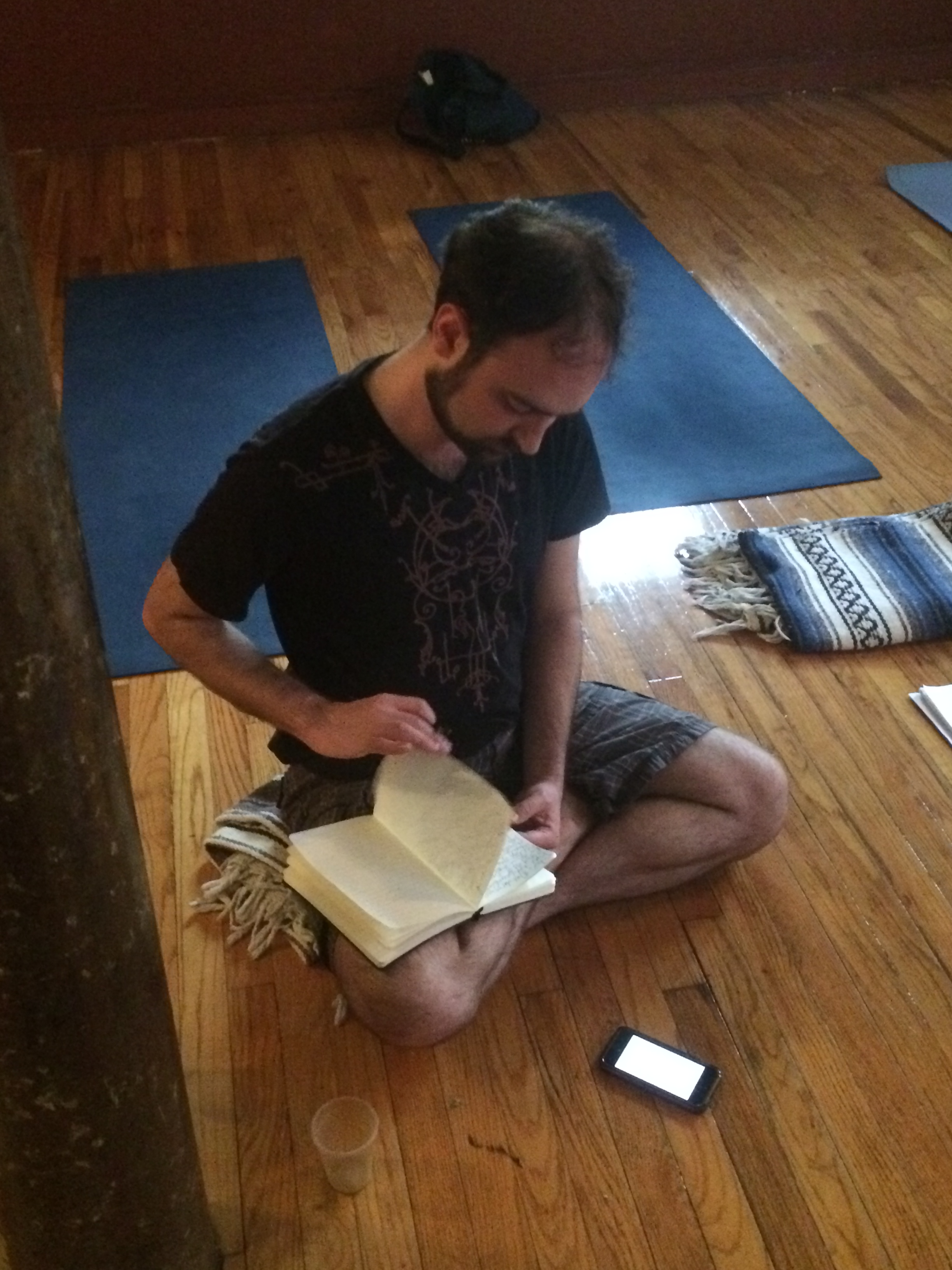
This past weekend, the Cambridge Writers’ Workshop hosted a Pre-Thanksgiving Yoga and Writing Cleanse at Ashtanga Yoga Shala in Manhattan, NY. The purpose of this event was to allow participants the chance to enjoy a weekend of yoga, juice cleansing, and writing workshops before the holiday season began. With the help of yoga and juice cleansing, the participants were able to cleanse their minds and spirits, and in turn were able to focus their renewed energy on the two workshops hosted by CWW members.

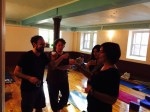
The event began on Saturday, November 22. At the Shala, guests removed their shoes and moved into the yoga room to begin the cleanse. The first part of the event was forty minutes of yoga with Elissa Lewis, our yoga instructor. Elissa led the group through various yoga exercises, each designed to help circulate breathing and to eliminate any stress the participants might have been carrying before they came to the workshop.

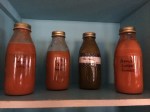
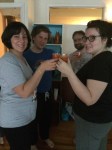
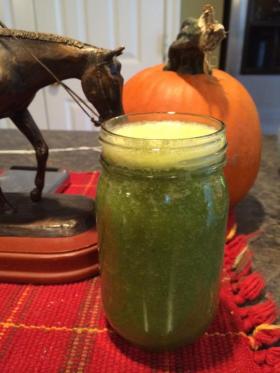
After that, the participants were treated to a juice cleanse. CWW co-director Diana Norma Szokolyai, CWW Editorial & PR intern Alex Carrigan, and Norma’s husband, Dennis Shafer, presented three different types of organic fruit and vegetable juice for the participants to drink. They could choose between a carrot-apple-ginger mix, a carrot-celery-apple mix, or “The Hulk,” a concoction of cucumber, spinach, celery, apple, and carrot. Participants enjoyed this naturally sweet and delicious way to take in loads of nutrients and cleanse their digestive systems.

Jessica Reidy led our first workshop, titled “The Art of Withholding in Creative Writing.” This workshop was designed to have the writer use action and sensory details to convey exposition. This involved two different exercises. The first exercise was about writing about a person meeting a lover for the first time, but writing two versions.

photo (17)

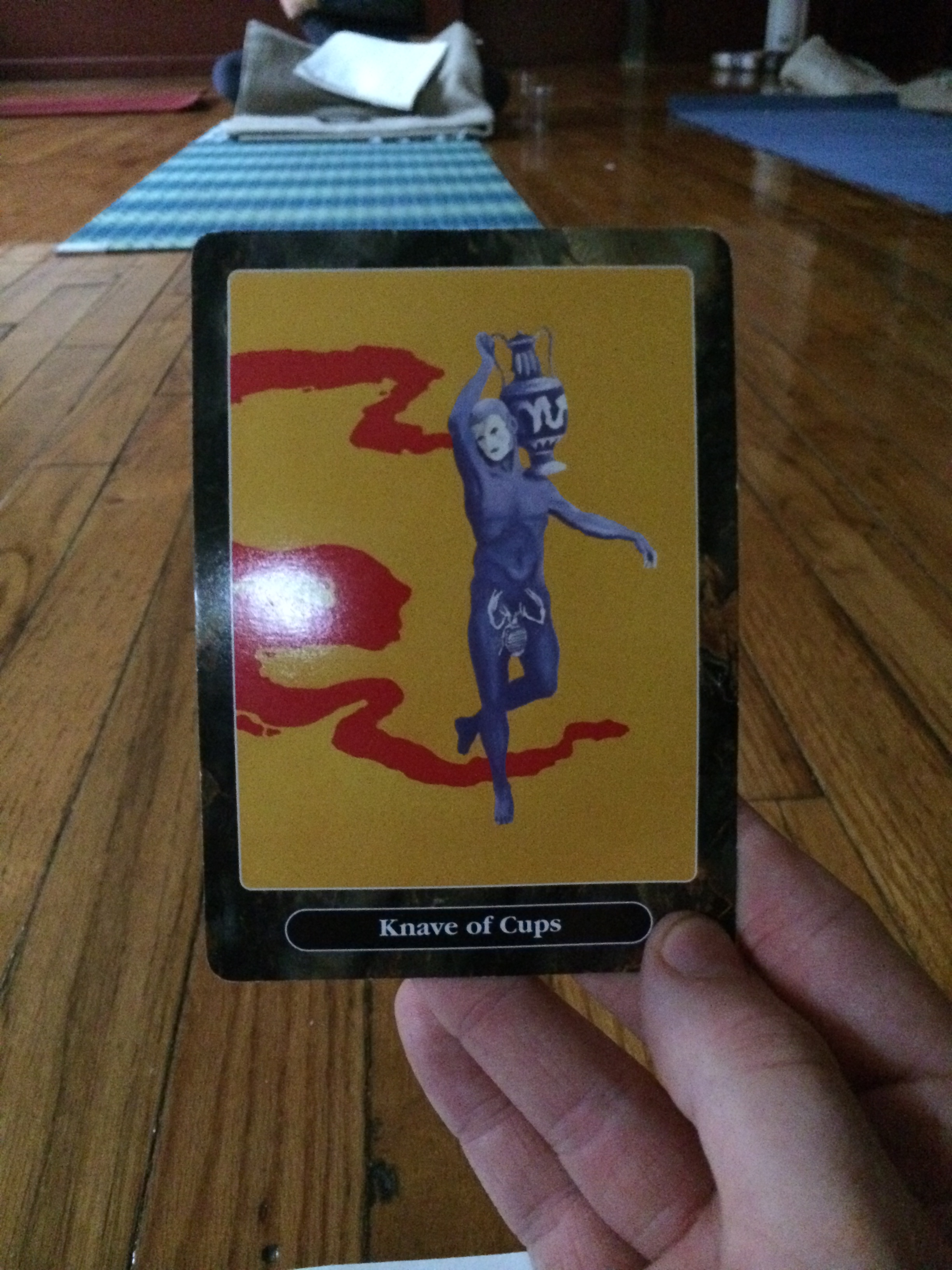
The first version would be writing as if you are telling a friend, the second telling your father. Jessica’s next exercise began with her having the writers draw a tarot card from a deck. The writer then had to write a piece based on the image of the card, without knowing what the card meant.

photo (36)

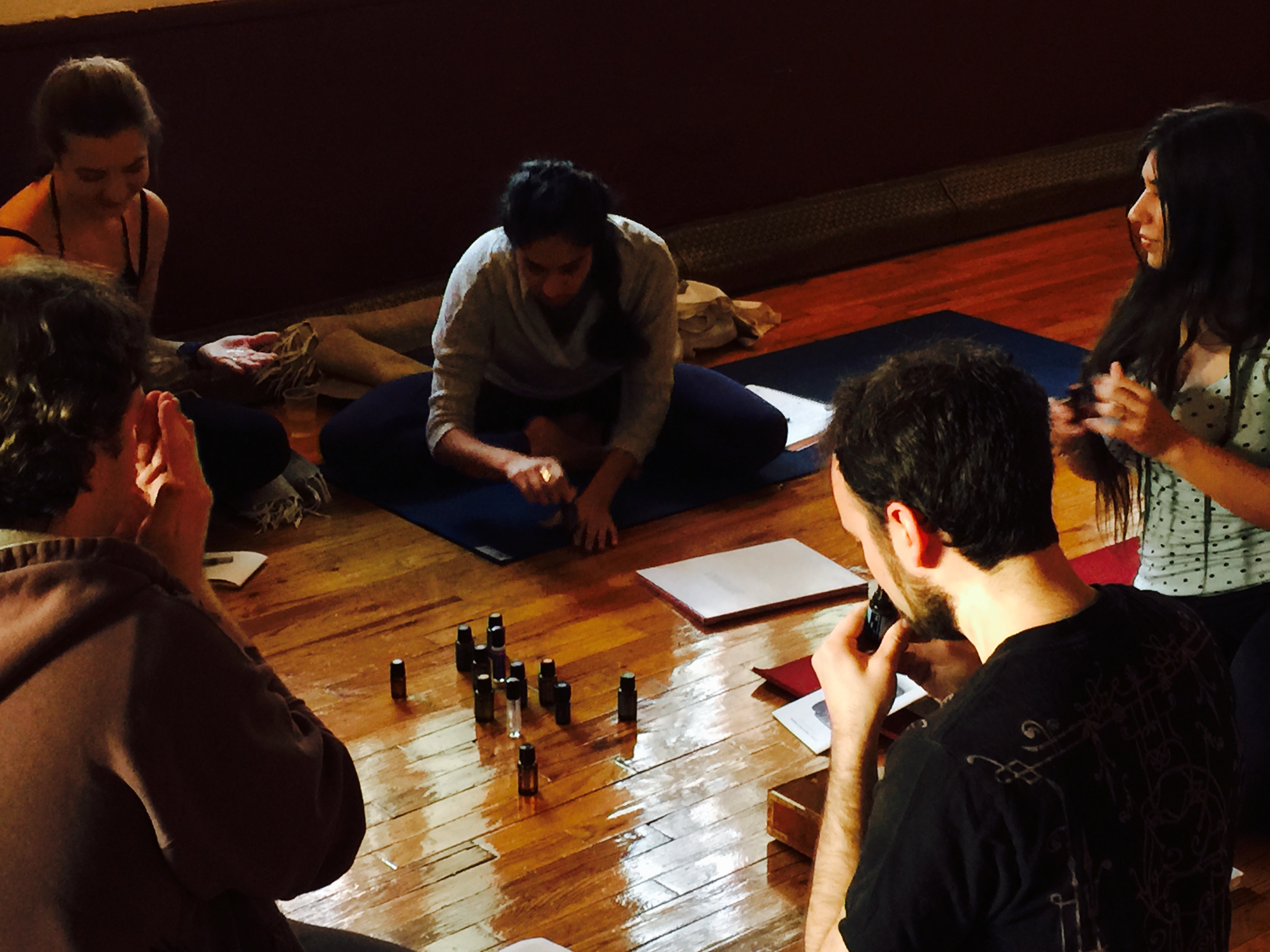
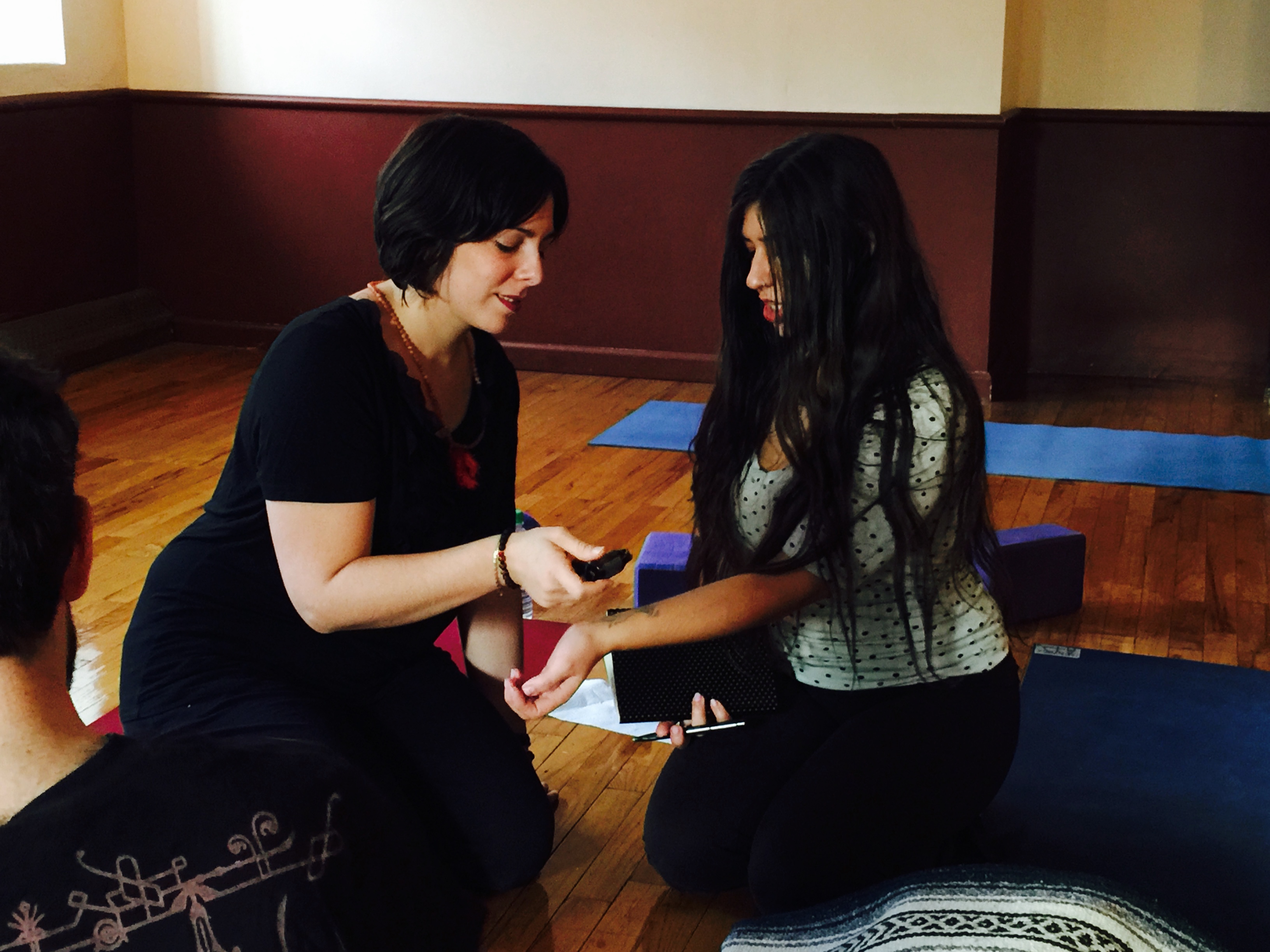
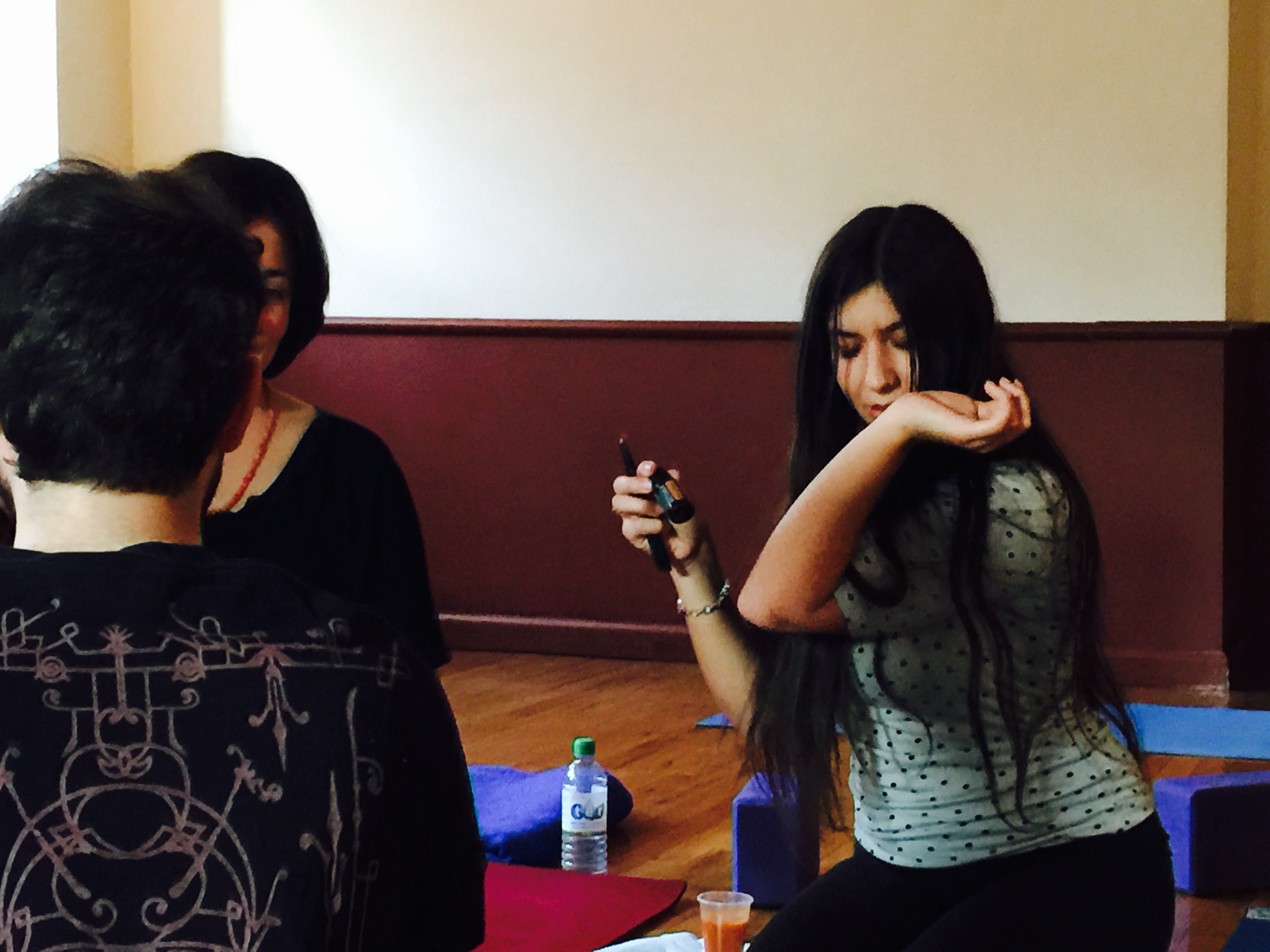
Norma then led a workshop titled “Sense of Smell, Memory, and Narrative.” On Saturday, Norma read the famous excerpt from Proust’s Swann’s Way, and everyone relived the the exquisite “madeleine” moment, so quintessentially demonstrative of the power of the olfactory bulb to produce strong recollections.  Proust was so ahead of his time, and who knew that contemporary neuro-cognitive science would confirm what he had written so eloquently–that sense of smell is a powerful memory trigger?  She then passed along some essential oils for the participants to either rub on their hands or waft. The exercise was to take the smell and write about what memories and emotions they recalled, using the scents to get deeper into writing sensory details. These included recognizable scents like peppermint and lavender, but also included a fusion scent that Norma withheld the name of until after the writing was done. By using a scent of unidentifiable nature, the writers could pull out memories and different ideas, ranging from pieces about gardens to markets in Egypt.

photo (39)
photo (41)

Sunday, November 23rd saw the second day of the workshop. Like before, Elissa led forty minutes of yoga, followed by a juice cleanse. Norma led the second part of her “Sense of Smell, Memory, and Narrative” workshop. This time, a wide variety of scents were laid out for the participants to choose from. They could apply some to their skin or smell them, and then choose one to write about, with the restriction of keeping the “scene” or “action” in the piece to one minutes at most. As Norma explained, studies have shown that the part of the brain that processes smell is linked to long term memory, and the memories that are recalled are usually vivid and emotionally-charged.  Norma’s unique idea for these”olfactory prompts” got the creative juices flowing for everyone, and some wonderfully rich pieces of poetry and prose were written by the participants.

photo (20)

photo (15)Jonah Kruvant then led a workshop called “The Art of Revision.” Jonah’s exercise was all about how a piece can change the more you work on it, structured in three parts. The first part had the writers spend twenty minutes writing as many details about a room as they can. The second part had them write a paragraph about a person in the room, with the rule that the person had to be of a certain occupation that couldn’t be specifically stated.

photo (30)

The last part was to spend five minutes writing three sentences about the person in the room, but convey their emotional state. The idea was that in each new version of the story, the writer had to choose the most important details to include and to also practice brevity.

Everyone left the workshop with something new. Some left with new juice recipes to try out, others had pieces of writing to expand upon or use in their writing projects, and some left feeling refreshed. We hope that those who came enjoyed their time and participate in another yoga and writing retreat we hold.

photo (40)

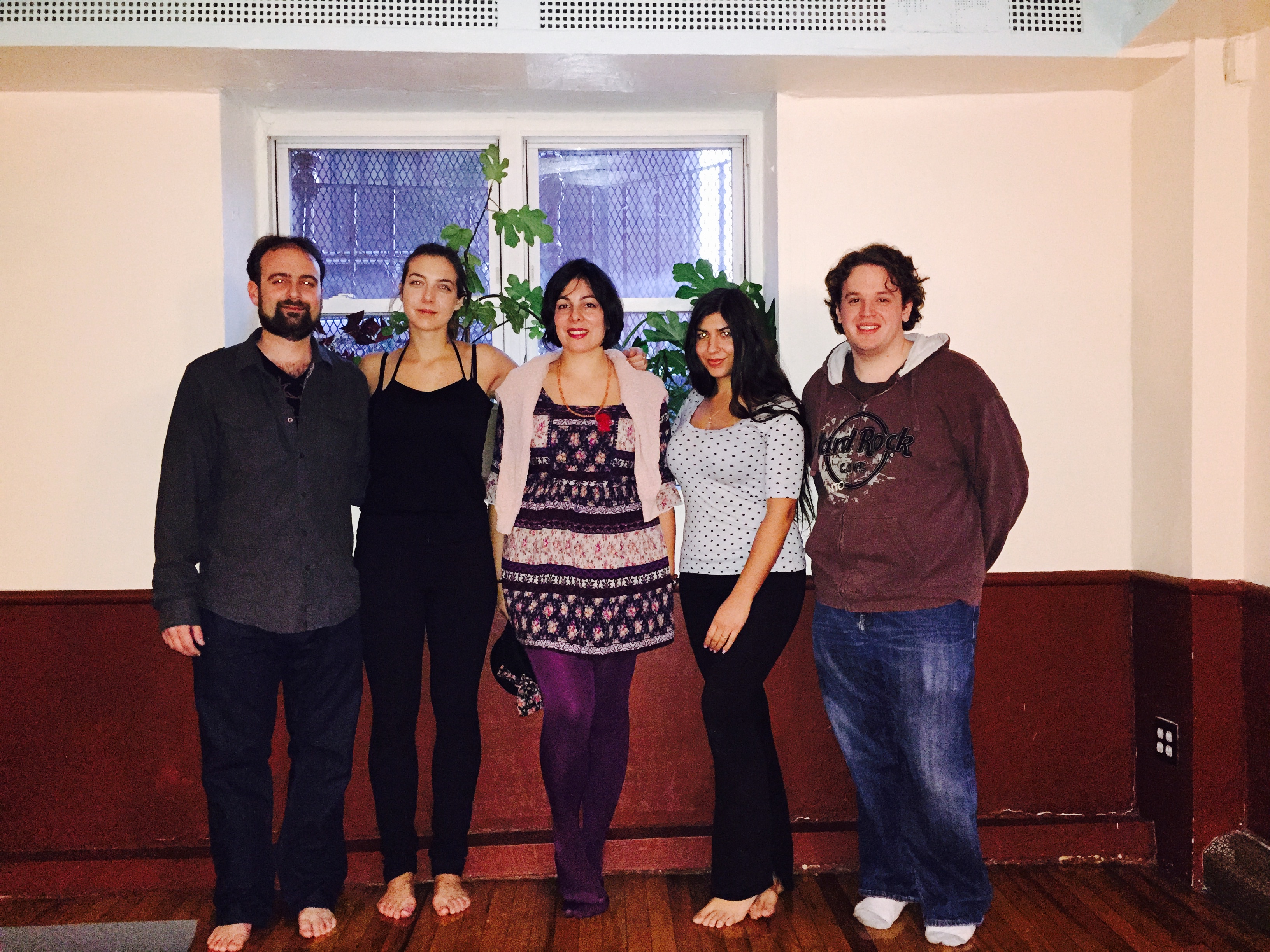
Thanks to the CWW members who helped organize and run the event (from left to right: Jonah Kruvant, Elissa Lewis, Diana Norma Szokolyai, Jessica Reidy, Alex Carrigan)

Megan Tilley’s “Puddle” feat. in Quail Bell Magazine

The Cambridge Writers’ Workshop is proud to announce that Megan Tilley’s poem, “Puddle,” is featured in the new issue of Quail Bell Magazine.  Megan Tilley, one of the one of the Cambridge Writers’ Workshop’s interns has been instrumental in planning the CWW’s upcoming Pre-Thanksgiving Yoga, Writing, and Juice Cleanse Retreat in Quail Bell Magazine (November 22-23). In the interview, the CWW shares tips on creating a creative discipline of writing, yoga, and self-care.  If you are interested in the CWW’s Pre-Thanksgiving Yoga, Writing, and Juice Cleanse Retreat, there is a limited time reduced registration fee. It will only last until Thursday, November 20th at 11 p.m., so apply now! – Jessica Reidy

Puddle
by Megan Tilley

I.
The bodies around me dream of poppies, draped half-lidded across scratchy couches. Science fiction is all that plays on the television, and I watch tin can space crafts drift in and out of stars, fingers of both hands on two different pulses to make sure there’s still life in their veins. I can feel the wet thumping through the pad of my thumb as space flashes by me and I wonder if this is how god feels.

II.
When the azaleas are in bloom we go walking among the fires of their blooms, grass soft underfoot. Golden bourbon sings in our veins, softening in the shadows and the sunlight that shines through lazy-branched oaks. There are notches in the park from the great war, where men hung like the wind chimes on my grandmother’s porch. She drinks sweet tea like it was water from Jordan, says words so gentle they melt in your mouth like rose hips.

III.
Summer closes. The trees bear heavy fruits, skin smooth under grasping palms. He takes a bite, juice running along his jaw, autumn sweet. We dangle our feet over rock edges, where fish dappled orange and yellow gape pink mouths wide. He says how sad it is that they their pond is all they know. I look to the north, at a horizon unsmudged by mountains, at the trees still summer-bleached forming a cup of its own, a puddle shimmering in unending sun where we swim day after day, pretending it’s the ocean.

Rita Banerjee & Diana Norma Szokolyai’s “Mis/Translations” feat. in Quail Bell Magazine

Who-LambThis month, Quail Bell Magazine will be curating and publishing a series of “Mis/Translations” poems by Rita Banerjee and Diana Norma Szokolyai.  Rita Banerjee and Diana Norma Szokolyai are the founders and directors of the Cambridge Writers’ Workshop (CWW). You can read about the CWW’s upcoming Pre-Thanksgiving Yoga, Writing, and Juice Cleanse Retreat in Quail Bell Magazine. In the interview, the CWW shares tips on creating a creative discipline of writing, yoga, and self-care.  Rita also discusses the creative writing invention exercise “Mis/Translations” and how it can help kick-start your writing. Rita’s poem, “Who Lamb” was inspired by a Mis/Translation exercise at the last CWW Verderonne retreat. Norma read her own poem, “hullám/wave” in Hungarian and Rita “Mis/Translated” based entirely on the sound and feel of  words that were foreign to her.  – Jessica Reidy

hullám/wave
by Diana Norma Szokolyai
(to be read out loud simultaneously in Hungarian & English)

Az állando hullám                                The continuous wave
igaznak hangzik                                     rings true
egymással keresztbe futó hullámok              cross sea
elmerülök a hullám sírban                       I am submerged in a watery grave
érzed?                                                   Do you feel it?
Már jön az érzelmi hullám                       The tidal wave is already coming
Az égbe nyúlik                                       It is reaching for the sky
és a felhök, gyáva mint a nyúl                   and the clouds, timid as rabbits
hallom a folyamatos hullámot                   I hear the continuous wave
beszélsz hullámositásokat                                    you are talking channelings
szeizmikus hullámok idógörbéje                time curve,
a hajadba, hullámos papirszalag             in your hair, streamers
hullám, hullám                                       wave, wave,
hullám                                                  wave

Who Lamb*
by Rita Banerjee

Who lamb.
Who’s into who lamb?
Igor likes Congo Music,
Caress my photo, who lamb.
He said Marion bring me a who lamb,
Sheared.

Azaleas on the bank,
Hollow as eggs
On the bank

Best who lamb with chocolate
Seismic who lamb
Igor likes to pay
For it with
Who lamb
Who lamb
Who lamb

* A “Mis/Translation” of Diana Norma Szokolyai’s poem “hullám/wave.”

Check out the on-going series of “Mis/Translations” poems by Rita Banerjee and Diana Norma Szokolyai at Quail Bell Magazine!  If you are interested in the CWW’s Pre-Thanksgiving Yoga, Writing, and Juice Cleanse Retreat (November 22-23), there is a limited time reduced registration fee. It will only last until Thursday November 20th, so apply now!

CWW Interview in Quail Bell Magazine about Yoga, Writing, Juice Cleansing, & our Pre-Thanksgiving Retreat

We are delijuiceghted that “Writing Through Holiday Stress: Cambridge Writers’ Workshop on Pre-Thanksgiving Retreat” is in Quail Bell Magazine. You’ll find our tips and tricks for cultivating our writing and self-care rituals; our perspectives on the supportive relationships between yoga, Ayurveda, juice cleansing, and creative regimen; our SPECIAL REDUCED RATE for registration (only lasts till Thursday!); more information about what the retreat entails; and even a juice recipe to get you started at home. We hope you can join us in New York this weekend, but if you can’t this is the next best thing.  Read the interview here and sign up for our retreat here!

Schedule for CWW Pre-Thanksgiving Yoga and Creative Writing Cleanse

GaneshFinalPosterNov23&24retreat

Hello everyone! We’re about a week away from our Pre-Thanksgiving Yoga and Creative Writing Cleanse at Ashtanga Yoga Shala. We hope you’re as excited for this event as we are. There are still spots to register, which you can do here. We’ve just released our schedule for the two day event. It’s $50 a day, but you should try to come to both days.  Here’s the schedule for the weekend:

* SPECIAL OFFER: Register BETWEEN 11 p.m. Mon 11/17 & 11 p.m. Thurs. NOV. 20 for $35 /day ( or $75 for both)*

SATURDAY Nov. 22:  2pm-4 pm

*  YOGA with Elissa Lewis
*  “The Art of Witholding in Creative Writing” with Jessica Reidy
*  Raw Juice Cleanse
*  “Sense of Smell, Memory, & Narrative Part I” (includes an aromatherapy session with essential oils) with Diana Norma Szokolyai

SUNDAY Nov. 24: 2 pm-4pm

*  YOGA with Elissa Lewis
*  “The Art of Revision” with Jonah Kruvant
*  Raw Juice Cleanse
*  “Sense of Smell, Memory, & Narrative Part II” (includes an aromatherapy session with essential oils) with Diana Norma Szokolyai

Here’s some info about the people involved with the workshop:

Diana Norma Szkoloyai is author of the poetry books Roses in the Snow and Parallel Sparrows (Finishing Line Press). Her writing and hybrid art have appeared in Lyre Lyre, Dr. Hurley’s Snake Oil Cure, The Fiction Project, Teachers as Writers, Polarity, The Boston Globe, The Dudley Review, Up the Staircase, Area Zinc Art Magazine, Belltower & the Beach, and Human Rights News. Founding Literary Arts Director of Chagall Performance Art Collaborative and co-director of the Cambridge Writer’s Workshop, she holds an Ed.M from Harvard and an M.A. in French Literature from the University of Connecticut.  She is also a certified reiki healer and uses essential oils aromatherapy daily.

Norma will be leading a two part workshop over the weekend, using aromatherapy as part of her workshop “Sense of Smell, Memory, and Narrative.”

Elissa Lewis is the Yoga & Arts Coordinator of the Cambridge Writers’ Workshop.  She began her journey with yoga in 2006, when she moved to France and made the practice part of her daily routine. She saw yoga as a lifestyle, not only a class, helping her to clear her mind and have more compassion for herself and others. In 2010 she moved to New York and completed her teacher training at Laughing Lotus, a creative, soulful yoga studio that teaches the student to ‘move like yourself.’ She’s taught private and group classes in Manhattan and Brooklyn ever since. Visit her website for informative yoga sequences and information. Elissa will be leading our yoga workshops at this event.

Jessica Reidy is a mixed-Romani (Gypsy) heritage writer from New Hampshire. She earned her MFA in Fiction at Florida State University and a B.A. from Hollins University. Her work has been nominated for a Pushcart, and has appeared in Narrative Magazine as Short Story of the Week, The Los Angeles Review, Arsenic Lobster, and other journals. She’s a staff-writer and Outreach Editor for Quail Bell Magazine, Managing Editor for VIDA: Women in the Literary Arts, Visiting Professor for the Cambridge Writer’s Workshop retreats, and Art Editor for The Southeast Review. She also teaches yoga and occasionally still works her family trades, fortune telling and dance. Jessica is currently working on her first novel set in post-WWII Paris about Coco Charbonneau, a half-Romani burlesque dancer and fortune teller of Zenith Circus, who becomes a Nazi hunter.

Jessica will lead a workshop on Saturday titled “The Art of Withholding in Creative Writing.”

Jonah Kruvant is one of the Cambridge Writers’ Workshop’s  NYC area program organizers and is also a teacher, performer, writer, and student of the world.  He used to live in Costa Rica, where he wrote a popular blog, “From Gaijin to Gringo: Living Abroad in Costa Rica.”  His writing has been published in Digital Americana, and you can read about his adventures in Latin America here: http://costaricagringo.blogspot.com/.

Jonah will be leading a workshop on Sunday called “The Art of Revision.”

Alex Carrigan is from Newport News, Virginia and attended college at Virginia Commonwealth University.  He graduated this year with a degree in print/online journalism and a minor in world cinema.  He is currently an intern for the Cambridge Writers’ Workshop, as well as Staff Film Reviewer for Quail BellMagazine.  He has written articles for The Commonwealth Times and has had work featured in Luna Luna Magazine. He is also a creative writer and has had work published in Amendment Literary Journal and in Poictesme Literary Journal, of which he was a staff member for four years, two years in which he was deputy editor-in-chief.

Alex will be assisting with the running of the weekend event, ensuring everyone has all the materials and juice they need.

If you would still like to sign up, click here to learn how to sign up. You can also email us at directors@cambridgewritersworkshop.org if you have any specific questions.  Follow us on Facebook, Twitter, and Tumblr for more information and to learn more about upcoming events.

CWW Intern, Megan Tilley’s writing featured in Fictionvale

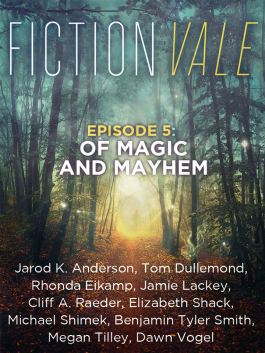
Our inFictionValetern, Megan Tilley, has a short story coming out in thelatest episode of Fictionvale!  She would like to thank their wonderful staff and editors for giving her this opportunity.  Megan Tilley is a recent graduate from Florida State University with a degree in Creative Writing.  She has been published in The Rectangle, The Kudzu Review, and Wiley Writer’s online podcast.  She was senior editor at Live Music Media for three years, and also edited for The Kudzu Review.  Writing and editing has always been her passion, and Megan is excited to be able to expand her experience with editing, among other things, while working with the Cambridge Writer’s Workshop.

Meet Katy Miller, our new Editing and Communications Intern

Katy PhotoWe, at the Cambridge Writers’ Workshop, are excited to announce a new member of our CWW team.  Katy is our new Editing and Communications intern from Córdoba, Spain:

Katy Miller is excited to become the latest Editing and Communications intern for CWW.  She is a recent MA graduate (Contemporary Literature) from the University of Manchester’s Centre for New Writing, where her interests included race and gender theory in post-2000 novels.  Previously interested in journalism before pursuing literary studies, Katy has been published in the Tulsa World and the Huffington Post. She is looking forward to furthering her enthusiasm for the arts with the Cambridge Writers’ Workshop and hopes to expand her editing experience and promote new writing through social media.